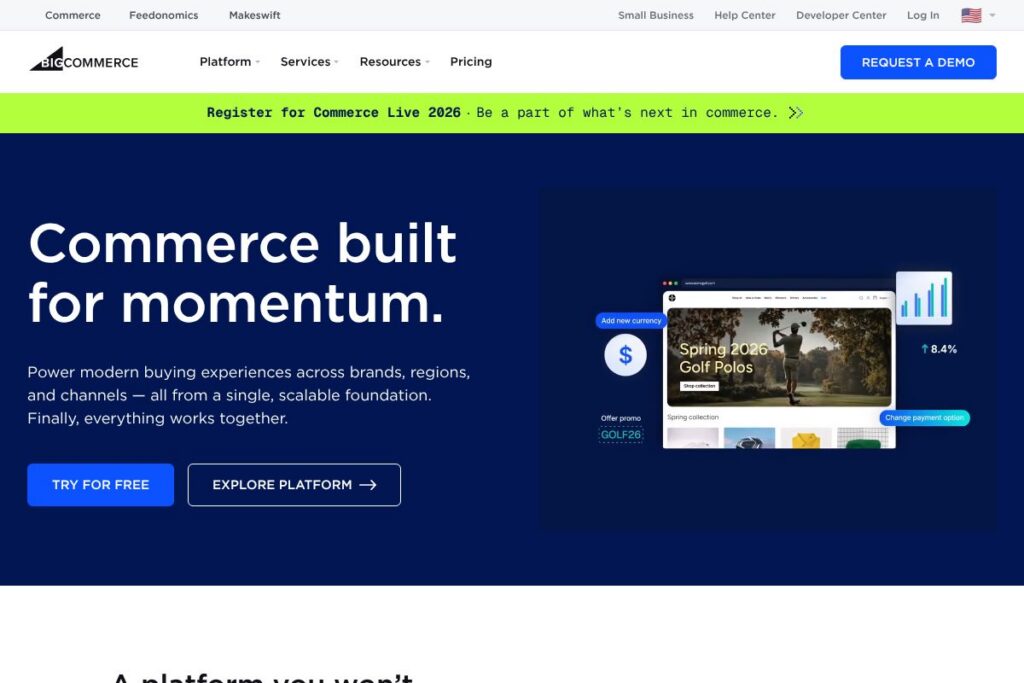

What is BigCommerce
BigCommerce is an ecommerce platform designed to support growth across brands, regions, and sales channels from a single codebase. It combines storefront tooling, headless APIs, checkout customization, and commerce integrations so businesses can scale without duplicating systems or rebuilding infrastructure.
Compared with Shopify, BigCommerce emphasizes built-in B2B features and multi-storefront capabilities that reduce reliance on third-party apps. Compared with Adobe Commerce (Magento), BigCommerce offers a managed SaaS foundation that removes the hosting and maintenance overhead while still supporting extensible APIs. Against Salesforce Commerce Cloud, BigCommerce tends to be more accessible for mid-market merchants while providing enterprise-grade integrations and performance.
All of this makes BigCommerce a practical choice for merchants that expect rapid growth, need multiple brands or regional stores, or require unified control over catalog, pricing, and payments.
How BigCommerce Works
The platform combines a hosted core with comprehensive APIs so teams can run either traditional storefronts or headless architectures. Merchants manage products, pricing, and inventory in a central catalog, then publish that catalog to multiple channels and brands while keeping a single source of truth.
BigCommerce integrates with third-party systems such as ERP, PIM, and payment providers to avoid heavy custom builds; teams use prebuilt connectors or the platform API to sync orders, inventory, and customer data. Practical workflows include launching a new regional storefront from the same admin, using the drag-and-drop site builder for landing pages, and customizing checkout flows with the Custom Checkout tooling.
BigCommerce features
BigCommerce bundles storefront management, flexible checkout, B2B capabilities, and a robust API layer. Recent emphasis has been on Custom Checkout, the B2B Edition, and deeper channel feed support through partners like Feedonomics, all designed to reduce friction when selling across many surfaces.
Custom Checkout
Custom Checkout lets merchants tailor the payment and checkout experience to improve conversion and support unique flows such as B2B payments and quotes. The capability supports integration with a wide range of payment gateways so teams can choose from 130+ payment providers and implement localized payment methods.
B2B Edition
B2B Edition provides catalog segmentation, customer-specific pricing, quote and invoice workflows, and tools to automate approval processes. It lets manufacturers and distributors run unified B2B and B2C experiences without separate platforms for each buyer type; that reduces manual sales work and keeps commerce data centralized.
Multi‑brand and Multi‑storefront Support
The platform supports running multiple brands and regional storefronts from one account, reusing product data and back-end integrations. This avoids duplicating systems when expanding and simplifies inventory, pricing, and order management across markets.
Headless APIs and Developer Tools
BigCommerce exposes REST and GraphQL APIs so development teams can implement headless frontends, mobile apps, and custom integrations. The developer platform includes SDKs, webhooks, and documentation for building custom apps or connecting to third-party systems; see the developer documentation for endpoints and examples.
Integrations and App Ecosystem
A broad app marketplace and partner network make it easy to connect ERPs, PIMs, marketing tools, and marketplaces. Notable integrations include feed management via the Feedonomics app and a partner directory for agencies and technology providers.
Page Builder and Visual Editor
The drag-and-drop visual editor supports design systems and custom components so marketing and design teams can build landing pages and product pages without developer support. This reduces time-to-launch for promotional content and ensures consistent brand presentation across channels.
Catalog, Inventory, and Channel Management
Centralized catalog and automated syncs help keep product data, pricing, and inventory accurate across marketplaces and advertising channels. Feed management and channel connectors reduce data errors and improve product visibility without rebuilding catalogs for each surface.
With these capabilities, BigCommerce helps teams scale commerce operations across channels while preserving control over catalog, checkout, and integrations.
BigCommerce pricing
BigCommerce uses a custom and tiered pricing approach for businesses of different sizes rather than listing a single public price structure on the product site. Enterprise needs, multi-store setups, and B2B requirements commonly lead merchants to request tailored quotes or discuss plan tiers with sales.
For specific rates and plan comparisons, review BigCommerce’s general platform information and request detailed options via the BigCommerce homepage and contact channels. Sales and partner teams can provide plan details that match projected revenue, required integrations, and desired service levels.
What is BigCommerce Used For?
BigCommerce is used to run online stores, marketplaces, and multi-brand commerce operations that need centralized control over product data, pricing, and order flows. Teams use it to publish catalogs to web storefronts, social commerce, and marketplace channels while maintaining synchronized inventory and pricing.
It is also used by manufacturers, distributors, and wholesale sellers that require B2B features like customer-specific catalogs, quote management, and invoicing. Marketing teams use the visual editor and channel integrations to improve product visibility and conversion without heavy engineering cycles.
Pros and cons of BigCommerce
Pros
- Built for scale: BigCommerce supports multiple brands and regions from a single platform, reducing duplication and operational complexity. This benefits organizations expanding internationally or managing several product lines.
- Strong B2B capability: Built-in B2B Edition features address customer-specific pricing, quoting, and invoice workflows, which reduces the need for third-party workarounds when serving wholesale buyers.
- Flexible checkout and payments: Support for 130+ payment providers and a Custom Checkout framework allow merchants to optimize conversion and meet local payment requirements.
- Extensible APIs and integrations: A mature developer platform and an app ecosystem make it straightforward to connect ERPs, PIMs, marketplaces, and marketing tools.
Cons
- Enterprise focus can increase cost: Custom and enterprise pricing, plus the capabilities needed for large-scale deployments, can make Total Cost of Ownership higher for small merchants compared to simpler platforms. Implementation and integrations may require professional services.
- App gaps for niche needs: While the marketplace is extensive, some specialized features still rely on third-party apps or custom development, which can add complexity and maintenance overhead.
- Learning curve for advanced features: Teams using headless architectures, multi-storefront setups, or complex B2B workflows will need developer and commerce operations expertise to realize the platform’s full value.
Does BigCommerce Offer a Free Trial?
BigCommerce offers a free trial and guided demos for new users, and you can request personalized demos or trials through their sales team to evaluate features like Custom Checkout and B2B Edition before committing to a plan.
BigCommerce API and Integrations
BigCommerce provides a comprehensive developer platform with REST and GraphQL APIs, webhooks, and SDKs for building custom storefronts, integrations, and apps; see the developer documentation for endpoints and examples. Common integration targets include ERPs, PIMs, payment gateways, and channel feed managers.
Key integrations are available through the app marketplace and partner network, including feed management with the Feedonomics app and connections to major payment and marketplace providers. For enterprise projects, BigCommerce partners and services teams can assist with migrations and custom connectors.
10 BigCommerce alternatives
Paid alternatives to BigCommerce
- Shopify — A widely used hosted ecommerce platform with a large app ecosystem and simple setup, often chosen by fast-growing retail brands for ease of use.
- Adobe Commerce (Magento) — A highly customizable commerce platform suitable for complex catalogs and full control over code and hosting, often favored by larger enterprises with development resources.
- Salesforce Commerce Cloud — An enterprise-grade platform with deep CRM and marketing integrations, aimed at brands that want tight customer data and commerce alignment.
- CommerceTools — A headless, API-first commerce platform focused on composable architectures for teams building custom frontend experiences.
- BigCommerce Enterprise — The enterprise-tier option within the same product family for very large merchants that need bespoke SLAs and services.
- Sales Layer — A product experience platform that pairs with ecommerce backends for advanced PIM capabilities and catalog syndication.
- Wix eCommerce — A simpler hosted option that provides design-first storefronts and built-in tools for smaller merchants and direct-to-consumer brands.
Open source alternatives to BigCommerce
- Magento Open Source — The community edition of Magento offers full control and customization for teams that can self-host and maintain the platform.
- Saleor — A modern, GraphQL-first open source commerce platform designed for headless implementations and high performance.
- Shopware (Community Edition) — An open-source commerce platform with focus on modularity and experience-driven commerce.
- Solidus — A Ruby-based open source platform derived from Spree, aimed at developers who prefer a code-first approach for ecommerce.
Frequently asked questions about BigCommerce
What is BigCommerce used for?
BigCommerce is used to build and operate ecommerce storefronts, multi-brand sites, and B2B commerce experiences. Merchants use it to centralize catalog, pricing, inventory, and channel syndication across web, marketplaces, and social commerce.
Does BigCommerce support B2B features?
Yes, BigCommerce includes a B2B Edition with features for customer-specific pricing, quotes, and invoice workflows. Those tools let manufacturers and distributors manage complex selling scenarios without separate platforms.
Can BigCommerce integrate with ERP and PIM systems?
Yes, BigCommerce integrates with ERP and PIM systems via native connectors, apps, or custom API integrations. The platform’s app marketplace and partner ecosystem help implement robust data syncs and reduce manual reconciliation.
Is there a BigCommerce API for headless implementations?
Yes, BigCommerce offers REST and GraphQL APIs for headless storefronts and custom integrations. Developers can use the developer documentation to access endpoints, SDKs, and webhook details.
How does BigCommerce handle payments and checkout?
BigCommerce supports a wide range of payment providers and a customizable checkout framework. Merchants can choose from over 130 payment gateways and adjust checkout behavior to match local payment methods and conversion goals.
Final verdict: BigCommerce
BigCommerce stands out as a platform that balances enterprise capability with a managed SaaS foundation, making it suitable for brands that need multi-brand, multi-region, and B2B commerce without running separate platforms. Its strengths are centralized catalog control, checkout flexibility, and an extensible API surface that supports both monolithic and headless architectures.
Compared with Shopify, BigCommerce tends to include more enterprise and B2B functionality out of the box while Shopify’s entry-level plans can be less expensive up front but may require additional apps to match functionality. For teams that require built-in multi-storefront support and deeper B2B workflows, BigCommerce provides a more integrated path to scale.
For pricing details and to evaluate how BigCommerce matches your specific business needs, contact the BigCommerce team via the homepage and contact channels.