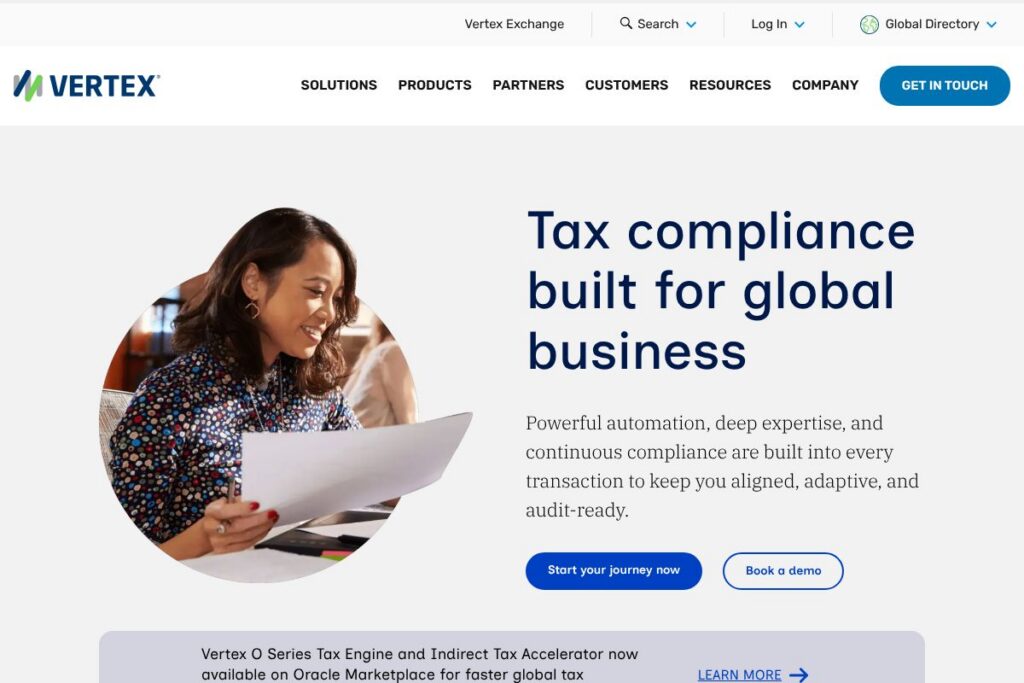

Vertex: An Overview
Vertex is an enterprise tax technology provider focused on automating indirect tax for global businesses. The platform centralizes tax-sensitized data, real-time tax determination, returns generation, and audit traceability so finance and tax teams can reduce manual effort and maintain consistent compliance across jurisdictions.
Vertex competes directly with major tax automation providers such as Avalara, Sovos, and Stripe Tax. Compared with Avalara, Vertex emphasizes deep ERP and enterprise integration patterns and centralized tax data models; versus Sovos, Vertex places similar weight on compliance and e-invoicing coverage across multiple countries; compared with Stripe Tax, Vertex targets larger enterprise tax operations with broader returns and reporting capabilities.
All of this makes Vertex especially well suited to large, multi-entity organizations that need continuous compliance across many tax jurisdictions. The platform is built to fit into existing ERP and finance landscapes and to support tax teams that require audit-ready records and traceable change controls.
How Vertex Works
Vertex embeds tax logic and content into transactional workflows so that tax determination and reporting happen as part of the normal order-to-cash, procure-to-pay, and invoicing processes. Tax-sensitized data flows from ERPs and ecommerce systems into Vertex, which applies rates, rules, exemptions, and cross-border logic in real time to each transaction.
Implementation typically involves connecting Vertex to an ERP or financial system, mapping tax-relevant master data, and configuring jurisdictional rules. Once live, Vertex returns tax calculations via APIs or native integrations and can generate compliant invoices and filing outputs for local authorities while logging an audit trail for each calculation.
Vertex features
Vertex’s platform covers the full indirect tax lifecycle with modules for tax determination, returns and reporting, compliance content, e-invoicing, and audit analytics. Recent product messaging highlights the Vertex O Series tax engine and an Indirect Tax Accelerator aimed at faster global deployments and tighter ERP integrations.
The platform includes several powerful capabilities worth highlighting:
Tax-sensitized data
Vertex centralizes tax-relevant master data so calculations use consistent product classifications, taxability rules, and exemption certificates. This reduces variability across systems, improves calculation accuracy, and provides one source of truth for tax reporting and audits.
Real-time tax determination
The tax engine applies jurisdictional rules, rates, and cross-border logic to transactions as they occur. This supports online sales, invoicing, and procurement scenarios with immediate, auditable tax outcomes that can be consumed by the originating system via API or connector.
Returns and reporting automation
Vertex converts calculation and transaction data into jurisdiction-specific filing formats and supports automated return generation and submission workflows. The module helps maintain filing calendars, track submission statuses, and store return artifacts for audit purposes.
Audit trail and tax planning
Every calculation and rule change is recorded so finance teams can trace tax positions back to source transactions and configuration versions. Centralized reporting and scenario capabilities help with tax provisioning and strategic tax planning.
Integrations and connectors
Vertex offers prebuilt integrations and connectors for major ERPs, ecommerce platforms, and procurement systems to embed tax automation into existing workflows. The platform is API-ready so organizations can extend or customize connections as needed; see the Vertex integrations page for partner details.
E-invoicing and continuous transaction control
Vertex supports continuous e-invoicing and real-time reporting mandates used by tax authorities in multiple countries, helping companies comply with evolving CTC requirements and automate invoice submission flows. This functionality aims to reduce manual interventions and ensure VAT/GST compliance across markets.
With these capabilities, Vertex helps companies reduce manual tax effort, lower audit risk, and maintain continuous compliance across jurisdictions. The biggest benefit is having a single platform that ties calculation logic, compliance content, and audit-ready reporting to core financial systems.
Vertex pricing
Vertex follows an enterprise licensing and subscription model with pricing that is customized to the size of the organization, required modules, deployment approach, and integration scope. Costs typically reflect the breadth of jurisdictions, transaction volumes, and support SLAs required by enterprise customers.
Pricing details are not published as fixed consumer plans; for current licensing options and to discuss implementation scope, contact Vertex through their site and sales channels. View Vertex’s contact and pricing information on the Vertex website to request a tailored quote or to schedule a demo.
What is Vertex Used For?
Large organizations use Vertex to automate indirect tax calculation and compliance across sales, procurement, and invoicing workflows. This reduces manual tax work, improves calculation consistency between business units, and supports centralized reporting and audit readiness.
Tax and finance teams also use Vertex to manage e-invoicing obligations, file returns to multiple jurisdictions, and maintain an auditable record of tax decisions and configuration changes. The platform fits businesses that operate across many tax regimes and require enterprise-grade integrations and control.
Pros and Cons of Vertex
Pros
- Comprehensive jurisdiction coverage: Vertex supports tax rules, rates, and compliance formats across a large number of countries, which reduces the need for multiple point solutions. This makes it easier for global teams to standardize processes and centralize tax logic.
- Deep ERP integration: Prebuilt connectors and strong ERP integration patterns help embed tax calculation into existing order-to-cash and procure-to-pay systems, minimizing changes to core financial workflows. That lowers implementation friction for enterprise ERPs like SAP and Oracle.
- Audit-ready data and traceability: Detailed audit trails and versioned configuration make it straightforward to explain historical tax positions during audits and to support tax provision and planning processes.
Cons
- Enterprise focus and complexity: The platform is optimized for large, multi-jurisdiction businesses, which can make initial setup and configuration more involved for smaller organizations. Implementation often requires ERP and tax subject matter expertise.
- Custom pricing and procurement: Licensing and deployment are negotiated on a case-by-case basis, which can extend procurement cycles and require direct engagement with sales for clear cost estimates.
Does Vertex Offer a Free Trial?
Vertex offers enterprise licensing with custom demos and trial arrangements for prospective customers. Many engagements begin with a scoped proof of concept or pilot tailored to the customer’s ERP, transaction volume, and targeted jurisdictions, after which enterprise licensing and onboarding are negotiated.
Vertex API and Integrations
Vertex provides APIs and a set of prebuilt connectors to integrate tax determination and reporting into ERPs, ecommerce platforms, and financial systems. The Vertex integrations page documents partner connectors and integration patterns for SAP, Oracle, NetSuite, and common ecommerce platforms.
Developers can use Vertex APIs to push transactional data, retrieve tax calculations, and automate return outputs; consult Vertex’s developer and API resources through their site for technical documentation and integration guides. For enterprise implementations, Vertex also supports partner-led integration services to accelerate deployment.
10 Vertex alternatives
Paid alternatives to Vertex
- Avalara — Cloud tax automation with broad small-to-medium business and enterprise support, strong ecommerce and point-of-sale connectors.
- Sovos — Compliance and reporting platform with an emphasis on e-invoicing, regulatory reporting, and VAT/GST compliance across global markets.
- Stripe Tax — Embedded tax calculation service targeted primarily at online sellers and platforms that want usage-based tax calculation integrated with Stripe payments.
- TaxJar — Automated sales tax calculation and reporting aimed at ecommerce sellers, including filing automation and marketplace integrations.
- Thomson Reuters ONESOURCE — Enterprise tax and accounting platform focusing on tax provision, indirect and direct tax compliance, and global reporting.
- Wolters Kluwer CCH — Tax and accounting software with global compliance content and reporting tools for large accounting operations.
Open source alternatives to Vertex
- OpenFisca — Open-source tax and benefit modeling framework useful for simulating tax rules and scenarios, more oriented to policy modeling than filing automation.
- tax-calculator — An open-source US federal tax microsimulation model used for policy analysis; suited to analytical use cases rather than transactional tax calculation and filing.
- InvoiceNet — Open-source invoice processing and extraction tools that can support parts of an automated tax workflow by extracting structured data from documents.
Frequently asked questions about Vertex
What is Vertex used for?
Vertex is used for enterprise indirect tax automation, returns, and compliance reporting. Organizations deploy it to centralize tax determination, automate filings, and maintain audit-ready transaction data across jurisdictions.
Does Vertex integrate with SAP and Oracle?
Yes, Vertex provides prebuilt integrations and connectors for major ERPs including SAP and Oracle. These integrations let finance teams keep tax calculation within their existing order-to-cash and procure-to-pay processes while delegating tax logic to Vertex.
How does Vertex handle e-invoicing?
Vertex supports continuous e-invoicing and real-time reporting mandates for multiple countries. The platform automates invoice generation, format conversion, and submission to tax authorities where required.
Can Vertex generate tax returns automatically?
Yes, Vertex can generate and validate jurisdiction-specific returns and support automated submission workflows. It tracks filing status and stores return artifacts to simplify ongoing compliance and audit preparation.
Is Vertex suitable for small businesses?
Vertex is primarily built for mid-market and enterprise organizations with multi-jurisdiction needs. Smaller businesses may find simpler or usage-based tax solutions more appropriate unless they require centralized enterprise controls and broad jurisdiction coverage.
Final verdict: Vertex
Vertex is a comprehensive enterprise tax platform that emphasizes centralized tax data, real-time determination, and audit-ready reporting for multinational businesses. It excels at integrating with enterprise ERPs and handling complex, multi-jurisdiction indirect tax requirements while offering modules for e-invoicing and continuous compliance.
Compared with Avalara, which provides strong pay-as-you-go options and broad ecommerce integrations for smaller sellers, Vertex is positioned for larger organizations that need deep ERP connections and centralized control; Avalara often publishes clearer, usage-based options while Vertex approaches pricing through tailored enterprise agreements. For businesses with complex global footprints that require end-to-end tax lifecycle management, Vertex is a robust choice that balances calculation accuracy, compliance content, and corporate-level control.