
Blackbaud: An Overview
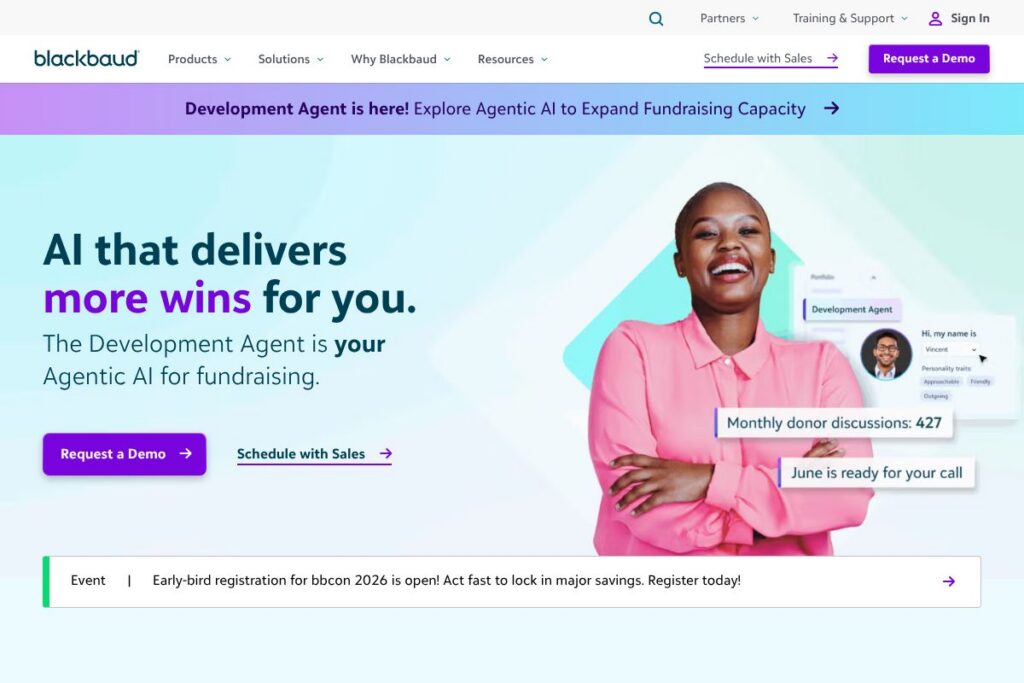
Blackbaud provides a suite of cloud applications and services targeted at organizations focused on social impact, including nonprofits, foundations, K–12 and higher education institutions, and corporate giving programs. The platform centers on fundraising and donor management, nonprofit accounting, constituent relationship management, and analytics, with an ecosystem of partner integrations and developer tools that support larger-scale institutional needs. Blackbaud positions specialized products such as Raiser’s Edge NXT® and embedded AI capabilities like the Development Agent for donor personalization and scale; see the Raiser’s Edge NXT product page for product-level details.
Compared with general-purpose CRMs, Blackbaud is purpose-built for social impact workflows. Salesforce Nonprofit Cloud provides extensive customization and a broad app ecosystem but typically requires more configuration for nonprofit-specific finance and gift accounting. Bloomerang and DonorPerfect serve many small and mid-sized charities with simpler implementations and more transparent pricing, while Blackbaud focuses on enterprise-level feature depth, complex accounting, and integrations with partner networks. All of this makes Blackbaud a strong option for organizations that need donor accounting, advanced reporting, and sector-specific workflows at scale.
Blackbaud does particularly well at handling complex fundraising lifecycles, institutional finance needs, and long-term constituent data management. It is best suited for mid-size to large nonprofits, foundations, and educational institutions that require integrated fundraising, accounting, and analytics across programs and campuses.
How Blackbaud Works
Blackbaud products are built around modular applications that share constituent and financial data so teams can move from cultivation, solicitation, and stewardship into accounting and reporting without duplicate data entry. A typical implementation centralizes donor and constituent records in a fundraising database, uses campaign and gift modules to track activity, and routes financial transactions into the nonprofit accounting system for reconciliation and financial statements.
The Development Agent is an example of an embedded AI workflow: it analyzes donor data, suggests personalized engagement steps, and helps scale outreach by generating tailored messages or next-step recommendations. Organizations usually implement Blackbaud through a staged deployment: data migration, connector setup for payment and email systems, staff training on fundraising and finance modules, and a period of iterative configuration with Blackbaud partners or developers.
What does Blackbaud do?
Blackbaud’s platform combines fundraising CRM, financial management, analytics, and AI-driven automation to support the full nonprofit lifecycle. Core capabilities cover donor cultivation, major gifts, recurring giving, grants management, nonprofit accounting, reporting, and secure payment processing, along with industry-specific templates for education and foundations.
Let’s talk Blackbaud’s Features
Fundraising and donor management
A centralized CRM tracks constituents, gifts, pledges, relationships, and engagement history so development teams can segment donors, manage campaigns, and track solicitation outcomes. Features support major gift workflows, annual fund management, and recurring donor programs, which helps fundraisers prioritize outreach and measure ROI.
Nonprofit accounting and financial management
Integrated accounting modules handle fund accounting, grant tracking, budgets, and financial controls tailored to nonprofit reporting requirements, facilitating consolidated financial statements and audit-ready records. This reduces reconciliation overhead between fundraising and finance teams and supports compliance for foundations and educational institutions.
Development Agent (Agentic AI for fundraising)
The Development Agent applies AI to personalize donor outreach, suggest next actions, and scale communication while keeping campaign context and donor history intact. Teams can use the agent to draft emails, recommend segmentation strategies, and surface high-value prospects, which speeds outreach and increases consistency across development officers.
Analytics, reporting, and dashboards
Built-in reporting tools and dashboards aggregate fundraising, enrollment, and financial metrics so leaders can monitor performance and trends. Custom reports and scheduled exports help finance and development teams create board-ready reports and track KPIs across programs and campuses.
Integrations and partner ecosystem
Blackbaud supports payment processing, email deliverability, learning management, and payroll/accounting connectors through a broad partner network and developer tooling. The platform offers a developer portal and APIs for custom integrations; see the developer portal for API endpoints and integration guides.
Security, privacy, and compliance
Security features include role-based access, audit trails, and data controls designed for donor privacy and institutional compliance. These controls support multi-campus deployments and help IT teams manage user provisioning and data segmentation across schools or program units.
With these features combined, Blackbaud helps organizations close the loop between fundraising activity and financial reporting, enabling more coordinated campaigns, cleaner accounting, and data-informed strategy.
Blackbaud pricing
Blackbaud uses a custom enterprise pricing model rather than listing public subscription tiers, with costs determined by product selection, organization size, deployment needs, and required support. Organizations typically engage with sales for a tailored proposal and may add implementation services, partner integrations, and ongoing support to the total cost; request a demo or consult Blackbaud’s team for quotes.
How to get pricing details
To obtain specific pricing and licensing options, request a tailored quote through Blackbaud’s demo and sales channels. For institutions evaluating total cost of ownership, consider implementation services, data migration, and annual support fees when comparing alternatives; use the request a demo page to start a pricing conversation.
What is Blackbaud Used For?
Blackbaud is commonly used for fundraising and constituent relationship management, nonprofit financial management, grants administration, and alumni or donor engagement programs in education. Its workflows support campaign planning, major donor cultivation, recurring giving, and reconciled accounting across funds and grants.
Larger organizations use Blackbaud for centralized reporting across departments and campuses, complex gift accounting, and integration with payment processors and learning systems. Small and mid-sized nonprofits that expect to scale into multi-program operations also choose Blackbaud for its sector-specific templates and partner network.
Pros and cons of Blackbaud
Pros
- Purpose-built for social impact: The platform includes features aimed specifically at nonprofits, foundations, and educational institutions, reducing the need for heavy customization.
- Integrated fundraising and accounting: Shared data across donor management and finance modules streamlines reconciliation and reporting for audit and grant compliance.
- Large partner and developer ecosystem: A broad network of implementation partners, third-party apps, and developer tools supports customization and extension to fit complex workflows.
Cons
- Enterprise-focused pricing and procurement: Organizations should expect a sales-led purchasing process and implementation costs; this can be a barrier for smaller shops without dedicated budgets.
- Configuration and training required: The depth of features means more time spent on setup and staff training to realize full value, often necessitating partner support for advanced scenarios.
Does Blackbaud Offer a Free Trial?
Blackbaud offers paid, enterprise software with demos available. There is no public freemium tier; prospective customers can request a customized demo or pilot through Blackbaud’s demo request process, and many organizations evaluate the platform with a guided proof-of-concept arranged with Blackbaud or a certified partner.
Blackbaud API and Integrations
Blackbaud provides APIs and a developer portal that document endpoints for constituent data, gift transactions, events, and other product-specific resources; developers can access SDKs and integration guides on the developer portal.
Key integrations include payment processing and merchant services, email and marketing platforms, financial and payroll systems, and learning/administration systems used by schools; see the Blackbaud Merchant Services page for payment options and connector details.
10 Blackbaud alternatives
Paid alternatives to Blackbaud
- Salesforce Nonprofit Cloud — A highly customizable CRM with an extensive app ecosystem that supports constituent management, program administration, and analytics through the Salesforce platform.
- Bloomerang — Focuses on donor retention and ease of use for small to mid-sized nonprofits, with simplified donor dashboards and email integration.
- DonorPerfect — A donor management system with flexible modules for gift tracking, online giving, and constituent reporting designed for mid-market nonprofits.
- Salsa CRM — Combines donor management with advocacy and digital fundraising tools, aimed at organizations that mix outreach and online campaigns.
- Neon One — An integrated platform covering CRM, fundraising, events, and membership management with built-in fundraising tools for growing nonprofits.
- Classy — Primarily focused on online fundraising and peer-to-peer campaigns, with tools for donation forms, event fundraising, and campaign pages.
Open source alternatives to Blackbaud
- CiviCRM — A free, open-source CRM designed for nonprofits and civic organizations, offering contact management, contributions, events, and case management that can be self-hosted or used through hosting providers.
- ERPNext — An open-source ERP with nonprofit-friendly modules for accounting, HR, and project management, suitable for organizations that want an integrated finance-first system.
- Odoo (Community Edition) — A modular open-source platform that includes CRM, accounting, and project apps which can be adapted by developers to support nonprofit workflows.
Frequently asked questions about Blackbaud
What is Blackbaud used for?
Blackbaud is used for fundraising, donor management, nonprofit accounting, and education administration. Organizations use it to manage campaigns, gifts and grants, financial reporting, and constituent engagement across programs.
Does Blackbaud offer an API for developers?
Yes, Blackbaud provides APIs and developer documentation. The developer portal includes endpoints, SDKs, and guides for building custom integrations.
Can Blackbaud handle nonprofit accounting and grant reporting?
Yes, Blackbaud includes nonprofit accounting and grant tracking capabilities. Its finance modules are designed to produce fund accounting reports, grant reconciliation, and audit-ready records for foundations and educational institutions.
Is Blackbaud suitable for small nonprofits?
Blackbaud can serve small nonprofits but is typically positioned for mid-size to large organizations. Smaller organizations should evaluate implementation and support costs and compare against lighter-weight alternatives like Bloomerang or DonorPerfect.
How do I get pricing for Blackbaud?
Blackbaud uses custom enterprise pricing determined by product selection and deployment needs. Organizations should request a demo or contact sales via Blackbaud’s demo request page to get a tailored quote.
Final Verdict: Blackbaud
Blackbaud is a comprehensive platform for organizations that require integrated fundraising, financial management, and analytics tailored to the social impact sector. Its strengths lie in sector-specific workflows, robust accounting features, a large partner ecosystem, and emerging AI capabilities such as the Development Agent that help personalize donor engagement at scale.
Compared with Salesforce Nonprofit Cloud, Blackbaud emphasizes nonprofit accounting and fundraising workflows out of the box while Salesforce offers broader customization and an expansive app marketplace. Pricing for Blackbaud is delivered via custom quotes and typically includes implementation and support costs, whereas Salesforce licensing is modular and can be structured per user; organizations should weigh feature fit, total cost of ownership, and available implementation resources when choosing between the two.
For institutions that need sector-focused features, consolidated reporting across development and finance, and a partner network for implementation, Blackbaud is a strong option. If you need a tailored demonstration or pricing conversation, request a demo through Blackbaud’s request a demo page.