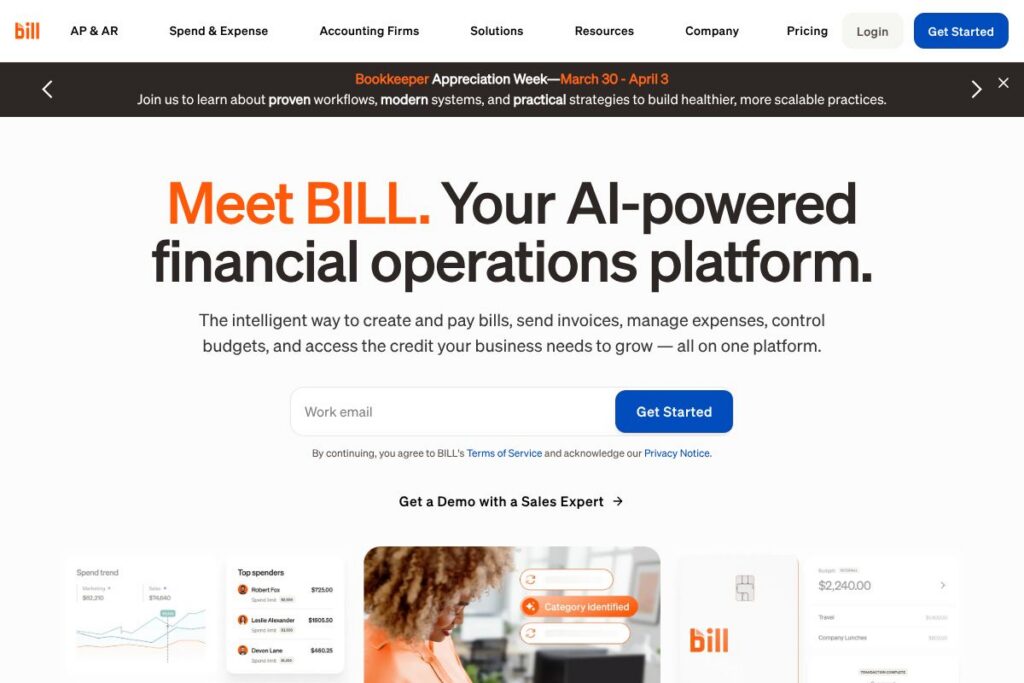

BILL: An Overview
BILL is a financial operations platform that brings AP, AR, spend, expense controls, and embedded credit into one workspace. It combines AI-enhanced invoice capture and approval routing with payment execution and accounting sync to reduce manual work across bookkeeping teams and finance departments.
Compared with competitors, BILL sits between mid-market accounting-focused products like Tipalti, which emphasizes enterprise global supplier payments, and newer spend-management platforms like Ramp, which center on card-based controls and corporate cards. Against Stampli the focus shifts: Stampli concentrates on invoice collaboration and approval workflows, while BILL pairs those workflows with integrated payments, spend cards, and access to credit. All of this makes BILL especially well suited for small to mid-size businesses and accounting firms that need end-to-end financial operations in a single platform.
BILL does particularly well at combining payments and accounting integrations into a shared network that reduces reconciliation work. It is best for firms that want a single system to manage invoicing, vendor payments, corporate spend, and short-term credit, and for accounting firms that want to offer bill pay and expense services for clients.
How BILL Works
BILL captures invoices using PDF upload, email capture, or mobile scan, then applies machine learning to extract vendor, date, amounts, and line details for faster data entry. The platform routes invoices through configurable approval workflows and records approval history so teams maintain control and auditability.
Once approved, payments can be scheduled using ACH, check runs, virtual cards, or integrated partner rails, with BILL automatically syncing transactions back to connected accounting packages. Teams can set budgets, enforce spend controls via company cards, and request short-term credit lines to smooth cash flow, all from the same dashboard.
Finance teams typically implement BILL by connecting their primary accounting system first, then inviting approvers and accounts payable staff, enabling invoice capture, and configuring payment methods and approval thresholds. For accounting firms, the platform supports multi-client management and delegated client access through BILL’s partner tools.
BILL features
BILL organizes its functionality around accounts payable, spend controls, accounts receivable, and embedded financing. Core capabilities include AI-driven invoice processing, approval workflows, integrated vendor payments, spend and expense management with corporate cards, and an accountant partner program that helps firms manage multiple clients. The platform also emphasizes accounting integrations and networked payments that reduce reconciliation overhead.
AP automation
AI-assisted data extraction reduces manual entry by reading invoice fields and matching them to vendors and bills. Approval workflows can be routed by amount, department, or custom rules, and approvers receive tasks in a centralized queue.
Vendor payments
The platform supports ACH, check, and virtual card payments and batches runs to control timing and cash flow. Payments are logged and reconciled automatically with connected accounting software to reduce bookkeeping time.
Invoice creation and AR
Users can create and send professional invoices, accept electronic payments, and track receivables from a shared interface. AR workflows include reminders and online payment options to shorten collection cycles and improve cash conversion.
Spend and expense management
Company cards and employee expense workflows centralize spend, with receipt capture and automated matching to corporate cards. Budgets and card-level controls let finance teams limit merchant categories, per-transaction limits, and employee spend.
Embedded credit and Divvy card integration
BILL provides access to business credit lines and an integrated spend card program to support working capital needs and controlled spending. Credit availability and card issuance are subject to application approval by BILL’s financing partners.
Accounting integrations
The platform offers bi-directional sync with major accounting systems to keep ledgers current and reduce reconciliation effort. Common integrations include QuickBooks, Xero, and NetSuite which allow bills, payments, and vendor data to flow automatically into the general ledger; see BILL’s integration resources for specific connectors.
Accountant Partner Program
Designed for bookkeeping and accounting firms, the partner program centralizes client bill pay, automates recurring bookkeeping tasks, and supports billing services at scale. Firms can manage multiple client accounts from a single partner dashboard.
Security and compliance
BILL implements standard enterprise controls such as role-based access, audit logs, and secure payment rails to protect financial data and transactions. The platform also works with bank partners for card issuance and payment settlement to meet regulatory and banking requirements.
With these features, BILL reduces time spent on AP and reconciliations, consolidates spend controls, and provides outlets for short-term credit, making it a tool for teams that want a single system for payables, receivables, and corporate spend.
BILL pricing
BILL uses a subscription-based software model combined with transaction and payment fees that vary by payment method and volume, and it offers additional financed products such as embedded credit lines and corporate card programs. Pricing is tailored to business size, required modules, and transaction volume, so costs are typically presented as custom quotes.
For specific plan levels, payment-processing fees, and financing terms, consult BILL’s official site to view current pricing and the available product bundles. Visit BILL’s homepage to explore plans, request a demo, or contact sales about custom pricing and payment fees.
What is BILL used for
BILL is used to centralize and automate accounts payable and accounts receivable workflows, reduce manual invoice processing, and shorten payment and collection cycles. Teams use it to set approval policies, run payment batches, and keep accounting ledgers synchronized with fewer reconciliation steps.
Organizations also use BILL for spend control and expense management by issuing corporate cards, enforcing budgets, and tracking employee expenses in one place. Accounting and bookkeeping firms use BILL to offer bill pay and spend management as a client service, simplifying client bookkeeping and improving client cash flow.
Pros and cons of BILL
Pros
- Comprehensive AP and AR coverage: The platform combines invoice capture, approval workflows, bill pay, and invoicing so teams can handle payables and receivables from one system.
- Integrated spend controls and cards: Card issuance and budget controls help finance teams manage employee and departmental spending with clear policies and real-time tracking.
- Accounting sync: Automatic reconciliation and two-way integrations with popular accounting packages reduce manual posting and errors.
- Accountant-focused features: The partner program supports multi-client management and delegated workflows, making it practical for bookkeeping and accounting firms.
- Network scale: A large payments network can speed vendor adoption and reduce friction when sending or receiving payments across the BILL network.
Cons
- Transaction fees and financing terms vary: Payment and card processing fees, plus financing terms, depend on payment method and underwriting, which can complicate cost forecasting.
- Customization may require setup work: Large organizations with complex approval paths or ERP customizations can expect configuration and change management during rollout.
- Embedded credit is conditional: Access to credit lines and specific card issuances depend on underwriting and partner bank decisions, so approval is not guaranteed.
Can You Test BILL Before Buying?
BILL provides paid subscription plans and typically offers demos or time-limited trials on request. Prospective customers can request a demo, trial access, or a guided onboarding conversation through BILL’s contact channels to evaluate the platform with their own invoices and vendor data.
BILL API and Integrations
BILL provides developer-facing APIs and prebuilt integrations to connect with accounting systems, ERPs, and other financial tools. The developer documentation outlines endpoints for creating invoices, managing vendors, and initiating payments; see BILL’s developer documentation for technical details.
Built-in integrations commonly include QuickBooks, Xero, and NetSuite, plus connectors for bank feeds and payroll systems so that teams maintain a single source of truth for financial transactions. Integration setup typically involves OAuth or API credentials and mapping chart of accounts between systems.
10 BILL alternatives
Paid alternatives to BILL
- Tipalti — Focuses on global supplier payments and compliance, with automation for mass payments and supplier onboarding for larger enterprises.
- Stampli — Emphasizes invoice collaboration and approval workflows, with AI to reduce coding and email-based bottlenecks.
- AvidXchange — Targets mid-size to large organizations with accounts payable automation and vendor payment processing at scale.
- Airbase — Combines corporate cards, bill payments, and spend management with strong policy controls and real-time reporting.
- Ramp — Offers corporate cards and spend management with aggressive cost-reduction tools and analytics focused on finance teams.
- Coupa — Enterprise procurement and spend platform with deep sourcing, purchasing, and expense controls for large organizations.
- Oracle NetSuite — An ERP with integrated financials, AR, AP, and global accounting features for comprehensive enterprise resource planning.
Open source alternatives to BILL
- ERPNext — An open-source ERP with modules for accounting, purchase invoices, and expense management that can be self-hosted and extended.
- Odoo — Open core ERP with accounting and purchase modules that support invoice processing and vendor payments, suitable for custom deployments.
- Apache OFBiz — A flexible open-source framework that can be configured to manage invoicing, payments, and financial workflows for technical teams.
- Dolibarr — Lightweight open-source ERP and CRM with invoicing and expense features aimed at small businesses and nonprofits.
Frequently asked questions about BILL
What is BILL used for?
BILL is used to manage accounts payable, accounts receivable, spend and expense workflows, and to provide integrated payments and credit for businesses. It brings invoice processing, approvals, vendor payments, and spend controls into a single platform.
Does BILL integrate with QuickBooks?
Yes, BILL offers bi-directional integration with QuickBooks. Bills, payments, and vendor records can sync automatically to keep the general ledger and bank reconciliation up to date.
How does BILL provide credit to businesses?
BILL offers access to business credit lines through partner underwriting and embedded financing products. Credit amounts and terms depend on the application review and partner bank decisions.
Can accounting firms use BILL for multiple clients?
Yes, BILL includes an Accountant Partner Program to manage multiple client accounts. The partner tools let firms automate bookkeeping tasks and offer bill pay services on behalf of clients.
Does BILL have an API for automation?
Yes, BILL provides APIs for invoice, vendor, and payment management. Developers can use the API to integrate BILL into existing workflows and automate financial operations; see BILL’s developer documentation for full API details.
Final Verdict: BILL
BILL excels at bringing accounts payable, accounts receivable, spend controls, and short-term financing into a single platform designed for accounting teams, small and mid-size businesses, and firms that manage multiple client books. Its strengths are AI-assisted invoice capture, integrated payment rails, strong accounting integrations, and partner tools for accountants, all of which reduce manual reconciliation and speed up payment cycles.
Compared with Tipalti, which focuses on enterprise-scale global payments and supplier compliance, BILL is better suited for firms and mid-market businesses that need combined AP, AR, spend, and credit in one product. From a pricing perspective BILL follows a subscription plus transaction-fee model tailored to business needs, while Tipalti commonly targets larger enterprises with enterprise pricing; feature-wise, BILL prioritizes accountant workflows and embedded credit along with payments, whereas Tipalti prioritizes global mass-payments and supplier onboarding.
Overall, choose BILL if you want a unified financial operations tool that integrates payments, spend, and accounting with partner-facing features for bookkeeping firms. For organizations primarily focused on large-scale global payables, evaluate enterprise alternatives like Tipalti or Coupa as part of a broader procurement and payments strategy.