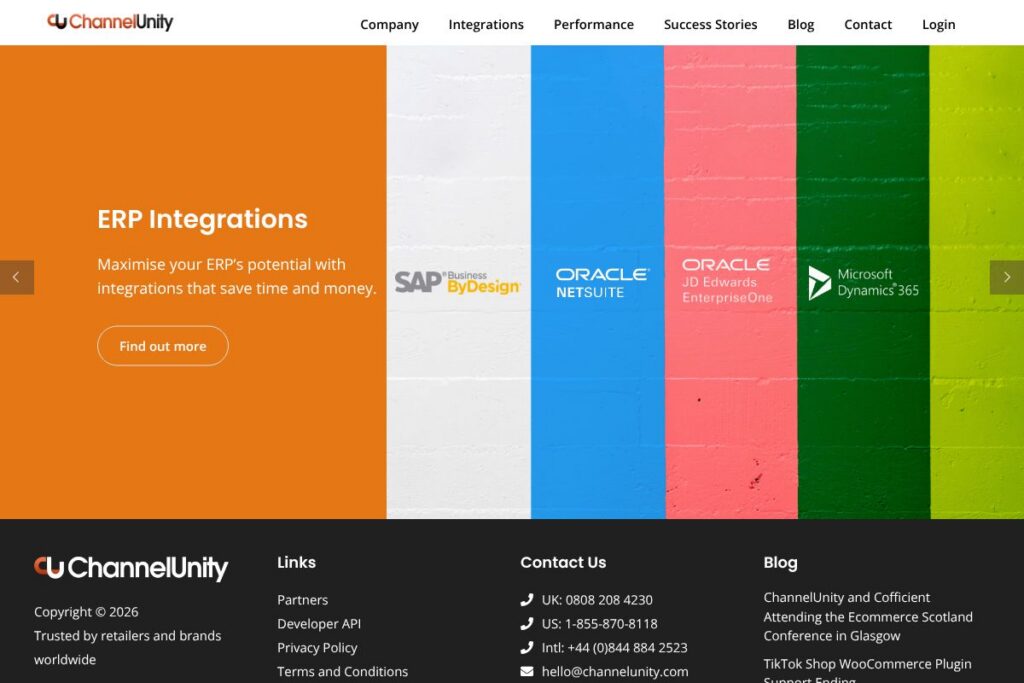

ChannelUnity: An Overview
ChannelUnity is a multi-channel integration platform that links ecommerce carts, ERP systems, and marketplace channels so merchants can manage listings, inventory, and orders from a single system. It focuses on connector-based integrations to remove manual processes involved in running multiple marketplaces while preserving existing ERP and cart workflows.
Compared with ChannelAdvisor, which targets very large enterprises with a broad suite of marketplace marketing and analytics features, ChannelUnity places stronger emphasis on practical connector coverage and ERP synchronization for mid-market merchants. Compared with Linnworks, ChannelUnity offers an integration-first approach that leans into ERP and cart connectors rather than deeper inventory orchestration and built-in warehouse management.
All of this makes ChannelUnity well suited for ecommerce teams that rely on a traditional ERP or accounting system and need reliable, configurable connectors to marketplaces and carts. It works particularly well for merchants who want to reduce manual data entry and centralise marketplace operations without replacing their back-office systems.
How ChannelUnity Works
ChannelUnity operates as a connector layer between your ecommerce platform or ERP and destination marketplaces. Merchants install ChannelUnity connectors for their cart or ERP, map products and attributes, and configure channel-specific listing rules and pricing adjustments.
Once set up, ChannelUnity synchronizes product data, updates inventory levels in near real time, and imports orders into the connected cart or ERP for fulfilment. Typical workflows include automatic SKU mapping, order routing back into the merchant’s system, and configurable rules for pricing and shipping that vary per marketplace.
Implementation usually involves configuring connectors, creating product templates for each marketplace, and testing order flows; teams can then monitor activity from a central dashboard and use logs or notifications for exceptions.
ChannelUnity features
ChannelUnity groups its functionality around integrations and automation that reduce manual marketplace work. Core capabilities include ERP integrations, marketplace channel management, ecommerce cart connectors, and account-level reporting and support for case studies and success management.
ERP Integrations
ChannelUnity connects to ERP and accounting systems so product master data, stock levels, and order records remain consistent across marketplaces. These integrations reduce duplicate entry and help ensure orders flow directly into the merchant’s fulfilment and financial processes.
Marketplace Channels
The platform supports publishing and managing listings across multiple marketplaces, applying channel-specific formatting, titles, and pricing rules. This lets teams scale marketplace presence without maintaining separate spreadsheets or manual listing processes.
Ecommerce Systems
ChannelUnity integrates directly with popular ecommerce carts to automate order imports, inventory updates, and product synchronisation. That means carts remain the primary order and customer data store while marketplaces are treated as additional sales channels.
Order and Inventory Synchronisation
Automated inventory and order syncing are core to keeping availability accurate and preventing oversells across channels. Rules-driven updates allow buffer stock or channel-specific availability to be applied where needed.
Customer Success and Case Studies
ChannelUnity provides implementation support and post-launch customer success to help adapt connectors for complex product catalogs and ERP logic. The provider showcases customer outcomes and case studies that explain integration approaches and measurable results.
ChannelUnity’s biggest practical benefit is reducing manual, repeatable work when selling across marketplaces by providing focused connectors to ERPs and carts. That helps merchants preserve their existing back-office investments while expanding into new marketplaces efficiently.
ChannelUnity pricing
ChannelUnity offers custom pricing tailored to each merchant’s integration scope and marketplace footprint; there is no standard public price list. For licensing, connector count, and enterprise-level support details, contact ChannelUnity directly through their website to request a tailored quote and implementation estimate.
View ChannelUnity’s contact and information pages on their official site for the most up-to-date details and to request pricing specific to your ERP, cart, and marketplaces.
What is ChannelUnity Used For?
ChannelUnity is used to automate marketplace listing, pricing, inventory and order flows for merchants that sell across multiple channels. It is particularly useful when a merchant needs to keep product master data and orders in an ERP or ecommerce cart rather than in each marketplace dashboard.
Teams use ChannelUnity when they want to expand into new marketplaces without reengineering fulfilment or accounting systems. It is also used to reduce operational overhead from manual listing updates, reconcile orders centrally, and apply channel-specific pricing and shipping rules consistently.
Pros and Cons of ChannelUnity
Pros
- ERP connectivity: ChannelUnity provides robust connectors so merchants can keep ERP systems as the source of truth and avoid duplicate data entry. This simplifies accounting and order fulfilment workflows.
- Marketplace coverage: The platform supports publishing to a wide variety of marketplaces, letting merchants scale sales across different customer groups without separate manual processes. This reduces time spent on individual channel setups.
- Cart and order sync: Automatic import of marketplace orders into the merchant’s cart or ERP reduces manual order handling and the risk of errors in fulfilment. It helps maintain consistent customer and order records.
- Implementation support: ChannelUnity includes customer success and implementation assistance geared toward mapping complex product catalogs and business rules. That support helps shorten the setup cycle for connectors.
Cons
- Custom pricing model: ChannelUnity uses tailored pricing which can lead to longer procurement cycles and requires direct engagement to get a quote. Smaller merchants may need to budget for onboarding and connector fees.
- Feature depth vs. specialised platforms: While strong at integrations, ChannelUnity may not offer the deeper analytics or marketplace advertising tools available in specialist marketplace management platforms. Teams needing advanced marketplace optimization may layer other tools on top.
- Dependency on connectors: Functionality is tied to available connectors and their maintainers; if a required ERP or marketplace connector is not supported out of the box, custom integration work may be necessary.
Does ChannelUnity Offer a Free Trial?
ChannelUnity offers custom demos and evaluation trials on request. Prospective customers can arrange product demonstrations and trial access with a ChannelUnity representative to validate connectors and workflows before committing to a contract.
ChannelUnity API and Integrations
ChannelUnity provides connector-based integrations for ecommerce carts, marketplaces, and ERP systems and supports partner APIs for bespoke integrations. Explore ChannelUnity’s integration information to see which connectors are available and to request API access or partner support.
If you need specific endpoints or developer documentation, contact their team via the official site to request API documentation and integration guides for your ERP or platform.
10 ChannelUnity alternatives
Paid alternatives to ChannelUnity
- ChannelAdvisor — Enterprise-focused marketplace management with broad channel optimization, feed management, and advertising features for large sellers.
- Linnworks — Centralised order and inventory management with workflow automation and integrations for multichannel fulfilment operations.
- ChannelEngine — Marketplace integration platform that focuses on catalogue transformation, order routing, and analytics for retailers and brands.
- Sellbrite — Marketplace listing and inventory management aimed at SMBs and mid-market sellers for multi-channel operations.
- CedCommerce — Offers connectors and marketplace apps to publish listings and synchronise orders across numerous marketplaces and carts.
- Webgility — Ecommerce accounting and automation platform that synchronises orders and financial data between marketplaces and accounting software.
Open source alternatives to ChannelUnity
- Magento Open Source — Self-hosted ecommerce platform with extensions and community modules that can be combined with marketplace connectors for custom integrations.
- Saleor — Modern, GraphQL-first ecommerce platform that can be extended to connect to marketplaces via custom integration work.
- Reaction Commerce — An event-driven, open source commerce platform that developers can extend to handle marketplace integrations.
- OpenCart — Lightweight open source cart with community extensions for managing multichannel listings and integrations.
Frequently asked questions about ChannelUnity
What marketplaces does ChannelUnity support?
ChannelUnity supports a broad range of marketplaces through connectors. The platform is designed to publish listings and sync orders across multiple marketplaces; contact ChannelUnity via their site to confirm specific channel coverage for your region.
Does ChannelUnity work with my ERP system?
ChannelUnity integrates with many ERP and accounting systems via connectors and custom integrations. For specific ERP compatibility and implementation options, request integration details from ChannelUnity’s implementation team on their website.
How does ChannelUnity handle order synchronization?
ChannelUnity imports marketplace orders into the merchant’s cart or ERP and updates order status across systems. Orders flow back into fulfilment and accounting systems to preserve existing business processes and reporting.
Can ChannelUnity manage inventory across multiple channels?
Yes, ChannelUnity synchronises inventory and product availability across channels based on configured rules. You can apply buffers, channel-specific stock settings, and automatic updates to reduce oversells.
Is ChannelUnity suitable for small businesses?
ChannelUnity can be used by small businesses but typically targets merchants with multiple channels and integration needs. Small sellers should evaluate connector availability and onboarding costs when deciding if a tailored integration platform is the right fit.
Final verdict: ChannelUnity
ChannelUnity is a practical integration platform for merchants who need reliable connectors between ecommerce carts, ERPs, and marketplaces. It does well at preserving back-office systems while automating listing, inventory, and order flows, which reduces manual work and improves data consistency across channels.
Compared with ChannelAdvisor, ChannelUnity usually offers a tighter focus on ERP and cart integration rather than a full suite of marketplace marketing and analytics tools; pricing is custom for both vendors, so ChannelUnity tends to be positioned for merchants who prefer bespoke connector arrangements over out-of-the-box enterprise packages. For mid-market retailers that must keep ERP-driven workflows intact while expanding marketplace sales, ChannelUnity is a solid option to evaluate via a demo and trial.