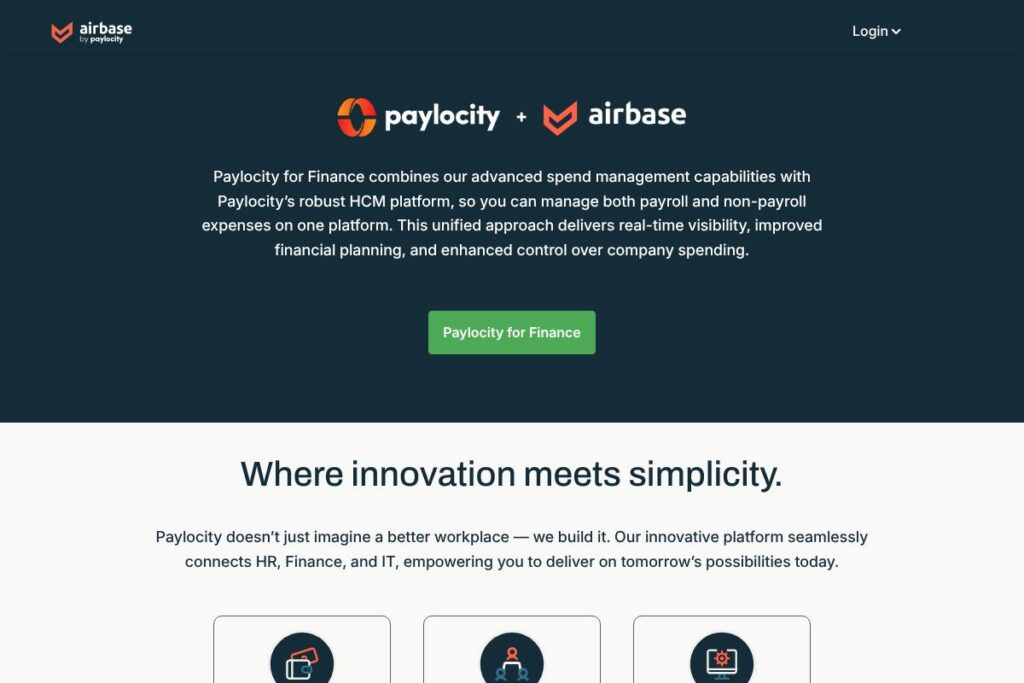

Airbase: An Overview
Airbase is a cloud-based spend management platform now integrated with Paylocity’s HCM capabilities to let organizations manage payroll and non-payroll spend from a single system. The integration links card programs, vendor payments, and AP automation to employee and payroll data so finance and HR teams operate from the same set of records. Learn about Paylocity’s HCM platform through the Paylocity site and view Airbase product information on the Airbase product site.
Compared with competitors, Airbase emphasizes the combination of spend controls and HCM context. Ramp focuses on card-led expense optimization and reimburses savings back to customers, making it attractive for companies prioritizing card rebates. Brex blends corporate cards, rewards, and treasury services with a developer-friendly stack and card-first workflows. Coupa targets large enterprises with broad procure-to-pay suites and heavy sourcing functionality, which can be more complex to deploy for mid-market teams. Airbase sits between these approaches by offering AP automation alongside corporate cards, with the added benefit of Paylocity integration for payroll alignment.
All of this makes Airbase particularly well suited to finance teams that need tight alignment with HR and payroll data, and to mid-market to enterprise organizations that want AP automation, corporate cards, and vendor payments managed from one platform. The platform is most relevant where central controls, auditability, and payroll-linked spend policies matter.
How Airbase Works
Airbase centralizes spend by creating a single ledger of transactions that ties card activity, vendor bills, and employee reimbursements back to accounting and payroll records. Cards and virtual cards can be issued with pre-set budgets and approval flows, while vendor invoices are captured and routed through configurable workflows for approval and payment.
In practical terms, a typical workflow starts with purchasing or expense initiation, continues with automated approvals and coding, and ends with payment and reconciliation. Data syncs to the general ledger and to Paylocity’s HCM for consistent employee and payroll context, enabling payroll-affecting transactions to be handled alongside non-payroll expenses.
Airbase features
Airbase’s feature set centers on automated AP, card management, and reporting that ties directly into HR and payroll systems. Since joining Paylocity, the platform emphasizes alignment with HCM data to reduce duplication and improve controls. Below are the core capabilities worth highlighting.
Unified Spend Hub
A central ledger aggregates corporate card charges, vendor invoices, reimbursements, and transfers into one system for visibility and reconciliation. This hub reduces manual data entry and ensures every spend event maps to the correct employee, cost center, and payroll context.
Accounts Payable Automation
Invoice capture, intelligent routing, three-way matching, and scheduled payments lower manual work and accelerate closing cycles. Automated approval flows integrate with role-based permissions so approvers only see what matters to them, which reduces processing time and routing errors.
Corporate Cards and Virtual Cards
Physical and virtual corporate cards can be issued with controls for spend limits, merchant categories, and expiration rules to prevent misuse. Card transactions are categorized and matched to invoices or expense reports to speed reconciliation and cut reconciliation errors.
Reconciliation and GL Sync
Automated posting to the general ledger, customizable coding, and bank reconciliation tools help keep books current and audit-ready. The platform supports mappings to common accounting systems so month-end processes are faster and more consistent.
Controls, Compliance, and Audit Trails
Role-based permissions, approval histories, and transaction-level audit logs support internal controls and external audits. Policy enforcement can be applied automatically at the point of purchase so exceptions are minimized and approvals are documented.
With these capabilities, the biggest practical benefit is reduced manual effort across AP and expense workflows while maintaining control and traceability. Integration with Paylocity adds payroll context that helps companies govern spend that intersects with employee compensation and benefits.
Airbase pricing
Airbase follows a enterprise-oriented subscription model with custom pricing for organizations; public, standardized price tiers are not published. For details on licensing, module packaging, and any implementation fees, contact Paylocity sales or review the combined product resources on the Paylocity for Finance overview.
Airbase Use Cases
Airbase is commonly used to streamline accounts payable, manage corporate card programs, and automate vendor payments while keeping a full audit trail. Finance teams consolidate spend data for forecasting and month-end close, and they use role-based approvals to enforce procurement policies.
Companies that need payroll-aware spend controls use Airbase to align expense eligibility, payroll deductions, and reimbursements with HR data. This is useful for organizations with complex payroll structures, multiple employee types, or frequent payroll-linked transactions.
Pros and Cons of Airbase
Pros
- Integration with HCM: The Paylocity integration ties spend data to employee records, helping align payroll and non-payroll expenses and simplifying cross-team workflows.
- Comprehensive AP automation: Invoice capture, routing, and payment scheduling reduce manual processing and speed up vendor payments.
- Card controls and reconciliation: Virtual and physical card capabilities with automated matching cut reconciliation time and help prevent fraud.
Cons
- Enterprise-focused pricing and deployment: Smaller organizations may find implementation complexity and procurement timelines more appropriate for mid-market or larger teams rather than very small companies.
- Customization and change management: Organizations that require heavy customization should plan for configuration and training, as tailored approval flows and integrations will add setup time.
Does Airbase Offer a Free Trial?
Airbase offers demos and pilot programs rather than a public free plan. Prospective customers typically arrange a product demonstration or pilot through Paylocity sales to evaluate how the system maps to their chart of accounts, approval workflows, and payroll integration needs.
Airbase API and Integrations
Airbase provides APIs and prebuilt connectors to accounting and ERP systems for automated data exchange; developers can extend workflows and extract transactional data. See the Airbase developer documentation for API endpoints and authentication details.
The platform also offers integrations with common financial systems such as QuickBooks, NetSuite, Sage Intacct, Xero, and collaboration tools like Slack, alongside the Paylocity HCM connection for payroll and employee data synchronization. Integration choices focus on keeping ledger, vendor, and employee data consistent across systems.
10 Airbase alternatives
Paid alternatives to Airbase
- Ramp — Corporate cards, expense management, and spend analytics with a card-first model designed to reduce spend and automate reconciliation.
- Brex — Combines corporate cards, spend management, and treasury services, with integrations geared toward startups and high-growth companies.
- Coupa — Enterprise procure-to-pay and expense management with sourcing, supplier management, and advanced procurement controls.
- SAP Concur — Expense and travel management at enterprise scale, with deep travel booking integrations and policy enforcement.
- Tipalti — Global payables automation focused on supplier onboarding, mass payments, and tax compliance.
- Bill.com — Accounts payable and receivable automation targeting small to mid-market finance teams with vendor management and payments.
- Airbase (standalone historical offering) — For teams already familiar with Airbase prior to the Paylocity acquisition, the original product offered tightly integrated AP and card controls.
Open source alternatives to Airbase
- Odoo — Open source ERP with accounting, invoicing, and purchase modules that can be adapted for spend management and AP workflows.
- ERPNext — Full-featured open source ERP including accounting, purchase, and expense modules suitable for small to mid-market deployments.
- GNUCash — Desktop accounting software that supports basic expense tracking and reconciliation for small organizations.
- Dolibarr — Modular open source ERP/CRM with invoicing and supplier management capabilities useful for basic payables workflows.
Frequently asked questions about Airbase
What is Airbase used for?
Airbase is used for corporate spend management, accounts payable automation, and card program administration. Finance teams use it to reduce manual AP work, enforce purchasing policies, and reconcile card transactions more quickly.
Does Airbase integrate with Paylocity?
Yes, Airbase is integrated with Paylocity’s HCM platform. The connection aligns employee and payroll data with spend activity so payroll-affecting transactions and employee reimbursements are consistent across systems.
Can Airbase replace traditional accounts payable processes?
Airbase can significantly reduce manual AP tasks through invoice automation, approvals, and scheduled payments. Organizations typically retain accounting oversight while offloading data entry, routing, and reconciliation to the platform.
Is Airbase suitable for small businesses?
Airbase is primarily aimed at mid-market and enterprise organizations. Small businesses may prefer simpler or lower-cost expense tools unless they specifically need payroll-aligned spend controls and enterprise-grade AP automation.
Does Airbase provide an API for integrations?
Yes, Airbase provides developer APIs and prebuilt connectors. The Airbase developer docs cover endpoints for transactions, vendors, and GL mappings to help automate data flows into downstream systems.
Final Verdict: Airbase
Airbase, now operating as part of Paylocity, stands out for combining AP automation, card management, and vendor payments with payroll-aware data from an HCM platform. That integration reduces reconciliation friction between HR and finance and supports stronger policy enforcement for payroll-adjacent spend.
Compared with Ramp, which emphasizes a free or card-rebate driven pricing model and fast card issuance, Airbase emphasizes deeper AP workflows and the benefits of HCM alignment under a custom enterprise pricing model. For teams that need payroll-linked controls and a consolidated ledger across payroll and non-payroll spend, Airbase is a compelling option; organizations focused primarily on card economics or very small teams may find alternative tools more cost effective.
For more information on product details and deployment options, explore Paylocity’s resources for finance teams at the Paylocity for Finance overview and the Airbase product site.