
BillingPlatform: An Overview
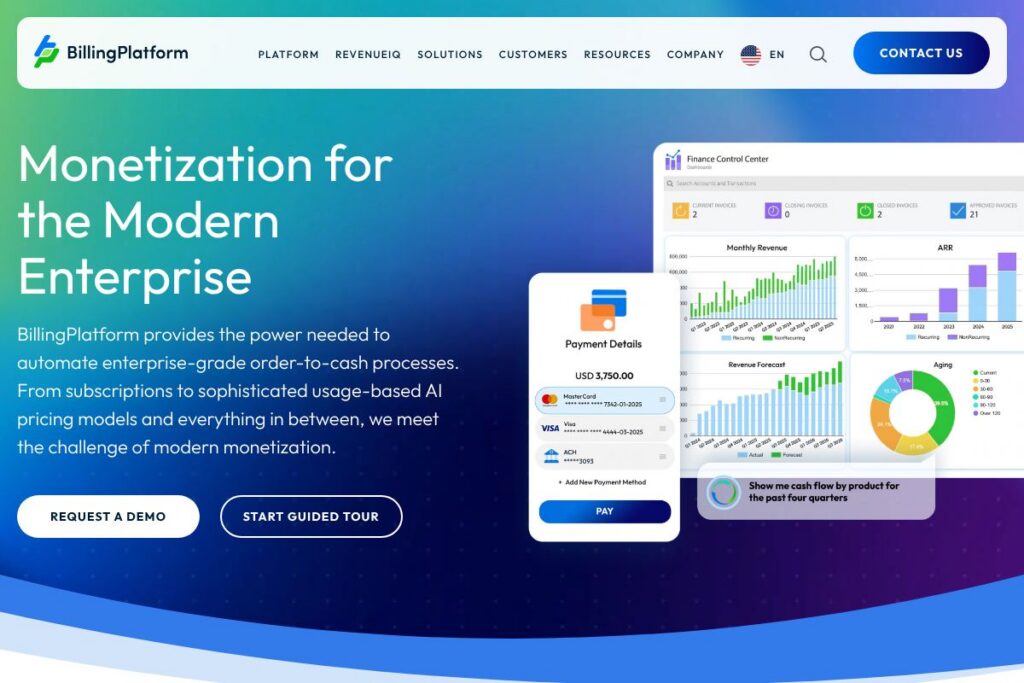
BillingPlatform is a cloud-based platform for managing recurring billing, subscription lifecycle events, usage-based pricing, and revenue recognition at enterprise scale. It combines a configurable billing engine, payments orchestration, revenue accounting, and reporting to support complex business models such as tiered pricing, metered usage, and multi-entity consolidations.
Compared with competitors, BillingPlatform focuses on large, complex revenue operations. For example, Zuora competes in the enterprise recurring billing space with a strong subscription management suite, but BillingPlatform emphasizes point-and-click configuration and integrated revenue accounting for highly customized deployments. Chargebee targets mid-market SaaS and offers transparent tiered pricing and quicker self-serve onboarding, while BillingPlatform is geared toward organizations that require deep customization, multi-currency support, and enterprise-grade controls.
BillingPlatform does particularly well at handling complex rating and pricing logic, consolidating multiple legacy systems into a single revenue platform, and supporting global billing and compliance needs. This makes it suited for large SaaS vendors, telecoms, fintechs, and any company running multiple subscription offers or usage-based products.
How BillingPlatform Works
BillingPlatform runs as a centralized revenue operations layer that ingests orders from sales systems, customer relationship platforms, and usage collectors. It applies configurable rating and pricing rules, generates invoices, and orchestrates payment collection across multiple gateways.
Administrators configure products, price books, and billing rules using a no-code interface that maps to business processes. Automated workflows handle renewals, proration, upgrades, downgrades, and cancellations, reducing manual touchpoints and improving billing accuracy.
The platform integrates with accounting systems to automate revenue recognition and with customer service systems to surface billing data during support interactions. Built-in analytics and AI features provide insights for churn prediction, revenue leakage detection, and scenario forecasting.
BillingPlatform features
BillingPlatform is organized around a flexible billing engine, subscription lifecycle management, payments and collections, revenue accounting, and analytics. Recent additions emphasize conversational AI assistants for reporting, natural-language configuration, and predictive analytics to detect anomalies and forecast churn.
Billing engine
The core rating engine supports time-based, usage-based, and tiered pricing with complex rule definitions. It processes high-volume transactions, applies taxes and discounts, and produces invoice line items that map to your chart of accounts for downstream accounting.
Subscription lifecycle management
Subscription management tracks every lifecycle event from order capture to renewal and termination. It supports immediate and scheduled changes, proration, add-ons, and bundling so operations teams can model real-world customer behaviors without custom code.
Ratings and pricing flexibility
Custom price books, multi-dimensional rate plans, and transformation logic let teams model promotions, discounts, and regional pricing. This capability helps businesses run promotional experiments and introduces new pricing models without lengthy engineering cycles.
Billing and invoicing automation
Automated invoice creation, delivery, and dispute tracking reduce manual AR work and speed collections. Invoices can be formatted per market requirements and delivered through email, SFTP, or electronic invoicing networks.
Payments and collections orchestration
The platform connects to multiple payment processors and gateways to support card, ACH, and local payment methods. Collections workflows, retry logic, and dunning policies are configurable to improve recovery while preserving customer experience.
Revenue recognition and accounting
Integrated revenue recognition automates ASC 606 and IFRS 15-compliant schedules and produces accounting entries that sync to ERP systems. This reduces reconciliation effort and provides accurate month-end close data.
AI studio and Copilot
Built-in AI capabilities enable natural-language reporting, anomaly detection, and process automation using pre-trained or custom models. The conversational Copilot helps non-technical users run reports and execute common admin tasks using plain language.
No-code configuration and extensibility
Point-and-click configuration lets administrators define objects, data mappings, and workflows without writing code. APIs and webhooks enable bi-directional integration with CRM, ERP, analytics, and billing-related systems.
BillingPlatform’s biggest benefit is its combination of enterprise-grade billing accuracy and highly configurable, no-code tools that let finance and product teams iterate quickly while maintaining accounting controls.
BillingPlatform pricing
BillingPlatform uses an enterprise pricing model with custom plans tailored to deployment complexity, transaction volume, and integration requirements. Pricing is typically negotiated and based on factors such as number of entities, billing volume, connector requirements, and professional services for implementation.
For specific pricing details and configuration-based estimates, contact BillingPlatform’s sales organization through the official BillingPlatform website or request a tailored quote via their contact and demos page. Enterprise buyers can discuss implementation scope, SLAs, and support levels directly with the vendor.
What is BillingPlatform Used For?
BillingPlatform is used for billing complex subscription and usage-based revenue streams, consolidating multiple legacy billing systems, and automating billing-to-revenue processes. Companies use it to reduce manual revenue operations work, improve billing accuracy, and manage compliance across multiple jurisdictions.
It also serves teams that need integrated revenue accounting, centralized invoice and payments handling, and analytics for detecting revenue leakage. Typical users include finance operations, revenue operations, product managers, and billing administrators at large enterprises.
Pros and cons of BillingPlatform
Pros
- Highly configurable billing engine: The platform supports complex pricing rules, usage rating, and multi-entity setups without heavy custom development, enabling finance teams to model real-world offers.
- Integrated revenue recognition: Built-in support for accounting standards reduces reconciliation work and helps accelerate month-end close with accurate deferred revenue schedules.
- Enterprise-grade controls and compliance: Multi-currency handling, tax integrations, and secure payment processing help large organizations operate across geographies with consistent controls.
- AI-assisted reporting and automation: Conversational Copilot and predictive analytics surface insights and automate routine tasks for non-technical users.
Cons
- Custom pricing model for enterprises: The vendor typically offers custom quotes which can make initial evaluation harder for smaller buyers used to transparent tiered pricing.
- Implementation complexity for very custom use cases: Deeply customized deployments or extensive legacy migrations can require professional services and longer implementation timelines.
Does BillingPlatform Offer a Free Trial?
BillingPlatform uses a custom enterprise licensing model with sales-led demos and proofs of concept rather than a public free tier. Prospective customers can request a demo, explore tailored proof-of-concept engagements, and evaluate the platform against specific business scenarios by contacting the vendor through the contact and demos page.
BillingPlatform API and Integrations
BillingPlatform provides APIs and webhook support for integrating with CRM, ERP, tax engines, payment gateways, and analytics systems. The developer documentation outlines REST endpoints for orders, invoices, payments, and subscription objects, along with examples for common integration patterns.
The platform also offers pre-built connectors and partner integrations for systems such as Salesforce, NetSuite, Avalara, and major payment processors to create a synchronized financial ecosystem.
10 BillingPlatform alternatives
Paid alternatives to BillingPlatform
- Zuora – A mature subscription management and billing platform with strong recurring revenue orchestration and a wide partner ecosystem.
- Chargebee – A subscription billing solution with transparent tiered pricing and self-serve onboarding aimed at SMB and mid-market SaaS businesses.
- Recurly – Focused on subscription management and churn reduction, Recurly provides hosted billing pages and AB testing for pricing experiments.
- Stripe Billing – A developer-friendly billing and invoicing product that integrates tightly with Stripe payments for lightweight subscription use cases.
- SaaSOptics – Provides subscription metrics, revenue recognition, and financial operations tools designed for growing B2B SaaS companies.
- Aria Systems – An enterprise monetization platform for complex usage-based and recurring billing models, often used in communications and IoT.
- Oracle NetSuite Billing – Part of the NetSuite ERP suite, offering integrated order-to-revenue capabilities for organizations already on NetSuite.
Open source alternatives to BillingPlatform
- Kill Bill – An open source billing and payments platform that supports plugins for payment gateways, catalog-driven pricing, and extensible workflows.
- ERPNext – An open source ERP with subscription billing features, invoicing, and accounting modules that can be extended for recurring revenue models.
- Invoice Ninja – Open source invoicing and payment tools that can handle recurring invoices and basic subscription workflows for small teams.
Frequently asked questions about BillingPlatform
What is BillingPlatform used for?
BillingPlatform is used to manage recurring billing, usage rating, payments orchestration, and revenue recognition for complex subscription businesses. Organizations use it to centralize billing operations and automate revenue processes across markets.
Does BillingPlatform provide APIs for integrations?
Yes, BillingPlatform exposes REST APIs and webhooks for orders, invoices, subscriptions, and payments. The developer documentation provides endpoint references and integration examples.
How does BillingPlatform handle revenue recognition?
BillingPlatform includes integrated revenue recognition to support ASC 606 and IFRS 15 workflows. It generates accounting schedules and journal entries that can be exported to downstream ERP systems for month-end close.
Can BillingPlatform manage global payments and taxes?
Yes, BillingPlatform supports multi-currency billing, multiple payment gateways, and tax integrations to manage regional compliance. It can connect with tax engines and local payment methods to align invoices and collections with market requirements.
Is BillingPlatform suitable for telecom or metered services?
BillingPlatform is designed to support usage-based and metered billing models at scale. Its rating engine, usage ingestion, and configurable charge models are well suited for telecom, IoT, and utility scenarios.
Final Verdict: BillingPlatform
BillingPlatform is a robust choice for enterprises that require a configurable, end-to-end revenue platform capable of handling complex subscription and usage-based billing. Its strengths lie in a flexible rating engine, integrated revenue recognition, and tools that let finance teams configure business logic without extensive engineering work.
Compared with Chargebee, which offers transparent tiered pricing and faster self-serve onboarding for SMBs, BillingPlatform is positioned for larger organizations with unique billing requirements and global operations. Where Chargebee favors quick time to value for mid-market customers, BillingPlatform provides deeper configurability and enterprise controls at a custom price point, making it a fit for companies that need a scalable, centralized revenue operations layer.