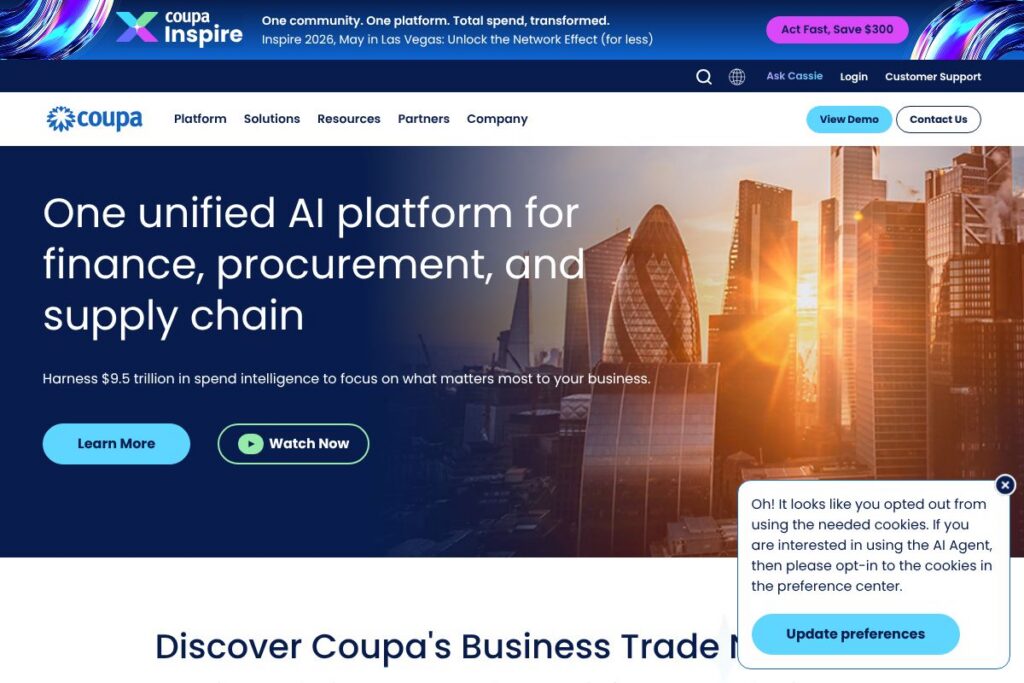

What is Coupa
Coupa is an AI-native total spend management platform that combines procurement, invoicing, payments, supplier collaboration, and supply chain optimization in one system. It connects buyers and suppliers through a large Business Trade Network to apply spend intelligence across transactions and decision points. Explore Coupa’s capabilities on the Coupa homepage and see how the Business Trade Network works via the Business Trade Network overview.
Compared with competitors, Coupa places a stronger emphasis on AI applied across procurement and finance workflows. SAP Ariba focuses on deep enterprise procurement and supplier lifecycle management with broad ERP integrations. Oracle Fusion Procurement is tightly coupled with Oracle Cloud ERP and appeals to organizations standardizing on Oracle for core finance functions. Ivalua positions itself on flexibility and supplier data mastery for organizations that need highly configurable procurement processes.
All of this makes Coupa particularly suited for large and mid-market organizations that want a single spend platform with built-in AI and a connected supplier network. It performs well when teams want to combine procurement controls, AP automation, and supplier collaboration under one data model to speed approvals and reduce risk.
How Coupa Works
Coupa centralizes procurement and spend data from purchase requests, purchase orders, invoices, and payments into a single platform where AI models analyze spend patterns and supplier performance. Procurement teams create catalogs and sourcing events, finance applies automated controls and validations during invoicing and payments, and supply chain teams use scenario modeling to test impacts on costs and availability.
On the supplier side, Coupa’s Business Trade Network connects suppliers to demand signals and automates onboarding, catalog updates, and electronic invoicing. Typical workflows include request-to-order routing with approval policies, automatic invoice matching, and AI-driven recommendations for preferred suppliers and contract compliance.
Implementation often begins with integrating Coupa to an ERP for master data and financial posting, onboarding key suppliers to the network, and enabling prebuilt connectors for payments and tax engines. Teams frequently start with procure-to-pay use cases, then expand to supplier risk management, supply chain modeling, and advanced analytics as adoption grows.
Coupa features
Coupa’s platform combines procurement, finance, supplier network, and AI capabilities into a single product set, with recent emphasis on generative AI for insights and automation. Core areas include the Business Trade Network, procure-to-pay automation, supplier performance and risk, payments, and machine learning-based supply chain optimization.
Business Trade Network
The Business Trade Network links buyers and suppliers to share demand signals, catalogs, and invoices, enabling faster order processing and improved visibility into supplier capacity. For suppliers, the network creates opportunities to surface offers to buyers and accelerate payment cycles, while buyers gain standardized transaction flows and richer spend intelligence.
AI and Machine Learning
Coupa applies machine learning and generative AI to surface insights such as anomaly detection, recommended suppliers, and automated invoice coding. These models reduce manual analysis cycles and help teams focus on exceptions instead of routine reconciliation.
Procure-to-Pay Automation
The platform automates requisitioning, purchase order creation, invoice matching, and approvals to reduce cycle times and manual touchpoints. Automation enforces policy controls and improves compliance while decreasing days payable outstanding when combined with digital payments.
Supplier Risk and Performance Management
Coupa centralizes supplier data, assesses risk signals, and tracks performance metrics so teams can identify disruptions early and manage remediation. Risk scoring and alerts help procurement and supply chain teams prioritize supplier actions and maintain business continuity.
Supply Chain Modeling and Optimization
Supply chain teams can run scenario analyses, evaluate alternative sourcing strategies, and quantify cost and service tradeoffs using Coupa’s analytics and simulation tools. These capabilities support continuous improvement and contingency planning for volatile supply conditions.
Analytics, Benchmarking, and Spend Intelligence
Built-in analytics provide category-level spend views, benchmarking against peer data, and dashboards for finance and procurement stakeholders. The platform leverages community spend data to surface market trends and negotiating opportunities.
Payments and Accounts Payable
Coupa integrates digital payments and AP automation to streamline settlement workflows, support multiple payment rails, and reduce reconciliation overhead. Automated controls and payment scheduling help protect margins and enforce approval policies.
With these capabilities combined, the biggest benefit is a single, data-consistent platform that applies AI across procurement, finance, and supply chain to reduce manual work, accelerate decisions, and surface risk before it becomes critical.
Coupa pricing
Coupa uses an enterprise subscription pricing model with custom packages tailored to organization size, modules required, and deployment preferences. Pricing is not published as fixed consumer tiers; instead the company builds quotes based on scope, number of users, transaction volume, and service requirements.
Enterprise
Enterprise – Custom pricing (Includes procurement, invoicing, supplier network access, optional supply chain modules, professional services, and support). For detailed options and quotes, contact Coupa through their contact sales page or review offerings on the Coupa homepage.
What is Coupa Used For?
Organizations use Coupa to centralize and control both direct and indirect spend, enforce procurement policies, and automate accounts payable workflows. Procurement teams adopt it to run sourcing events, manage catalogs, and maintain supplier contracts while finance teams use it to apply spend controls and reconcile payments.
Supply chain and operations teams use Coupa to model scenarios, monitor supplier health, and optimize sourcing to reduce costs and maintain service levels. The platform is also commonly used for supplier enablement and to accelerate electronic invoicing and payments across a broad supplier base.
Pros and Cons of Coupa
Pros
- AI-native analytics: Coupa applies machine learning and generative AI across procurement and finance workflows to reduce manual analysis and accelerate decision-making.
- Large supplier network: The Business Trade Network connects many buyers and suppliers, improving catalog coverage, invoicing automation, and visibility into market demand.
- End-to-end spend control: Combined procurement, AP automation, and payments capabilities provide a single ledger of spend and consistent policy enforcement across teams.
- Supply chain scenario planning: Built-in optimization and simulation tools help teams test sourcing strategies and estimate cost impacts for more resilient planning.
Cons
- Enterprise-focused pricing and procurement: Pricing and deployment are tailored to enterprise needs, which can be costly and complex for very small organizations seeking simple procurement tools.
- Implementation complexity: Integrating Coupa with ERPs, payment providers, and supplier onboarding can require significant project time and professional services.
- Customization trade-offs: Highly customized processes may need additional configuration or extensions, which can extend implementation timelines and increase cost.
Does Coupa Offer a Free Trial?
Coupa does not offer a public free plan, but provides product demos and pilot programs for prospective customers. Organizations can request a guided demo or discuss pilot options to validate use cases; start the process via Coupa’s contact sales page.
Coupa API and Integrations
Coupa provides APIs and prebuilt connectors to integrate with ERPs, HR systems, tax engines, and payment providers; developer resources and documentation are available in the Coupa API documentation. These APIs support catalogue management, invoices, purchase orders, and supplier data synchronization.
Common integrations include SAP, Oracle, Workday, NetSuite, and other enterprise systems to maintain master data and enable financial posting. Integration connectors and middleware options help reduce custom integration work and accelerate deployment.
10 Coupa alternatives
Paid alternatives to Coupa
- SAP Ariba – A comprehensive procurement and supplier management suite with deep ERP integration and marketplace capabilities for large enterprises.
- Oracle Fusion Procurement – Procurement functionality that integrates closely with Oracle Cloud ERP and finance modules for end-to-end financial operations.
- Ivalua – A procurement platform known for its flexibility and strong supplier information management capabilities for complex sourcing processes.
- Jaggaer – Focused on direct materials sourcing and supply chain procurement for manufacturing and higher-education sectors.
- GEP SMART – Cloud-native procurement suite that combines sourcing, savings tracking, and supplier management with strong category management features.
- Basware – Specializes in invoice automation and e-invoicing at scale with global payment and compliance capabilities.
- Zycus – Procurement suite with sourcing, contract management, and AI-driven procurement analytics.
Open source alternatives to Coupa
- ERPNext – An open source ERP that includes procurement and purchase order modules suitable for small to mid-sized organizations needing self-hosted options.
- Odoo (Community) – The community edition includes procurement and vendor management modules that can be extended for basic spend control and purchasing workflows.
- OpenBoxes – An open source inventory and supply chain management system focused on health supply chains and inventory tracking.
- Dolibarr – An open source ERP/CRM with procurement and supplier modules for small organizations seeking cost-effective self-hosted solutions.
Frequently asked questions about Coupa
What is Coupa used for?
Coupa is used to manage and control enterprise spend across procurement, invoicing, payments, and supply chain analytics. It centralizes transactions, applies automated controls, and provides intelligence to reduce cost and risk.
Does Coupa integrate with enterprise ERPs like SAP or Oracle?
Yes, Coupa integrates with major ERPs and financial systems. Prebuilt connectors and APIs support data synchronization for purchase orders, invoices, supplier master data, and financial posting.
Can Coupa help reduce supplier risk?
Yes, Coupa includes supplier risk and performance management tools. The platform aggregates supplier signals, scores risk, and surfaces issues so teams can act before disruptions escalate.
Is Coupa suitable for global organizations?
Coupa is designed for global deployments with multi-currency, tax compliance, and large supplier networks. Its Business Trade Network and payment integrations support international operations at scale.
Does Coupa offer APIs for automation?
Yes, Coupa provides developer APIs and integration documentation. The Coupa API documentation describes endpoints for automating procurement, invoicing, and supplier workflows.
Final verdict: Coupa
Coupa stands out for integrating procurement, finance, and supply chain into a single AI-native platform backed by a large Business Trade Network. Its strength lies in applying machine learning and connected supplier data to accelerate approvals, detect anomalies, and model supply chain scenarios, making it a strong fit for mid-market and enterprise organizations aiming to centralize spend intelligence.
Compared to SAP Ariba, both platforms use enterprise pricing models and provide broad procurement functionality, but Coupa differentiates with an explicit AI-first approach and a tightly integrated business trade network that speeds supplier connectivity. Organizations choosing between the two should weigh Coupa’s AI-driven analytics and network effects against Ariba’s deep ERP-centric procurement feature set and existing enterprise contracts.
For buyers evaluating total spend management platforms, Coupa is a compelling option when you need unified controls, supplier engagement at scale, and AI-powered insights to reduce manual work and improve decision speed. To explore specific module fit and pricing, contact Coupa via their contact sales channel or request a demo on the Coupa homepage.