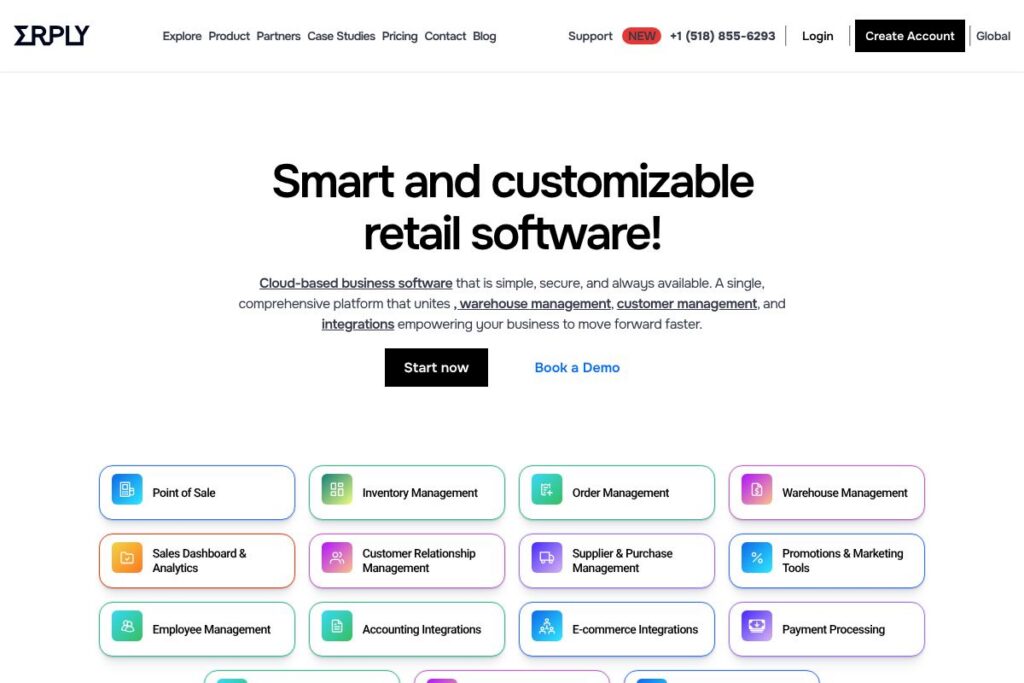

Erply: An Overview
Erply is a cloud-native retail point of sale and back-office platform designed to manage transactions, inventory, and store operations across single shops and large retail chains. Core capabilities include register-based POS, centralized inventory and purchase order management, customer records and loyalty, and role-based access for multi-store teams.
Compared with competitors, Erply targets mid-market and growing retailers that need deeper inventory control than consumer-focused systems like Square, while offering more turnkey cloud management than open-source packages such as Odoo. Compared to Lightspeed, Erply focuses more on scalable inventory and multi-warehouse workflows, while Lightspeed emphasizes integrated e-commerce and hospitality verticals.
Erply works well for retailers that need a single system to run point of sale, warehouse processes, and omnichannel sales. Its strength lies in multi-location inventory synchronization, offline-capable POS, and developer-friendly integration points that make it a practical choice for chains and retail businesses planning to scale.
How Erply Works
Stores run Erply through web and native POS apps that connect to a central cloud account, keeping stock levels and sales data synchronized across locations. The POS supports barcode scanning, programmable quick-select keys for fast checkout, returns and exchanges, and receipt reprinting for customer service tasks.
Back-office functions let managers create purchase orders, receive shipments, and track inventory in real time, including mobile warehouse workflows for receiving, packing, and shipping. Offline mode keeps registers functional during network interruptions and performs automatic sync when connectivity returns.
Erply integrates payments, third-party e-commerce platforms, and analytics: you can connect the POS to payment providers of your choice, bridge online storefronts for buy-online-pickup-in-store flows, and push sales into reporting dashboards for margin and trend analysis.
What does Erply do?
Erply packages POS operations and inventory management into a single system so retailers can sell in-store and online without maintaining separate product records or manual reconciliation. The platform consolidates product catalog, stock levels, pricing, and customer records, and feeds that data into centralized reporting and audit trails.
Key capabilities include programmable Quick Select Keys for rapid checkout, employee timeclock for labor tracking, till and receipt reconciliation tools for loss prevention, and mobile warehouse apps for paperless receiving and shipping. Erply also exposes developer tools and built-in integrations so retailers can connect e-commerce, delivery, and accounting systems.
The platform supports configurable workflows for multi-store chains, including transfer orders between locations, store-level pricing overrides, and role-based permissions to control what cashiers and managers can do at the register.
Erply features
Erply’s feature set centers on retail checkout, inventory control, and extensibility. The platform continues to expand integration points and mobile warehouse tooling to reduce manual work and speed order fulfillment. Below are the standout capabilities worth considering.
Point of Sale
The POS supports fast checkouts, programmable quick-select product buttons, barcode scanning, and offline operation so sales continue during network outages. It includes receipt reprints, returns handling, and register-level reporting to help cashiers and managers manage tills accurately.
Inventory and Warehouse Management
Real-time stock tracking, transfer orders, and mobile receiving let retailers manage multiple warehouses and stores from a single account. The mobile warehouse app covers receiving, shipping, and packing, reducing paper use and ensuring purchase order updates happen in real time.
Payments and Integrations
Erply allows retailers to choose payment providers and integrates with major processors while offering its own payment option. The platform supports EMV and contactless payments and integrates payment data into sales records for reconciliation and reporting. See the payment integrations for supported providers and integration details.
Customer Management and Loyalty
Customer records store purchase history, contact details, and loyalty balances to enable targeted offers and faster service at the register. Loyalty and campaign modules help convert one-time shoppers into repeat customers by linking promotions to customer accounts.
Reporting and Analytics
Sales, margin, and stock movement reports are available at store and chain levels to inform purchasing and promotional decisions. Managers can pull recent register transactions for audit, review the last 100 sales at a terminal, and configure alerts for inventory thresholds or cash variances.
Automat App Maker
The low-code Automat App Maker integrates with Erply to build tailored business apps and automate workflows without heavy development overhead. It provides role-based access, secure deployment, and a marketplace for reusable business apps that extend POS and inventory functionality.
With these features, Erply helps retailers reduce manual tasks, maintain accurate stock visibility, and scale operations across stores and warehouses while supporting integrations and custom apps.
Erply Pricing
Erply uses a flexible, modular pricing approach with plans and add-ons tailored to business size, number of registers, and desired modules, typically offered as subscription tiers or enterprise agreements rather than fixed public price points. For specific package options and deployment plans, check Erply’s website or contact sales for a customized quote.
What is Erply Used For?
Erply is used to run in-store sales, manage inventory across multiple locations, and coordinate warehouse operations using mobile devices. Retailers use it to unify in-store and online catalogs, handle BOPIS (buy-online-pickup-in-store) workflows, and keep financial and stock records synchronized across channels.
Teams that benefit most include small chains scaling to multiple outlets, specialty retailers with large SKU counts, and operations that need mobile receiving and shipping tools to reduce paper processes. Erply also serves merchants who require custom integrations or bespoke workflows via API access and low-code app building.
Pros and Cons of Erply
Pros
- Scalable multi-store support: Erply synchronizes inventory, pricing, and reporting across many locations, making it suitable for retail chains and franchises.
- Strong inventory and warehouse tools: Mobile receiving, transfer orders, and real-time stock updates reduce stockouts and manual reconciliation work.
- Flexible payment options: You can use Erply Payments or connect other payment processors to match regional needs and pricing.
- Extensible platform and App Maker: Low-code app capabilities and an open API let technical teams customize workflows and integrate external systems.
Cons
- Custom pricing model: Pricing is typically customized, which can lengthen procurement cycles for smaller retailers that prefer transparent list prices.
- Implementation complexity for large deployments: Setting up advanced inventory rules, multi-warehouse flows, and integrations may require professional services or technical resources.
- Learning curve for advanced features: Some back-office and reporting capabilities require training to use effectively, especially in multi-location setups.
Does Erply Offer a Free Trial?
Erply offers a free account setup option and trial arrangements for new customers. The company provides initial account setup and demo access to evaluate POS and inventory workflows; businesses can request a trial or demo through Erply’s contact channels to test features and onboarding support.
Erply API and Integrations
Erply provides a developer-friendly API that exposes endpoints for inventory, customers, sales, and purchase order operations, enabling custom integrations and automation. The Erply API documentation covers authentication, endpoints, and example workflows for developers.
Built-in integrations include e-commerce platforms, payment processors, and delivery partners to support omnichannel retail. Explore the payment integrations and delivery integrations pages for common connector options.
10 Erply alternatives
Paid alternatives to Erply
- Square — A simple, consumer-friendly POS with built-in payments and online store tools; well suited to single locations and small chains. Square charges a per-transaction fee model, making it easy to start without large upfront costs.
- Lightspeed — Feature-rich POS and e-commerce platform aimed at retailers and restaurants, with strong inventory and multi-store features and built-in omnichannel capabilities.
- Shopify POS — Tightly integrated with Shopify’s e-commerce platform, useful for merchants that prioritize online sales backed by a unified catalog and store pickup flows.
- Clover — Hardware and app ecosystem for POS with flexible payment processing options and a catalog of third-party apps for added functionality.
- Revel Systems — Enterprise-focused iPad POS with advanced inventory, CRM, and multi-location management suitable for larger chains.
- Toast — Primarily for restaurants but used by food retailers with strong ordering and payments features, plus hardware bundles.
- Vend (Lightspeed Retail) — Retail-focused POS with intuitive register design and inventory features; now part of Lightspeed and integrated into its ecosystem.
Open source alternatives to Erply
- Odoo — Open-source ERP with a POS module, inventory, and e-commerce; highly modular and extensible for retailers comfortable with self-hosting or managed Odoo providers.
- uniCenta — A Java-based open-source POS system designed for retailers and hospitality, offering core register and inventory functionality for self-hosting.
- Chromis POS — Lightweight open-source POS with basic retail features and multi-platform support for small stores and kiosks.
- Floreant POS — Open-source POS originally built for restaurants but adaptable to retail environments through customization and plugins.
Frequently asked questions about Erply
What is Erply used for?
Erply is used to run retail point of sale and centralized inventory management across one or many locations. Retailers use it to process sales, manage stock, and coordinate warehouse and pick-pack workflows.
Does Erply have an API?
Yes, Erply provides a developer API for inventory, sales, and customer endpoints. The Erply API documentation explains authentication and available endpoints for automation and integrations.
Can Erply work offline at the point of sale?
Yes, Erply supports offline mode for registers so sales continue during network outages and sync when connectivity returns. Offline operation preserves transactions locally and reconciles them to the cloud automatically.
Is Erply suitable for multi-store retail chains?
Yes, Erply is designed for multi-store and multi-warehouse retail operations. It synchronizes stock, pricing, and reporting across locations and supports transfer orders and centralized purchasing workflows.
Does Erply integrate with e-commerce platforms and delivery services?
Yes, Erply integrates with common e-commerce platforms and delivery partners to enable omnichannel sales and fulfillment. See Erply’s integration pages for payment and delivery connectors and options.
Final Verdict: Erply
Erply is a solid choice for retailers that need comprehensive inventory control, multi-location synchronization, and configurable workflows for warehouse and POS operations. Its strengths are mobile warehouse tooling, quick-register features like Quick Select Keys, and a developer-friendly API plus a low-code App Maker for custom business apps.
Compared to Square, which is attractive for single-store merchants and uses a transparent per-transaction fee model such as 2.6% + $0.10 for in-person payments in many regions, Erply is built for scale and customization rather than lowest-cost entry. If your priority is rapid setup for a single shop, Square may be less complex and cheaper to start with, but for chains that need centralized inventory control and custom integrations, Erply delivers deeper operational control and extensibility.
Overall, Erply is well suited to retailers planning to scale beyond a single location, those with complex inventory or warehouse needs, or businesses that require API access and custom app development to align POS workflows with their operations. For pricing and a tailored quote, consult the Erply website or contact their sales team for a proposal.