FIS: An Overview
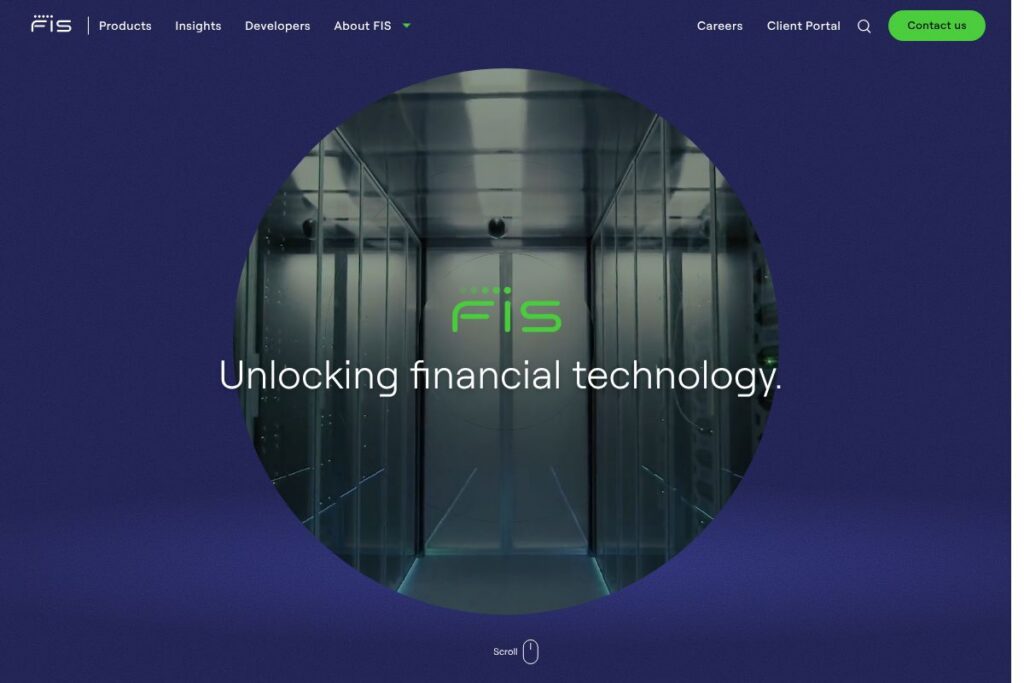
FIS provides enterprise-grade financial technology that supports how money is stored, moved, and put to work across banks, card issuers, payments networks, asset managers, and corporate treasuries. The company combines core banking platforms, payments processing, digital banking front ends, treasury and capital markets systems, and data analytics to serve large financial institutions and fintechs at scale.
FIS competes with vendors such as Fiserv, Temenos, and ACI Worldwide, each with overlapping strengths in core processing, payments, and digital channels. Compared with Fiserv, FIS emphasizes broad scale in treasury and capital markets services; versus Temenos, FIS often pairs core processing with extensive managed services; compared with ACI Worldwide, FIS brings deeper banking platform coverage alongside payments orchestration.
All of this makes FIS well suited for large banks, payments processors, and enterprise corporations that need an integrated technology stack with global reach, strong security and compliance controls, and configurable deployment options.
How FIS Works
FIS packages a mix of software platforms, managed services, and professional services to implement and operate financial systems. Typical deployments pair a core banking engine with digital channel software for web and mobile, plus payments rails and treasury modules that connect to internal systems and external networks.
Implementation commonly follows a phased approach: core migration or modernization, integration of payments and treasury services, then deployment of digital channels and analytics. FIS supports integration through APIs and connectors, offers managed operations on private or public cloud infrastructure, and provides ongoing support for regulatory reporting, security, and operational resilience.
FIS features
FIS’s product set covers core banking, payments, treasury, wealth services, analytics, and managed operating models. The platform emphasizes security, regulatory compliance, and scalability, while offering modernization paths such as Digital One for unified digital banking and private capital tooling for fund accounting.
Core Banking
FIS delivers mainframe and modern core banking engines that handle deposits, loans, ledger accounting, and customer lifecycle management. These cores are designed for high transaction volumes and configurable product definitions to support retail, commercial, and wholesale banking operations.
Digital Banking (Digital One)
Digital One provides a single platform for web and mobile banking experiences, with a modern user interface and integrated customer journeys. It connects to the core and to payments modules so institutions can deliver omnichannel services while centralizing identity, security, and personalization.
Payments and Processing
Payments capabilities include card processing, ACH, real-time payments, cross-border settlement, and payment orchestration to route transactions across networks. These modules focus on throughput, reconciliation, and predictable routing to reduce costs and operational friction.
Treasury and Cash Management
Treasury and cash management tools give corporates and banks visibility into cash positions, liquidity, and intraday flows, while supporting treasury workflows, sweeps, and payment netting. Integration with market and bank networks ensures real-time visibility for treasury teams.
Wealth, Asset Servicing and Private Capital Suite
FIS offers solutions for asset managers, custodians, and private equity firms that automate fund accounting, reporting, and investor servicing. These tools aim to reduce manual reconciliation, provide up-to-date analytics, and support configurable fund structures.
Risk, Compliance, and Security
Security and compliance capabilities include transaction monitoring, fraud detection, KYC integration, and support for regulatory reporting regimes. Managed security and risk services help institutions maintain controls across global jurisdictions while meeting audit and compliance demands.
Data, Analytics, and Decisioning
Embedded analytics, reporting, and data lakes provide performance metrics, customer insights, and operational dashboards. These features enable revenue optimization, risk monitoring, and fee analysis without extensive custom development.
Managed Services and Cloud Operations
FIS offers hosted and managed operating models that include application management, operations, and support, allowing clients to reduce in-house operational load. These services include resilience planning, patching, and adherence to industry security standards.
With this set of features, FIS is built to support end-to-end financial operations at scale, combining processing, front-end channels, analytics, and managed operations to reduce integration burden for enterprise clients.
FIS pricing
FIS uses enterprise, contract-based pricing tailored to the size of the institution, product mix, deployment model, and service level requirements. Pricing is custom for each engagement and typically reflects software licensing, implementation services, managed services fees, and transaction or usage-based components.
Enterprise Pricing
Enterprise – Custom pricing (Licensing, implementation fees, optional managed services; pricing depends on scope and deployment)
For a precise estimate and to understand how licensing, transaction fees, and managed services apply to your situation, contact FIS via their commercial pages or speak directly with a sales representative through the FIS company pages.
What is FIS Used For?
Banks and financial institutions use FIS to run core deposit and loan processing, modernize digital banking channels, and handle high-volume payment processing across domestic and cross-border rails. Large corporates and asset managers use FIS for treasury, liquidity management, fund accounting, and custody services.
Financial technology teams often rely on FIS when they need a single vendor capable of delivering integrated banking operations, payments orchestration, and enterprise-grade compliance support. The platform fits organizations that require predictable scalability, regulated controls, and professional services for large transformations.
Pros and Cons of FIS
Pros
- Breadth of capabilities: FIS covers core banking, payments, treasury, wealth services, and analytics, which reduces the need for multiple vendors and simplifies integration.
- Global scale and resiliency: The company supports high-volume processing and has experience with cross-border payments and multi-jurisdiction compliance, which benefits multinational institutions.
- Managed services option: Available hosted and managed operating models allow clients to outsource operations and focus internal resources on product and customer strategy.
Cons
- Enterprise focus and cost: The platform is designed for large organizations, which can make procurement and implementation costly and complex for smaller banks.
- Implementation timelines: Core and payments platform projects are substantial undertakings that typically require extended timeframes and significant change management.
- Customization complexity: Highly configurable modules can be powerful but may require extensive professional services to tailor workflows and integrations.
Does FIS Offer a Free Trial?
FIS is paid-only with enterprise licensing and customised deployments. Prospective customers can arrange demonstrations, pilot programs, or proof-of-concept engagements through FIS sales channels, and pilots are scoped per project rather than offered as a public free trial; contact FIS through the FIS commercial pages to request a demo or pilot.
FIS API and Integrations
FIS provides APIs and integration layers to connect core systems, payments networks, third-party services, and client systems, with developer documentation and partner connectors for common industry standards. For technical details on endpoints, authentication, and integration patterns, consult the FIS developer and integration resources.
The platform integrates with card networks, ACH/real-time rails, SWIFT, correspondent banking systems, major card schemes, and common enterprise ERPs and CRM systems to create end-to-end transaction flows and reconciliations.
10 FIS alternatives
Paid alternatives to FIS
- Fiserv — Payment processing, core banking, and merchant services with a broad retail banking footprint and payments network integrations.
- Temenos — Core banking and digital banking suites focused on configurable banking products and cloud-native deployments.
- ACI Worldwide — Real-time payments and payments orchestration with strong global payments network reach.
- Oracle Financial Services — Enterprise banking and risk systems aimed at large banks and capital markets firms with deep analytics capabilities.
- Broadridge — Wealth and securities processing, proxy, and investor communications services for capital markets and asset managers.
- Jack Henry — Core processing and digital banking solutions commonly used by regional and community banks with a range of integration options.
Open source alternatives to FIS
- Apache Fineract — Open source core banking platform focused on financial inclusion and flexible product definitions for microfinance and banks.
- Mifos X — Community-driven financial services platform for core banking, loans, and savings, suitable for smaller institutions and fintechs.
- Cyclos — Payments and e-money platform offering core payment account features and modular add-ons for community currencies and local payments.
- OpenCBS — Core banking system designed for microfinance and small banks, with loan management and reporting tools.
Frequently asked questions about FIS
What does FIS do?
FIS provides core banking, payments, treasury, wealth, and analytics software and managed services for financial institutions and corporates. Its platforms cover end-to-end processing needs from digital channels to backend accounting and settlement.
Does FIS offer APIs for developers?
Yes, FIS supplies APIs and integration interfaces for connecting to core systems, payments rails, and third-party services. Developers can work with FIS integration documentation and partner connectors to build secure, automated flows.
How much does FIS cost for a bank?
FIS uses enterprise, contract-based pricing which varies by product selection, deployment model, volume, and service level. Prospective customers should contact FIS through their commercial channels to obtain a custom quote based on project scope.
Can FIS support instant and real-time payments?
Yes, FIS supports real-time and instant payment rails along with settlement and reconciliation tooling. The platform includes payments orchestration features designed to route, monitor, and reconcile high-volume, low-latency transactions.
Is FIS suitable for regional or community banks?
FIS can serve regional banks but is primarily positioned for larger institutions and enterprises. Smaller banks may evaluate specific modular offerings or consider vendors focused on community banking to balance cost and implementation effort.
Final verdict: FIS
FIS is a comprehensive, enterprise-grade fintech provider that excels at delivering integrated banking, payments, treasury, and wealth systems with global scale, strong security, and managed operations. Its strengths are breadth of capabilities and the option to combine software with managed services, which reduces the integration burden for large financial organizations.
Compared with Fiserv, which also targets large financial institutions, FIS offers a similarly broad product portfolio and enterprise licensing model; both vendors use custom pricing based on scope, though institutions should compare specific functional fit and managed services terms when evaluating cost and time to value. For organizations that require a single-vendor approach to run core operations, payments, and capital markets workflows, FIS is a leading option backed by extensive professional services and global delivery capabilities.