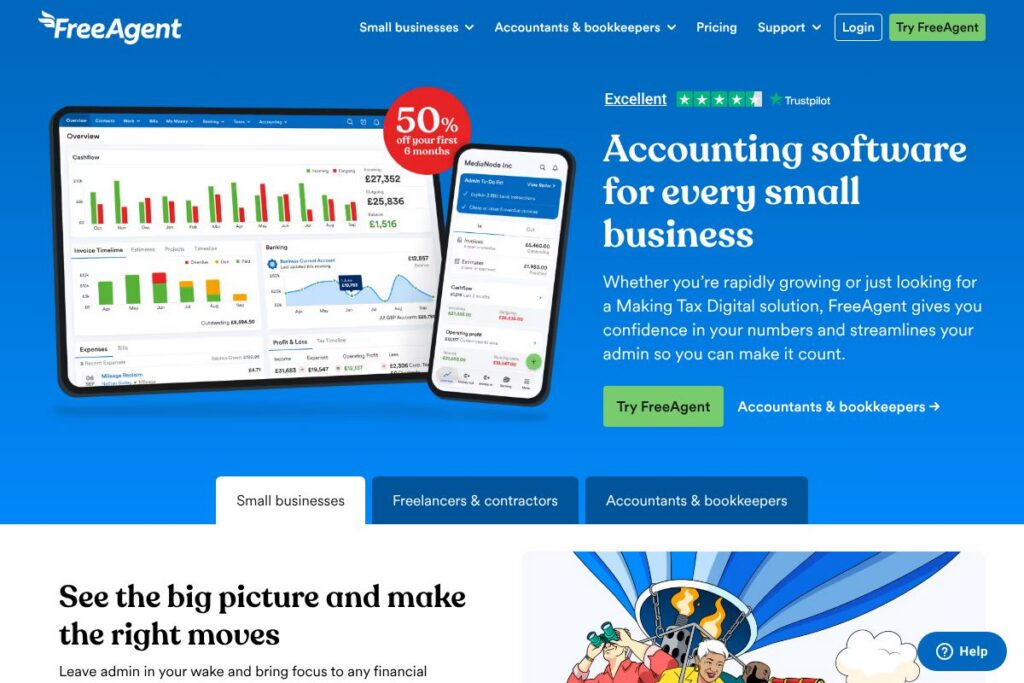

FreeAgent: An Overview
FreeAgent is a UK-focused cloud accounting platform built for sole traders, limited companies, contractors and landlords. It combines bookkeeping, bank feeds, invoicing, expense capture and compliance tools into a single subscription so small businesses can manage accounts without specialist software knowledge.
Compared with Xero, which targets a broader international market and a large third-party app ecosystem, FreeAgent emphasizes simplicity and UK tax workflows such as Making Tax Digital for Income Tax and direct Self Assessment filing. Compared with QuickBooks Online, FreeAgent provides a more guided experience for freelancers and landlords and includes time tracking and project billing in the core workflow. Compared with Sage, FreeAgent is positioned toward smaller businesses that want an all-in-one, easy-to-use tool rather than enterprise payroll and complex multi-entity accounting.
All of this makes FreeAgent a practical choice for UK small business owners who want straightfoward bookkeeping, reliable HMRC filing and collaborative access for their accountant. It does especially well at tax filing workflows and landlord accounting, and is a good fit for businesses that prefer a single, focused accounting product rather than a highly modular ecosystem.
How FreeAgent Works
FreeAgent connects to your business bank account to import transactions automatically, then helps you match and reconcile those transactions against invoices, bills and expenses. Users can create and send branded invoices, log time against projects, and assign costs to invoices for accurate project billing.
The platform provides HMRC-recognised pathways for Making Tax Digital for Income Tax, VAT and Self Assessment, so filings can be submitted directly from the app. Collaboration is handled via accountant invites and user permissions so your bookkeeper or accountant sees the same live data and can work in real time alongside you.
Typical workflows include connecting a bank feed, enabling Smart Capture for receipt images, creating recurring invoices, and using the built-in tax calendar to reserve funds for upcoming liabilities. The mobile app and web app provide access to the same bookkeeping features, letting business owners update records on the go.
FreeAgent features
FreeAgent centers on core small-business accounting functions plus UK tax compliance. Core capabilities include automated bank feeds and reconciliation, HMRC filing for VAT and Self Assessment, invoicing, expense and receipt capture, time tracking for client billing, and accountant collaboration tools. The platform has extended support for Amazon sellers and an optional Smart Capture add-on for higher-volume receipt processing.
Let’s talk FreeAgent’s Features
Bank feeds and reconciliation
Bank accounts and credit cards connect to FreeAgent to import transactions automatically, which speeds up reconciliation. Rules and recurring categorizations reduce manual work, and reconciled balances feed into reports and tax calculations so you always see an up-to-date view of cash position.
Invoicing and payments
Create, customise and send invoices with payment links and online payment options to accelerate collections. The system supports recurring invoices, invoice reminders and receipts, and integrates with payment providers to match incoming payments to outstanding invoices automatically.
VAT, Self Assessment and Making Tax Digital
FreeAgent includes HMRC-recognised workflows for Making Tax Digital for Income Tax, direct VAT submissions and Self Assessment filing for sole traders and directors. The tax calendar, estimated tax figures and filing tools make it easier to understand what is due and when, reducing the risk of missed deadlines.
Smart Capture (receipt and bill capture)
The Smart Capture add-on automates data extraction from receipt and bill images, matches uploads to transactions, and categorises expenses to speed bookkeeping. It is offered as an optional paid add-on for businesses that process many receipts each month and want to reduce manual entry.
Time tracking and project billing
Built-in time tracking lets contractors and service businesses log time against projects, convert time entries into billable items, and track profitability at the project level. Timesheets sync with invoices for accurate client billing and reporting.
Accountant collaboration and user permissions
Invite your accountant or bookkeeper to access your account with appropriate permissions so you can work together in real time. Accountant access supports easier year-end work, payroll handovers and shared review of tax filings.
Amazon marketplace and e-commerce connectors
An optional Amazon UK Marketplace connector helps sellers import orders and fees so e-commerce activity can be reconciled against sales and costs. Other integrations support payment providers and bank connections commonly used by UK businesses.
With these features, FreeAgent delivers a compact set of tools that cover the bookkeeping-to-filing lifecycle for UK small businesses, with optional add-ons to scale receipt processing and e-commerce connections.
FreeAgent pricing
FreeAgent uses a subscription pricing model with monthly and annual billing options, plus optional paid add-ons for receipt capture and e-commerce connections. The platform also offers a 30-day free trial and promotional introductory pricing for new customers.
Monthly Billing:
Standard subscription – £16.50 /month (introductory price, 50% off for the first six months, all core accounting features, Making Tax Digital-compatible)
Optional add-ons:
- Unlimited receipt and bill captures: £5/month, billed monthly (automatic data extraction and unlimited Smart Capture use)
- Connect with Amazon: £6/month, billed monthly (Amazon UK Marketplace connector for sellers)
Annual Billing:
Standard subscription – £165 /year (introductory price, 50% off for the first year, equivalent to £13.75 /month, all core accounting features)
Optional add-ons:
- Unlimited receipt and bill captures: £5/month, billed monthly (same Smart Capture add-on)
- Connect with Amazon: £6/month, billed monthly (same Amazon connector)
Bank partner offers and free access
FreeAgent is also offered free to customers of certain business bank accounts, including NatWest, Royal Bank of Scotland, Ulster Bank and Mettle, subject to terms. Optional add-ons may still be charged separately. For signup and trial information visit the official FreeAgent site.
What is FreeAgent Used For?
Small business bookkeeping: FreeAgent is commonly used to manage day-to-day bookkeeping tasks such as bank reconciliation, expense tracking and monthly reporting so owners can keep the numbers accurate without hiring full-time accounting staff. It is particularly helpful for single-owner businesses and freelancers who need straightforward accounts and tax-ready figures.
Tax compliance and filing: Many users adopt FreeAgent primarily for HMRC filing support, including Making Tax Digital for Income Tax, VAT returns and Self Assessment. The platform guides users through tax calculations and lets them submit returns directly to HMRC from the app.
Landlords and project-based businesses: FreeAgent includes workflows suited to landlords for tracking rental income and expenses, and to professional services firms that bill by time or project. The time-tracking, project profitability and client invoicing features make it a practical option for service providers.
Pros and Cons of FreeAgent
Pros
- UK tax integration: FreeAgent provides direct HMRC filing for VAT and Self Assessment, and supports Making Tax Digital for Income Tax, which simplifies compliance for UK businesses.
- Simple, focused interface: The product prioritises ease of use for sole traders, contractors and landlords, with guided workflows that reduce bookkeeping overhead.
- Accountant collaboration: Invite an accountant or bookkeeper to work in real time, which makes year-end preparation and tax advice easier.
Cons
- Limited global features: The platform is optimised for UK businesses, so organisations with international subsidiaries or complex multi-currency operations may find competitors like Xero or QuickBooks more suitable.
- Single-plan pricing structure: While simpler for many small businesses, the single subscription model may lack the granular tiered options some teams want as they scale.
- Optional add-on costs: Higher-volume receipt processing and Amazon marketplace connections require paid add-ons, which increases the overall cost for businesses with those needs.
Does FreeAgent Offer a Free Trial?
FreeAgent offers a 30-day free trial. The trial provides access to core accounting features, bank feeds, invoicing and HMRC filing workflows so you can evaluate the service; you can cancel at any time and some bank partners provide FreeAgent free for eligible business account holders.
FreeAgent API and Integrations
FreeAgent provides a developer API that allows accountants, developers and partners to integrate accounting data and automate workflows; the developer API documentation describes endpoints for invoices, expenses, projects, bank transactions and contacts. Key integrations include bank feeds from major UK banks, payment providers such as Stripe and GoCardless, and marketplace connectors like Amazon UK Marketplace.
If you need custom automation or a connection to a niche tool, the API and common integrations plus accountant collaboration support are designed to make those extensions practical.
10 FreeAgent alternatives
Paid alternatives to FreeAgent
- Xero — Cloud accounting with a large app ecosystem and strong multi-currency and payroll options suitable for growing businesses.
- QuickBooks Online — Widely used accounting platform with tiered plans and broad third-party integrations for small and medium businesses.
- Sage Business Cloud Accounting — Scales from small to enterprise payroll and accounting needs, with a strong focus on compliance and payroll in the UK.
- FreshBooks — Service-oriented accounting and invoicing with strong time-tracking and client billing features for freelancers and agencies.
- Zoho Books — Part of the Zoho suite, offering invoicing, automation and CRM integration for small businesses with broader Zoho usage.
- KashFlow — UK-focused accounting software with payroll add-ons, good for small businesses that prefer a UK-centric provider.
- FreeAgent (bank partner offers) — Note that some banks offer FreeAgent access bundled with business accounts for eligible customers.
Open source alternatives to FreeAgent
- GnuCash — Desktop-based open source accounting for small businesses and personal finance, suitable for self-hosted bookkeeping.
- ERPNext — Open source ERP with accounting modules that support invoicing, stock and multi-company setups for organisations comfortable with self-hosting.
- Odoo (Community edition) — Open source ERP with an accounting module, better suited for organisations that want a broader business management suite.
- LedgerSMB — Open source accounting and ERP focused on small to mid-sized organisations that need accounting control and hosting flexibility.
Frequently asked questions about FreeAgent
What is FreeAgent used for?
FreeAgent is used for cloud bookkeeping, invoicing and HMRC filing for UK small businesses, freelancers and landlords. It combines bank feeds, invoicing, expense capture and tax filing in a single app to streamline accounting tasks.
Does FreeAgent support Making Tax Digital?
Yes, FreeAgent supports Making Tax Digital for Income Tax and VAT. The platform provides HMRC-recognised workflows and lets users submit VAT and Self Assessment returns directly to HMRC.
Can I invite my accountant to FreeAgent?
Yes, you can invite an accountant or bookkeeper to access your FreeAgent account. Shared access allows both parties to work on the same data in real time and simplifies collaboration around filings and year-end accounts.
Is FreeAgent suitable for landlords?
Yes, FreeAgent includes features tailored to landlords. It supports tracking rental income and expenses, property-specific reporting and tax calculations relevant to property businesses.
Does FreeAgent offer integrations with payment providers?
Yes, FreeAgent integrates with common payment providers and bank feeds. Integrations include providers such as Stripe, GoCardless and connectors for marketplace sellers like Amazon UK Marketplace, plus bank feeds from major UK banks.
Final Verdict: FreeAgent
FreeAgent excels at delivering a compact, tax-focused accounting experience for UK small businesses, freelancers and landlords. Its strengths are HMRC-recognised filing workflows, simple bank feed reconciliation, integrated time tracking for project billing and direct accountant collaboration, all packaged in an interface that keeps bookkeeping approachable for non-accountants.
Compared with Xero, FreeAgent’s single subscription approach and guided UK tax workflows make it simpler for sole traders and small service businesses, while Xero tends to offer a larger app ecosystem and more tiered options for growing businesses. FreeAgent’s introductory pricing at £16.50 /month (monthly) or £165 /year (annual) provides a straightforward cost profile, and optional add-ons such as £5/month for unlimited Smart Capture should be weighed against your receipt processing needs.
If your business is UK-centric and you prioritise straightforward tax filing, project billing and easy accountant access, FreeAgent is a solid, practical choice. For organisations needing broader international features, heavier app integrations or advanced multi-entity accounting, consider Xero or QuickBooks Online as alternatives.