ION: An Overview
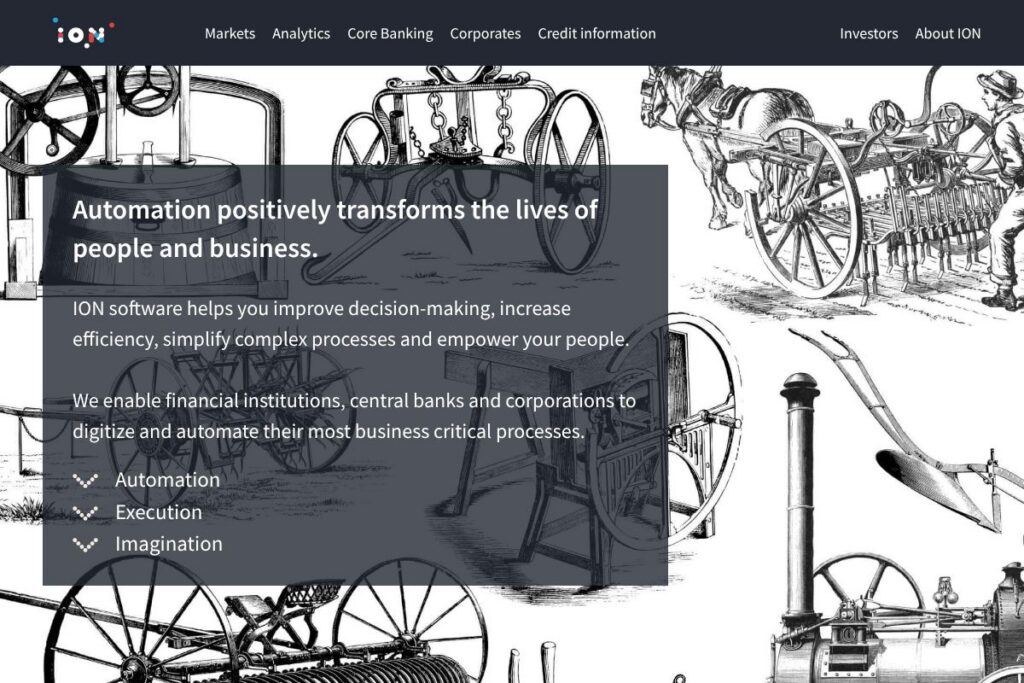
ION builds automation software aimed at financial institutions, central banks, and large corporations to digitize and automate high-value back-office and front-office operations. Its portfolio covers payments, treasury, trading, risk and compliance, and workflow orchestration designed for environments with high transaction volumes and regulatory needs.
Compared with competitors such as Temenos, Finastra, and Murex, ION places stronger emphasis on orchestration across heterogeneous systems and specialist automation modules for payments and treasury. Where Temenos focuses on core banking platforms and Murex leads in capital markets trading systems, ION positions itself as an integration and automation layer that connects banking applications, market access, and enterprise resource systems.
ION does well when organizations need to reduce manual processing across multiple legacy systems, centralize operational control, and improve decision support using consolidated data. All of this makes it a practical choice for banks and corporations that require deep automation, flexible integration, and vendor-led professional services for deployment and ongoing support.
How ION Works
ION packages functionality as modular products and solutions that can be deployed on-premises, in public or private clouds, or as managed services. Each module addresses a domain such as payments, treasury, trading, or regulatory reporting and can be integrated into an existing landscape through connectors, adapters, and APIs.
Typical implementations begin with mapping existing processes, identifying manual handoffs, and configuring ION workflows to automate those steps while preserving audit trails and controls. Implementations commonly include data consolidation, exception handling rules, automated reconciliation, and dashboards for operational and compliance teams.
ION features
ION’s product suite centers on automation, integration, and domain-specific processing for finance and operations. Core capabilities include workflow orchestration, payments and treasury processing, market connectivity, risk and compliance tooling, analytics and reporting, and integration frameworks. The vendor continuously adapts modules to support regulatory requirements and larger automation programs.
Workflow orchestration
ION provides a central engine to model and run multi-step processes that traverse multiple systems and teams, with built-in exception handling and routing. This reduces manual interventions, enforces SLAs, and creates auditable event logs that are useful for both operations and compliance teams.
Payments and treasury processing
Modules for payments and treasury manage message transformation, routing, settlement, and reconciliation across currencies and channels. Teams benefit from standardized processing logic, automated exception workflows, and integration with payment networks to reduce settlement risk and processing time.
Trading and market access
ION supports trading connectivity, order routing, and post-trade processing for market participants needing reliable market access and back-office automation. The platform helps reduce latency in trade lifecycle events and centralizes trade capture, confirmation, and settlement tasks.
Risk, compliance, and regulatory reporting
The platform includes tools to automate regulatory reporting, surveillance, and rule-based controls that help firms meet jurisdictional requirements. Built-in workflows and reporting templates reduce the effort required to compile audit-ready submissions and support ongoing compliance monitoring.
Data, analytics, and decision support
ION consolidates operational and transaction data into dashboards and reporting views that support operational decision-making and exception triage. Teams can use these reports to prioritize work, identify bottlenecks, and measure process KPIs.
Integration frameworks and APIs
A range of connectors, adapters, and APIs enable integration with core banking systems, ERPs, SWIFT networks, market infrastructures, and third-party services. This reduces the custom development burden when connecting legacy systems to modern automation workflows; see ION’s solutions pages for implementation patterns.
Deployment and managed services
ION offers flexible deployment options including cloud, on-premises, and managed services, backed by consulting and implementation teams that handle customization, testing, and handover. This helps organizations move from proof of concept to production with vendor-supported runbooks and operational SLAs.
With these capabilities, ION’s biggest strength is coordinating complex end-to-end financial processes across disparate systems, which reduces manual work and improves operational control for large, regulated organizations. That centralization and domain focus is the primary reason organizations choose ION for enterprise-grade automation.
ION pricing
ION offers enterprise pricing tailored to each customer’s deployment, scale, and service requirements rather than public, fixed subscription tiers. Pricing typically varies by product modules selected, transaction volumes, deployment model, and the scope of implementation and support services; for details contact ION sales or request a proposal through their site.
For assistance with licensing options and to arrange a demo or request a quote, visit ION’s official website or use the contact and sales channels to speak with a representative about solutions and pricing.
What is ION Used For?
ION is used to automate high-volume, rules-driven financial and operational processes such as payments clearing, treasury operations, trade lifecycle processing, and regulatory reporting. Organizations use it to replace manual reconciliations, paper-based handoffs, and siloed workstreams with end-to-end digital workflows.
Teams that benefit most include operations, middle office, treasury, payments, and compliance groups at banks, broker-dealers, and large corporate treasuries. Projects commonly focus on reducing operational risk, improving time-to-settlement, and making process performance visible through centralized dashboards.
Pros and cons of ION
Pros
- Strong domain coverage: ION provides deep functionality for payments, treasury, trading, and regulatory reporting, reducing the need for multiple niche vendors. This lowers integration complexity and centralizes controls.
- Integration and orchestration focus: The platform is designed to connect disparate systems via connectors and APIs, which helps organizations automate processes that cross legacy and modern systems.
- Flexible deployment options: Support for cloud, on-premises, and managed services allows organizations to choose the model that fits their security and operational preferences.
- Vendor-led implementation services: Professional services and managed support reduce internal burden during complex deployments and ongoing operations.
Cons
- Enterprise orientation: The platform is targeted at large organizations and can be excessive for smaller firms or teams with simple automation needs. Implementations often require significant planning and budget.
- Custom implementation effort: While integrations are a core strength, connecting deeply entrenched legacy systems often requires substantial configuration and vendor time, which can extend timelines.
- Less transparent pricing: Pricing is custom and negotiated, so initial procurement can take longer compared with off-the-shelf SaaS products with published rates.
Does ION Offer a Free Trial?
ION is paid enterprise software with custom pricing and does not provide a public free trial. Prospective customers typically engage through demonstrations, proof-of-concept projects, or pilot deployments coordinated with ION’s sales and professional services teams. For demo requests and pilot discussions, use ION’s contact page.
ION API and Integrations
ION exposes integration frameworks, connectors, and APIs to link core banking systems, ERPs, SWIFT and market infrastructure, and third-party data providers. Developers and architects can use these integration points to automate message routing, data transformation, and system orchestration across the enterprise.
Technical documentation and integration guidance are provided through ION’s implementation teams and partner channels; for technical onboarding and API access, contact ION via the products and technical pages.
10 ION alternatives
Paid alternatives to ION
- Temenos — Core banking and digital banking platform with a strong footprint in retail and wholesale banking, often chosen for core replacement projects.
- Finastra — Broad financial services software suite covering lending, payments, treasury, and capital markets with cloud-delivered solutions.
- FIS — Large provider of banking and payment technology, offering processing platforms, treasury, and risk solutions for global banks.
- FISERV — Payments and financial services technology firm with a focus on banking, payments, and processing networks.
- Murex — Specialist in trading, risk, and post-trade processing for capital markets and investment banks.
- Broadridge — Provider of investor communications, securities processing, and market infrastructure services.
- Oracle Financial Services — Enterprise-grade banking and financial management applications with extensive analytics and compliance tooling.
- SS&C Technologies — Provides software and services for investment management, treasury, and financial operations.
- SAP — Enterprise ERP and finance modules that integrate treasury, risk management, and accounting for large corporations.
- ION’s suite competitors vary by domain: select the vendor that best matches your primary use case, whether core banking, capital markets, or payments.
Open source alternatives to ION
- Apache Fineract — Open source core banking platform used for microfinance and banking projects with a developer-friendly API.
- ERPNext — Open source ERP with accounting, invoicing, and treasury-like modules that fit smaller finance operations or self-hosted projects.
- Mifos — Open source financial services platform focused on microfinance and community banking with configurable modules.
- Odoo — Modular open source business suite with accounting and financial apps suitable for mid-market organizations.
Frequently asked questions about ION
What is ION used for?
ION is used to automate and orchestrate financial processes such as payments, treasury, trading, and regulatory reporting. Institutions deploy it to remove manual steps, centralize control, and improve operational visibility across multiple systems.
Does ION provide APIs for integrations?
Yes, ION provides APIs, connectors, and integration frameworks for system-to-system automation. These integration points support connections to core banking systems, ERPs, SWIFT, and market infrastructures to enable seamless workflow orchestration.
How much does ION cost?
ION uses custom enterprise pricing based on modules, transaction volumes, and services required. For tailored pricing and licensing options, contact ION sales through their contact channels to request a proposal.
Can ION be deployed in the cloud?
Yes, ION supports cloud, on-premises, and hybrid deployment models. Organizations can choose vendor-managed hosting or run modules within their own cloud infrastructure depending on security and operational requirements.
Does ION support regulatory reporting and compliance?
Yes, ION includes features and modules designed for regulatory reporting and compliance workflows. Built-in reporting templates, audit logs, and control frameworks help firms meet jurisdictional and industry requirements.
Final verdict: ION
ION stands out for its focus on end-to-end automation and orchestration across payments, treasury, trading, and compliance domains, which makes it a strong fit for large banks, market participants, and corporate treasuries. Its combination of domain-specific modules, integration frameworks, and professional services addresses complex implementation needs where reliability and auditability matter.
Compared with Temenos, which is often chosen for core banking replacement, ION offers stronger cross-application orchestration and specialist automation for payments and treasury, while both vendors rely on custom enterprise pricing and implementation services. Organizations evaluating ION should prioritize it when the objective is to automate multi-system workflows and reduce manual operational risk across regulated financial processes.