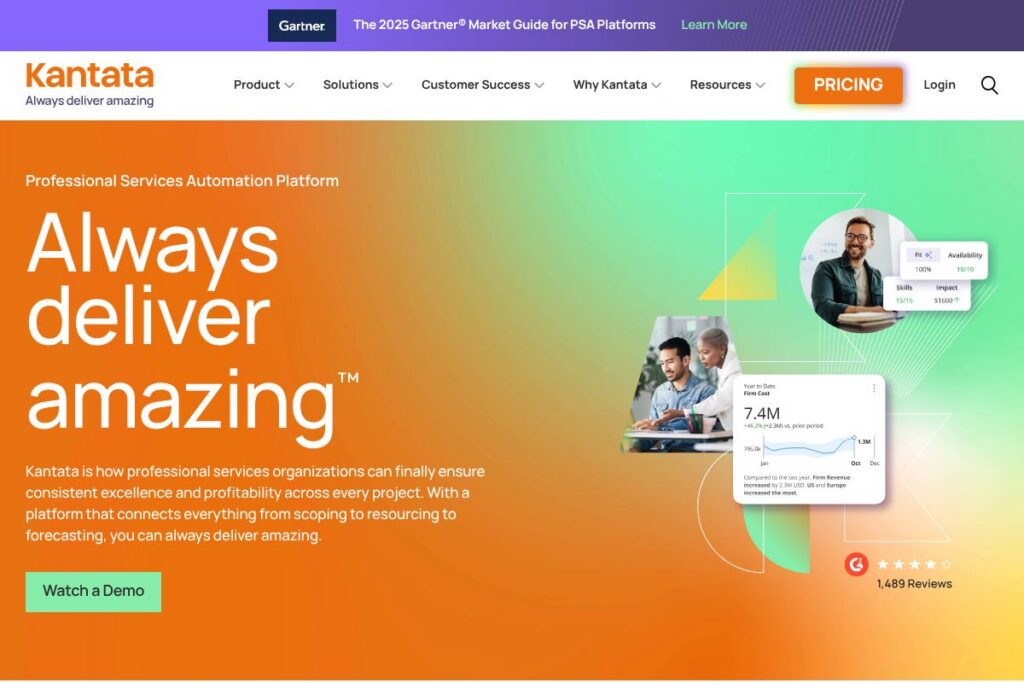

Kantata: An Overview
Kantata is a professional services automation platform built to connect scoping, resourcing, delivery, and financial forecasting in a single environment. It centralizes project definitions, matches skills and availability to scope, captures time and costs, and produces revenue and margin forecasts so services organizations can improve predictability and profitability.
Compared with FinancialForce, which is tightly integrated with Salesforce and emphasizes ERP-style financials, Kantata focuses on services-specific workflows such as resource matching and expertise capture. Against ServiceNow, which targets broad IT workflow automation across enterprises, Kantata concentrates on project delivery economics for professional services teams. Compared to Accelo, which targets smaller consultancies with simpler PSA features, Kantata scales toward mid-market and enterprise firms with deeper forecasting and resource-planning controls.
Kantata excels at connecting operational processes end-to-end, turning past project experience into reusable expertise and clearer margin visibility. It is best suited for professional services organizations, consultancies, and systems integrators that need tighter control of utilization, forecasting, and profitability across many concurrent projects.
How Kantata Works
Kantata starts with the project scope and financial assumptions, capturing deliverables, estimated hours, and target margins. Those inputs feed an expertise and skills model that suggests the best-fit people based on availability, required skills, and utilization targets.
Once teams are assigned, Kantata collects time and expense data, compares actuals to estimates, and updates forecasts continuously so project managers can see margin erosion early. The platform surfaces capacity and demand across the portfolio, letting resource leads optimize bench usage and reassign work to reduce overtime and missed deadlines.
Reporting aggregates pipeline, active work, and utilization into executive-facing dashboards so finance and sales can close planning gaps. Kantata also provides an expertise engine that converts historic delivery outcomes into templates and scoring that speed scoping and improve win rates.
Kantata features
Kantata groups project financials, resource planning, and delivery tools in an AI-enabled PSA platform so teams can scope, staff, and forecast from the same dataset. Recent product positioning emphasizes the expertise engine, resource matching, and portfolio forecasting as core differentiators.
Resource management
Resource matching evaluates skills, availability, scheduling constraints, and utilization targets to suggest ideal team members for a given scope. This reduces bench time and improves utilization by making it easier to staff projects with the right people at the right time.
Expertise engine
The expertise engine captures lessons and outcomes from past projects and surfaces them during scoping and staffing, turning institutional knowledge into reusable IP. That helps teams price more accurately, reduce onboarding time, and replicate successful delivery patterns.
Financial management and forecasting
Financial controls connect estimates, time, and expenses to live forecasts so revenue, margin, and cash flow projections reflect real project progress. Forecasts combine active project performance with pipeline estimates to give a comprehensive view of expected outcomes.
Project scoping and planning
Scoping templates and standardized cost models let delivery and sales create repeatable proposals quickly, with instant visibility into margin and risk. Scopes can be converted to staffed plans that carry the same assumptions into delivery and finance tracking.
Time and expense tracking
Built-in time capture and expense submission link directly to projects and billing codes so actuals update profitability dashboards in near real time. This reduces reconciliation work and keeps project managers informed about budget burn rates.
Analytics and portfolio reporting
Dashboards surface utilization, on-time delivery rates, margin variance, and capacity across the services portfolio so leaders can prioritize initiatives and re-balance work. KPI-driven insights help identify the performance drivers and recommended next steps.
Integrations and API access
Kantata connects with CRM, ERP, collaboration, and identity providers so data flows between sales, finance, and delivery systems. Integration options typically include linking pipeline data, invoicing, and single sign-on to streamline cross-team workflows.
Kantata’s biggest benefit is the link between expertise, resource decisions, and financial forecasts, which reduces surprises and improves the odds of profitable delivery. Teams get a single source of truth that ties scope assumptions to staffing and to actual performance.
Kantata pricing
Kantata uses enterprise-focused subscription pricing with plans and configurations tailored to professional services organizations of different sizes. Pricing is typically customized based on seat counts, modules selected, and deployment or support needs, so public list rates are often not listed.
For current details and to request a quote, view Kantata’s current pricing options. The vendor provides sales-assisted quotes and can discuss bundling resource management, financial forecasting, and expertise features for an organization.
What is Kantata Used For?
Kantata is used to standardize and automate the professional services lifecycle from initial scoping through resource allocation and project financials. Teams use it to turn proposals into staffed projects with transparent margins and to track delivery performance against those assumptions.
Typical use cases include capacity planning to avoid over-commitment, improving utilization rates by better bench management, driving consistent scoping and pricing, and forecasting revenue and margin across active work and pipeline. The platform is aimed at mid-market to enterprise services firms, managed services providers, and large consultancies that deliver time-based services.
Pros and Cons of Kantata
Pros
- End-to-end services coverage: Kantata centralizes scoping, staffing, time capture, and forecasting so organizations can manage project economics in one place without stitching multiple tools together.
- Expertise capture: The platform converts historical delivery knowledge into reusable templates and scoring that speed proposal creation and improve estimate accuracy.
- Resource optimization: Advanced matching and bench visibility help increase utilization and reduce costly bench time, improving revenue per billable head.
Cons
- Enterprise orientation: Kantata is designed for mid-market and larger services organizations, so smaller teams may find the platform more complex and costly than lighter PSA offerings.
- Implementation effort: Deploying end-to-end PSA with integrations to CRM and ERP requires project planning and change management to align processes and data sources.
- Custom pricing model: Lack of public list pricing means procurement requires direct engagement with sales to get a tailored quote and rollout plan.
Does Kantata Offer a Free Trial?
Kantata offers enterprise subscription plans with custom quotes and typically provides demonstrations and trial or pilot options on request. Prospective customers can request a demo or pilot to evaluate functionality against their workflows, with the vendor tailoring access and modules for a proof of concept. To schedule a demo or discuss a proof-of-concept pilot, use Kantata’s request a demo option.
Kantata API and Integrations
Kantata provides integration capabilities to connect CRM, ERP, collaboration, and identity systems so data about pipeline, invoicing, and users flows between sales, finance, and delivery. See the Kantata integration information for typical connectors and options to integrate with existing systems.
The platform also supports developer-focused APIs for automating workflows and synchronizing data across systems; organizations can work with Kantata’s technical resources to access API details and build the necessary integrations.
10 Kantata alternatives
Paid alternatives to Kantata
- FinancialForce — ERP and PSA on the Salesforce platform, strong for organizations that want deep accounting and revenue recognition tied to CRM data.
- ServiceNow — Enterprise workflow and IT service management with PSA modules for organizations that need broad IT and service delivery automation.
- Accelo — Cloud PSA built for smaller professional services firms with integrated CRM, project, and billing features.
- ConnectWise PSA — Popular among technology service providers and MSPs for ticketing, project management, and billing workflows.
- Deltek — Project-based ERP and PSA targeting professional services and government contractors with strong project accounting capabilities.
- Mavenlink — A PSA platform focused on resource planning and financial controls for service businesses, now part of the broader Kantata product history and direction.
Open source alternatives to Kantata
- OpenProject — An open source project management system with planning and tracking features that can be adapted for services delivery workflows.
- Redmine — Flexible project tracker and issue management platform that teams can extend for basic time tracking and project coordination.
- ERPNext — Open source ERP that includes project and timesheet modules and can serve small services teams that can self-host and customize the system.
- Odoo (Community) — The community edition of Odoo includes project and timesheet apps and is often used by small consulting firms willing to configure open source modules.
Frequently asked questions about Kantata
What is Kantata used for?
Kantata is used for professional services automation, linking scoping, resourcing, time capture, and forecasting. Teams use it to improve utilization, increase on-time delivery, and produce reliable margin forecasts across their project portfolios.
Does Kantata integrate with Salesforce and ERP systems?
Yes, Kantata integrates with CRM and ERP systems through native connectors and APIs. Organizations commonly connect pipeline data and invoicing systems so forecasting and revenue recognition flow across sales and finance teams.
How much does Kantata cost?
Kantata offers enterprise-tailored pricing rather than a public list rate. Pricing depends on the modules required, number of users, and integration or deployment needs, so you should request a quote via Kantata’s current pricing options.
Can Kantata help with resource forecasting?
Yes, Kantata includes resource planning and forecasting capabilities that combine active projects, bench data, and pipeline to model capacity and utilization. That makes it easier to plan hires, allocate contractors, or rebalance project assignments.
Does Kantata provide an API for automation?
Kantata provides API access and integration options for automating workflows and syncing data with other systems. Development teams can request API documentation and integration guidance through Kantata’s integration information.
Final Verdict: Kantata
Kantata stands out for linking project scoping, resource matching, and financial forecasting in a single PSA platform so professional services organizations can reduce surprises and improve profitability. Its expertise engine and focus on utilization and margin visibility make it well suited to mid-market and enterprise services firms that run multiple complex engagements simultaneously.
Compared to FinancialForce, which offers strong ERP-level financial controls within the Salesforce ecosystem, Kantata focuses more narrowly on services delivery patterns and resource optimization while also supporting financial forecasting. Both are enterprise offerings that require sales engagement for pricing; however, Kantata’s emphasis on resource intelligence and scoping templates makes it a compelling choice where predictable delivery and utilization are top priorities.