PayPal Enterprise Payments: An Overview
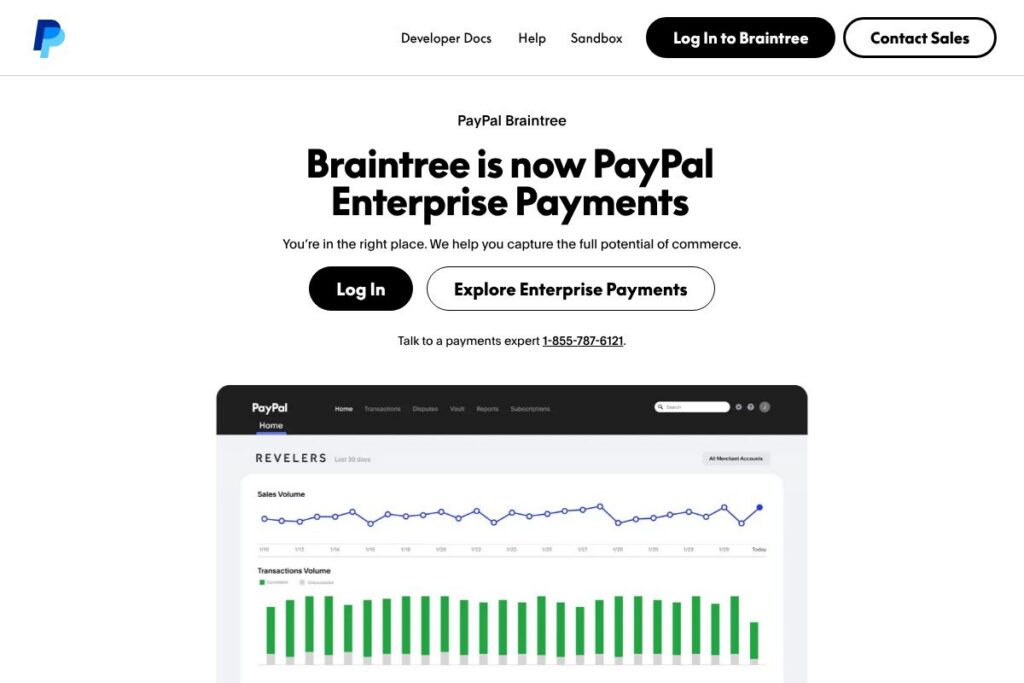
PayPal Enterprise Payments is the enterprise evolution of Braintree, packaged as a single global payments platform for merchants and marketplaces. It combines card and digital wallet acceptance, localized payment methods, payouts to partners and sellers, and fraud management into a single integration that scales across markets. The platform emphasizes a unified data model so merchant transactions, payouts, and risk signals are available for orchestration and analytics.
Compared with Stripe, PayPal Enterprise Payments brings tighter native links to PayPal and Venmo checkout experiences and broader access to PayPal-branded checkout flows. Compared with Adyen, it offers deeper integration with consumer-facing PayPal and Pay Later options, while Adyen may be preferable for merchants needing very granular acquiring flexibility in certain local markets. Against Square, PayPal Enterprise Payments is more focused on large-scale global online and marketplace payments rather than in-person point-of-sale ecosystems.
All of this makes PayPal Enterprise Payments especially suited to large merchants, marketplaces, and platforms that need global reach, built-in payouts, and the option to surface PayPal and Venmo as customer payment choices. It is built for teams that require developer tools and an enterprise sales relationship for onboarding and pricing.
How PayPal Enterprise Payments Works
Integration starts with server-side SDKs and client-side SDKs that accept card details, PayPal, or wallet payments and tokenize payment instruments for later use. Tokenization and a hosted fields approach reduce PCI scope while letting merchants store instruments in a secure vault for subscriptions and one-click checkout.
Payment routing and orchestration let merchants send transactions to different processors or to PayPal processing based on rules, while built-in fraud signals and adaptive risk management feed authorization decisions. For marketplaces, the platform supports managed payouts to sellers and partners, with a single provider handling settlement across hundreds of currencies and markets.
Developers typically begin in a sandbox environment to test flows end to end, then apply for a production merchant account and configure webhooks, reconciliation exports, and payout rails during onboarding. The platform exposes APIs for payment acceptance, vault management, dispute handling, and payouts so merchant backends can automate reconciliation and lifecycle events.
PayPal Enterprise Payments features
The platform groups payments acceptance, risk, and payouts under a single integration. Core capabilities include multi-method acceptance (cards, PayPal, Venmo, local wallets), an adaptive fraud stack, global payout rails, and developer tooling including SDKs and a sandbox. Recent updates emphasize orchestration, expanded payout markets, and tighter PayPal checkout integration.
Global payment acceptance
Accept cards, PayPal, Venmo, and a growing set of localized methods through one integration. The unified acceptance layer simplifies local compliance and helps merchants offer familiar payment methods in each market to reduce checkout friction.
Tokenization and vaulting
Securely store customer payment instruments in the platform vault to enable subscriptions, saved-card checkout, and charge retries. Vaulting reduces PCI scope and supports payment method lifecycle actions such as card updates and expirations.
Orchestration and routing
Route transactions to different processors, apply business rules for payment routing, and use orchestration to optimize authorization rates and costs. This capability supports complex setups like splitting volume across acquirers or favoring certain processors by country.
Adaptive fraud management
Leverage a suite of fraud controls and risk tooling that combine machine learning signals with rule-based filters to reduce chargebacks and false declines. Merchants can tune rules, review alerts, and integrate decisioning into their order workflows.
Payouts and marketplace support
Send fast, reliable payouts to sellers, gig workers, and vendors across more than 200 markets in 50+ currencies using a single provider. The payouts feature supports marketplace flows, mass payments, and reconciliation exports for accounting.
Developer tooling and sandbox
A documented API surface, server and client SDKs, SDK examples, and a sandbox environment let engineering teams validate flows before going live. The developer experience includes guides for web, mobile, and server implementations and webhook management.
With these capabilities combined, the primary benefit is a single platform that covers acceptance, risk, and disbursement needs for global commerce operations, reducing integration overhead while preserving flexibility for enterprise teams.
PayPal Enterprise Payments pricing
PayPal Enterprise Payments uses a custom, enterprise pricing model tailored to merchant size, transaction volume, payment methods, and payout needs. Pricing for large merchants typically combines processing rates, interchange pass-through, and volume-based discounts rather than a simple fixed monthly plan.
Enterprise
Enterprise – Custom pricing based on transaction mix, volume, risk profile, and required features such as payouts, fraud tools, and contract terms. For exact rates and a quote, contact sales or review the platform details on PayPal’s enterprise pages. Visit the enterprise payments overview or get in touch with a payments specialist via the contact options for enterprise customers.
What is PayPal Enterprise Payments Used For?
Large e-commerce merchants and marketplaces use the platform to accept payments from customers around the world while managing payouts to sellers or partners. It is particularly useful when businesses want a single provider to handle acceptance, fraud prevention, and cross-border disbursements.
Companies also use it to add PayPal, Pay Later, and Venmo as checkout options to increase conversion by matching consumer preferences. Platform businesses that need to automate mass payouts and reconcile settlements across currencies find the built-in payouts and reporting useful.
Pros and Cons of PayPal Enterprise Payments
Pros
- Broad payment coverage: Supports cards, PayPal, Venmo, Pay Later, and many local methods, helping merchants meet customers where they pay. This reduces checkout friction in multiple regions.
- Integrated payouts and marketplace features: Built-in tools for mass payouts and marketplace flows simplify paying sellers, gig workers, and vendors at scale. It reduces the need to stitch multiple providers together.
- Enterprise-grade fraud and compliance tooling: Adaptive fraud management and PCI-reducing tokenization help lower risk and streamline compliance processes.
Cons
- Custom pricing and onboarding: Enterprise focus means pricing and onboarding are typically negotiated, which can be slower than signing up for a self-serve processor. Smaller businesses may prefer transparent, self-serve pricing instead.
- Less granular acquiring flexibility: Merchants that require specific acquiring relationships in individual countries may find other processors like Adyen or Stripe offer more fine-grained acquiring control in some markets.
Does PayPal Enterprise Payments Offer a Free Trial?
PayPal Enterprise Payments provides a free Sandbox environment for testing integrations. Developers and merchants can use the sandbox to simulate transactions, test SDKs, and validate webhooks before applying for a production merchant account; production onboarding and pricing require contacting sales.
PayPal Enterprise Payments API and Integrations
The platform provides a developer API and server and client SDKs for common languages and platforms; the developer documentation describes endpoints for payments, vaulting, webhooks, dispute management, and payouts. Webhook and reporting endpoints support reconciliation and lifecycle automation.
Key integrations include major e-commerce platforms, order management systems, and fraud tools. For technical teams, the SDKs and sandbox environment are the primary starting points for integration and testing; see the sandbox overview for setup guidance.
10 PayPal Enterprise Payments alternatives
Paid alternatives to PayPal Enterprise Payments
- Stripe — A developer-first payments platform with broad global coverage, modular APIs for payments and payouts, and transparent pricing favored by many internet-first companies.
- Adyen — An enterprise payments processor known for direct acquiring relationships in many markets and consolidated reconciliation across acquirers and methods.
- Square — Strong in integrated in-person and online commerce, with hardware and POS-focused services as well as online payments and invoicing.
- Checkout.com — A payments provider focused on global online acceptance and detailed data to optimize authorization rates and routing.
- Worldpay — A long-established global processor offering a broad set of acquiring and merchant services for large enterprises.
- Authorize.Net — A payments gateway favored by businesses that need a gateway layer on top of existing merchant accounts.
Open source alternatives to PayPal Enterprise Payments
- Kill Bill — An open-source billing and payments orchestration platform that helps companies manage subscriptions, invoicing, and plugin-based payment integrations.
- Solidus — An open-source e-commerce platform built for flexibility that can integrate with multiple payment gateways and payment providers.
- Spree Commerce — A modular open-source e-commerce platform with integrations to common payment gateways and customization for enterprise needs.
- Apache OFBiz — An open-source suite that includes e-commerce and financial components which can be extended to support payment workflows.
Frequently asked questions about PayPal Enterprise Payments
What is PayPal Enterprise Payments?
PayPal Enterprise Payments is an enterprise payments platform that combines payment acceptance, fraud management, and payouts. It provides a unified integration for cards, PayPal, Venmo, local methods, and mass disbursements.
Does PayPal Enterprise Payments have an API for developers?
Yes, PayPal Enterprise Payments offers APIs and SDKs. The developer documentation provides guides and reference material for payments, vaulting, webhooks, and payouts.
How much does PayPal Enterprise Payments cost?
PayPal Enterprise Payments uses custom, enterprise pricing. Costs depend on transaction volume, payment methods, and required services; contact sales or view the enterprise overview for tailored pricing information.
Can PayPal Enterprise Payments handle payouts to sellers worldwide?
Yes, the platform supports payouts to 200+ markets in 50+ currencies. Built-in payout rails and reconciliation tools simplify mass payments for marketplaces and platforms.
Is there a sandbox to test PayPal Enterprise Payments?
Yes, a free Sandbox environment is available for testing integrations. Developers can validate payment flows, SDKs, and webhooks before moving to production; see the sandbox documentation to get started.
Final Verdict: PayPal Enterprise Payments
PayPal Enterprise Payments stands out as a comprehensive, enterprise-focused platform that bundles acceptance, fraud controls, and payer disbursement capabilities under a single integration. Its native support for PayPal and Venmo, combined with global payouts, makes it a strong choice for large merchants and marketplaces that need both consumer-facing checkout options and back-end settlement capabilities.
Compared with Stripe, which offers transparent self-serve pricing and very developer-centric tooling, PayPal Enterprise Payments emphasizes enterprise onboarding and integrated PayPal consumer flows. For businesses that prioritize access to PayPal-branded checkout, built-in mass payouts, and a one-provider approach to acceptance and disbursement, PayPal Enterprise Payments is a compelling option; for teams that want self-serve pricing and maximal routing flexibility, Stripe may be preferable.