
Prophix: An Overview
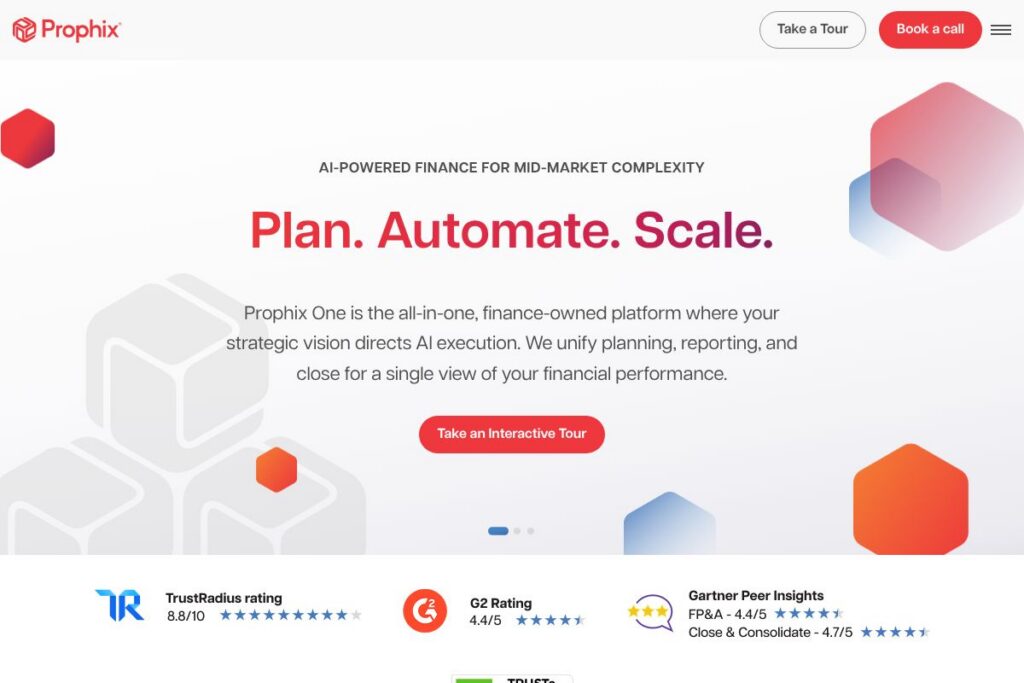
Prophix is a corporate performance management (CPM) platform built for finance teams that need to manage budgeting, forecasting, consolidation, and reporting at mid-market complexity. The platform, marketed as Prophix One, brings planning, close, and reporting into a single finance-owned environment with driver-based models, automated workflows, audit trails, and AI-assisted insights. See a live walkthrough via the Prophix One demo to observe model navigation, reporting, and AI explanations in action.
Compared with enterprise planning suites, Prophix targets mid-market organizations that require multi-entity consolidation and automated reconciliation without heavyweight implementation overhead. Against Anaplan, Prophix is more packaged for finance teams and often faster to implement for standard FP&A workflows. Compared with Workday Adaptive Planning, Prophix emphasizes consolidation and audit traceability alongside planning, while Oracle Hyperion serves larger, complex ERP landscapes where deep customization and scale are the priority.
Prophix does particularly well at unifying actuals, plans, and forecasts for faster decision making, and at automating reconciliation and close tasks so finance can focus on analysis rather than manual processes. This makes it a strong fit for mid-market and growing enterprises that require audit-ready consolidation, driver-based planning, and AI-assisted variance explanation without extensive custom development.
How Prophix works
Finance teams build structured, driver-based models in Prophix to map operational drivers to financial outcomes and to centralize data across ERP, GL, and operational sources. Models can ingest large volumes of actuals and plan data, and they support multi-currency, multi-GAAP, and multi-entity consolidations for standard close processes.
Automated workflows collect budget inputs from stakeholders, route approvals based on role, and apply reconciliation logic during close. AI agents and built-in automation reduce manual tasks such as intercompany matching, balance reconciliation, and variance explanation, while audit trails provide traceability for every adjustment.
Reporting is generated directly from the same financial models so board-ready reports, dashboards, and transaction-level drill downs remain synchronized with plans and consolidated results. Teams typically use Prophix for periodic budgeting cycles, rolling forecasts, and month-end close, integrating outputs with BI tools or exporting to Excel when required.
What does Prophix do?
Prophix groups planning, consolidation, reconciliation, and reporting in a single platform so finance teams can reduce cycle times and maintain a single source of truth for performance. Recent product messaging highlights expanded AI agents, autonomous finance capabilities, and deeper reconciliation automation to shrink close windows and improve accuracy.
Let’s talk Prophix’s Features
Financial Planning & Analysis
The platform supports driver-based budgeting, rolling forecasts, and what-if scenario modeling, enabling finance to model outcomes across departments and entities. These capabilities let teams run multiple forecast scenarios quickly and compare actuals to plan for informed decision making.
Close & Consolidation
Pre-built consolidation logic handles eliminations, currency conversion, and multi-GAAP adjustments so teams can consolidate results faster and with fewer manual journals. Role-based approvals and built-in traceability make the closing process auditable and transparent.
Reporting & Analytics
Report creation is model-driven, letting users produce board-ready packs, operational dashboards, and ad hoc reports without rebuilding data flows. Drill-down to transaction-level details supports root-cause analysis and feeds into AI-generated variance explanations.
Financial Reconciliation Automation
Automated matching and reconciliation reduce manual ledger work by pairing GL and intercompany balances, flagging timing errors and exceptions for review. The automation accelerates the reconciliation cycle and lowers the risk of missed adjustments during close.
AI Agents and Autonomous Finance
Platform-level AI assists with tasks such as budget collection, variance analysis, and suggested adjustments by surfacing explainable insights and recommended next steps. These autonomous agents free finance staff from repetitive tasks so they can focus on higher-value analysis.
Driver-based Modeling and Excel Integration
Prophix lets teams preserve Excel where it provides value while moving calculations and consolidation into structured models when Excel becomes a risk. Integration points and import/export capabilities smooth the transition for organizations that rely on spreadsheets.
Audit Trail and Compliance
Every change, approval, and adjustment is recorded with role-based approvals and traceable workflows so financial data remains audit-ready. This is useful for internal controls, external audits, and maintaining compliance across multiple accounting standards.
With Prophix you get a unified CPM solution that reduces manual effort in planning and close, provides explainable AI insights, and produces consolidated, audit-ready financial statements. The platform’s biggest benefit is centralizing planning and reporting on one finance-owned data model to preserve consistency and speed in decision making.
Prophix pricing
Prophix uses an enterprise software pricing model with custom subscriptions tailored to organization size, number of entities, deployment options, and required modules. Licensing and implementation costs vary by scope, and the vendor typically provides quotes based on functional requirements rather than published per-user rates.
For specific plan options and to request an estimate, view Prophix’s current pricing options and contact pathways to discuss deployment, licensing, and support packages with sales.
What is Prophix used for?
Prophix is commonly used for annual budgeting, rolling forecasts, and scenario planning where finance needs to align operational drivers with financial outcomes. Teams using Prophix run scenario comparisons, sensitivity analyses, and long-range plans that feed directly into consolidated financial statements.
It is also used to accelerate month-end close and consolidation cycles by automating intercompany eliminations, currency translation, and reconciliation tasks. Reporting teams use Prophix to prepare board packs, regulatory reports, and operational dashboards with traceable numbers and transaction-level drill downs.
Ideal users include finance leaders at mid-market companies and growing enterprises that require centralized FP&A, audit-ready consolidation, and automation to scale reporting without proportional headcount increases.
Pros and Cons of Prophix
Pros
- Comprehensive CPM functionality: Prophix combines budgeting, forecasting, consolidation, reconciliation, and reporting into one finance-owned platform, reducing fragmentation between tools.
- Strong reconciliation and close automation: Automated matching and reconciliation lower manual effort and risk during month-end close, improving both speed and accuracy.
- Explainable AI and variance insights: AI-generated explanations help finance teams understand drivers behind variances and suggest next steps, which supports faster decision making.
- Audit-ready controls: Built-in audit trails, role-based approvals, and traceability support internal controls and external audit requirements.
Cons
- Enterprise-oriented pricing and procurement: Custom pricing and implementation timelines can be a barrier for very small organizations or teams with constrained budgets.
- Implementation complexity for highly custom environments: Organizations with very bespoke ERP landscapes may require more integration work and professional services to achieve full automation.
- Learning curve for power users: Finance teams migrating from spreadsheets may need process redesign and training to adopt structured modeling effectively.
Does Prophix Offer a Free Trial?
Prophix offers demo and trial options rather than a permanent free plan. Prospective customers can request a tailored demo of Prophix One, attend product webinars, or join events such as Prophix Live! to evaluate capabilities before purchase; request a demo or trial through the Prophix One demo page.
Prophix API and Integrations
Prophix provides integration options for common source systems and BI tools so data can flow into models and reports from ERPs, data warehouses, and spreadsheets. Check Prophix’s integration options for connectors to systems like NetSuite, SAP, Oracle, and common BI platforms.
For automation and developer workflows, the vendor documents available connectivity and APIs in their technical resources; explore the API and developer documentation or contact the Prophix team to confirm supported endpoints and integration patterns.
10 Prophix alternatives
Paid alternatives to Prophix
- Anaplan — Connected planning for large-scale scenario modeling and workforce or supply chain planning across complex organizations.
- Workday Adaptive Planning — Cloud-native FP&A with strong budgeting and forecasting features and deep integration into Workday HCM and financial suites.
- Oracle Hyperion — Enterprise consolidation and close suite for organizations requiring high customization and global accounting complexity.
- SAP BPC — Planning and consolidation tightly integrated with SAP ERP environments for large enterprises.
- Vena Solutions — Spreadsheet-led planning with a central data model and workflow engine aimed at finance teams that prefer Excel-driven input.
- BlackLine — Focused on automation of reconciliation and close tasks, often paired with a separate planning tool for budgeting and forecasting.
- Board — Integrated decision-making platform with planning, BI, and analytics capabilities for finance and operations.
Open source alternatives to Prophix
- ERPNext — Open source ERP with accounting and budgeting modules that cover basic planning and consolidation scenarios for smaller organizations.
- Odoo — Modular open source suite with accounting and reporting apps that can be combined for planning and financial consolidation in simpler environments.
- Apache Superset — Open source analytics and dashboarding platform used for financial reporting and visualization paired with external planning models.
- Metabase — Lightweight open source BI tool for creating dashboards and reports from centralized data sources as part of a DIY CPM stack.
Frequently asked questions about Prophix
What is Prophix used for?
Prophix is used for budgeting, forecasting, consolidation, reconciliation, and financial reporting. Finance teams use it to centralize models, automate close tasks, and produce audit-ready reports.
Does Prophix integrate with ERP systems like NetSuite or SAP?
Yes, Prophix integrates with major ERP systems and BI tools. The platform offers connectors and integration options to bring actuals and operational data into planning models; see the integration options for specifics.
Can Prophix automate financial reconciliations?
Yes, Prophix includes reconciliation automation capabilities. Automated matching and exception detection reduce manual ledger reconciliation and accelerate the close process.
How does Prophix use AI in finance workflows?
Prophix uses AI agents to assist with variance analysis, suggested adjustments, and task automation. Explainable AI outputs provide natural-language explanations and recommended actions tied to the financial model.
Is Prophix suitable for multi-entity consolidation?
Yes, Prophix supports multi-entity, multi-currency, and multi-GAAP consolidation. It includes eliminations, currency translation, and audit trails needed for group reporting across jurisdictions.
Final verdict: Prophix
Prophix offers a focused CPM platform for mid-market finance teams that need to centralize planning, consolidation, reconciliation, and reporting within one finance-owned model. Its strengths are reconciliation automation, audit-ready consolidation, and AI-assisted variance insights that reduce manual work and improve the speed and reliability of financial close and forecasting cycles.
Compared with Workday Adaptive Planning, Prophix prioritizes consolidated close capabilities and traceability in addition to planning; Workday Adaptive Planning has strong planning usability and tight Workday ecosystem integration. Pricing for both platforms is typically enterprise and custom, so organizations should compare functional fit, implementation approach, and total cost of ownership by requesting tailored quotes from each vendor via Prophix’s contact page or the competitor’s sales channels.
Overall, Prophix is a practical choice for companies that want a single, finance-controlled platform to shorten budget cycles, automate reconciliation, and deliver auditable reports without building a large custom solution.