What is Salesforce
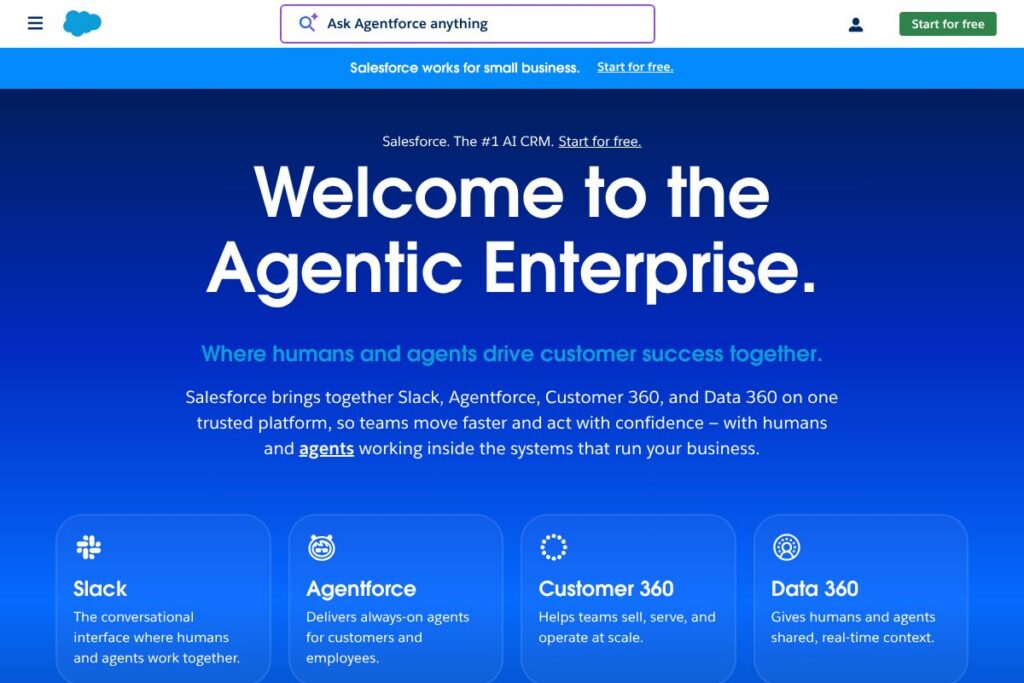
Salesforce is a cloud CRM and platform focused on bringing customer data, automation, and AI together so teams can manage the full customer lifecycle from lead to service. The platform groups core capability areas such as Sales Cloud, Service Cloud, Marketing Cloud, Customer 360, and an agentic AI layer called Agentforce to automate tasks and surface recommendations across workflows. Salesforce also integrates Slack, data services, and analytics into a single environment so teams can act on the same customer record in real time.
Compared with competitors, Salesforce emphasizes breadth and extensibility. Microsoft Dynamics 365 is often chosen for tight integration with Microsoft 365 and on-premises enterprise requirements, while SAP Customer Experience targets complex B2B commerce and backend ERP integration. HubSpot CRM is more prescriptive and easier to adopt for small marketing-led teams, but lacks the same depth of enterprise customization and industry solutions that Salesforce provides.
All of this makes Salesforce particularly strong for organizations that need a single platform to unify data, automation, and industry-specific processes at scale. It is well suited for large enterprises and growing mid-market companies that plan to customize workflows, embed AI agents into operations, and connect multiple systems across the organization.
How Salesforce Works
Salesforce runs as a cloud-native platform where customer records and metadata are stored in a central Customer 360 profile that feeds applications for sales, service, marketing, commerce, and analytics. Administrators and developers map data sources into Customer 360, then configure flows, automation, and agentic AI behaviors so that records, predictions, and actions are synchronized across apps.
Teams interact with Salesforce through industry apps, the web UI, mobile apps, and integrated collaboration in Slack; AI agents can surface suggested actions, draft messages, or autonomously resolve cases within configured guardrails. Common workflows include automatic lead scoring and assignment, case deflection with conversational agents, cross-channel campaign orchestration, and reporting driven by unified data from Data 360.
What does Salesforce do?
Salesforce combines CRM apps, data management, and an agentic AI layer to help teams find leads, close deals, resolve support issues, and personalize customer journeys. Recent focus areas include Agentforce conversational AI, deeper Slack collaboration features, industry-specific Agentforce solutions, and expanded Data 360 capabilities for governance and analytics. The platform is designed to let teams start with core CRM capabilities then extend into AI, automation, and custom apps as needs evolve.
Salesforce’s Core Capabilities:
Agentforce (agentic AI)
Agentforce provides autonomous and assisted AI agents that can handle multi-step tasks such as lead qualification, conversational case resolution, and automated follow-ups. It integrates with Customer 360 so agents use real-time customer context, reducing repetitive work for humans and improving response times for customers. Organizations use Agentforce to increase case deflection, accelerate pipeline velocity, and standardize decision-making across teams.
Customer 360
Customer 360 creates a unified customer profile by stitching together data from sales, service, marketing, commerce, and third-party systems so teams see a single view of interactions and transactions. That shared profile enables consistent personalization, accurate reporting, and coordinated actions across departments. It is the primary foundation for cross-channel campaigns and AI-driven recommendations.
Data 360 and analytics
Data 360 centralizes data management, governance, and analytics to provide trusted inputs for AI models and reporting. It includes tools for data integration, cleansing, and lineage so organizations maintain compliance and reduce data silos. Teams use Data 360 to feed dashboards, predictive models, and operational automation with governed datasets.
Sales Cloud
Sales Cloud provides lead and opportunity management, pipeline visualization, quoting tools, and sales performance analytics tailored for field and inside sales teams. It supports automation for lead assignment, workflow approvals, and forecasting, helping sales teams focus on high-value activities. Integrations with CPQ and ERP systems streamline quote-to-cash processes.
Service Cloud and omnichannel support
Service Cloud offers case management, knowledge bases, omnichannel routing, and conversational support workflows that combine human agents and AI. Features like automated case classification and agent assist reduce average handle time and improve first-contact resolution rates. Service teams can also use AI agents to resolve common inquiries without human intervention.
Marketing Cloud and personalization
Marketing Cloud enables cross-channel campaign orchestration, journey building, and real-time personalization using customer data and AI-driven segmentation. Marketers can automate email, mobile, advertising, and web experiences while measuring attribution across channels. The platform also supports content experimentation and audience orchestration for targeted outreach.
Slack integration and collaboration
Slack is embedded to connect customer context to real-time team collaboration, enabling deal huddles, case escalations, and cross-functional approvals without leaving the messaging environment. Notifications, record previews, and workflows can be triggered from Slack so work moves faster and visibility is preserved. This reduces context switching between collaboration and operational systems.
AppExchange and extensibility
AppExchange provides a marketplace for prebuilt integrations, industry solutions, and components that extend Salesforce capabilities without heavy custom development. Developers also build custom apps on the Salesforce Platform using low-code tools or Apex and Lightning components for full control. This extensibility helps accelerate time to value for industry-specific processes.
Security, trust, and governance
Salesforce includes enterprise-grade security controls, compliance certifications, and administrative governance tools to manage access, encryption, and model behavior. Features for identity, SSO, and audit logging support enterprise security requirements. Built-in governance helps organizations deploy AI while maintaining oversight and regulatory compliance.
With this set of features, Salesforce’s biggest benefit is its ability to unify customer data and automation across an entire organization, enabling consistent experience and operational scale. The platform’s extensibility and industry packs let teams adopt core functionality quickly while layering in advanced AI and integrations as they grow.
Salesforce pricing
Salesforce uses a subscription pricing model with plans that scale from small business suites to enterprise deployments, plus custom enterprise agreements for large organizations. The platform offers specific starter options for small businesses and portfolio pricing for broader suites and add-ons, with enterprise contracts typically negotiated with sales.
Monthly Billing:
Starter Suite – $25 USD/user/month (all-in-one CRM for small business with built-in AI for sales, service, and marketing)
Enterprise and Unlimited – Custom monthly pricing (expanded features, API limits, and enterprise services) – contact sales for details
Annual Billing:
Starter Suite – $25 USD/user/month billed monthly as a baseline offering; annual billing options are available through sales agreements for volume discounts and bundled services
Enterprise
Enterprise – Custom pricing (full platform, advanced governance, Agentforce at scale, and premium support) – large customers typically sign enterprise agreements that include implementation and support services
For precise plan details and the latest options, view Salesforce’s products and editions or consult Starter Suite information. For enterprise needs, check the salesforce enterprise solutions pages or contact a Salesforce representative.
What is Salesforce Used For?
Salesforce is used to manage sales pipelines, customer service operations, marketing campaigns, and e-commerce transactions while keeping a single customer profile across channels. Teams rely on it for lead management, case routing, campaign personalization, and consolidated reporting to measure revenue and service metrics.
It is also used to automate routine processes with AI and workflow rules, build custom industry applications, and centralize governance for data and AI behavior. Companies adopt Salesforce when they need a platform that supports complex integrations, multi-team collaboration, and the ability to scale AI-driven automation across customer touchpoints.
Pros and Cons of Salesforce
Pros
- Unified customer profile: The single Customer 360 profile ensures sales, service, and marketing teams work from the same data, reducing duplication and improving personalization.
- Extensive ecosystem: AppExchange and a large partner network provide prebuilt integrations and industry solutions to accelerate deployment and extend value.
- Agentic AI capabilities: Agentforce enables conversational automation and multistep task automation that can increase case deflection and pipeline conversion when configured correctly.
- Enterprise-grade security: Robust compliance, identity, and governance tools support large organizations with strict regulatory requirements.
Cons
- Cost for full platform: Moving beyond starter tiers to enterprise-scale usage, customization, and AI at scale can become expensive and often requires negotiated contracts and implementation budgets.
- Complexity for small teams: The breadth of features and customization options can be overwhelming for very small teams without dedicated admins or consultants.
- Implementation overhead: Achieving deep integrations and industry-specific flows frequently requires professional services or partner help, which adds to time and cost.
Does Salesforce Offer a Free Trial?
Salesforce offers a free 30-day trial and demo options, and Starter Suite is available for small businesses starting at a per-user subscription. The trial provides hands-on access to core CRM capabilities and agentic features with no installation required; you can also request a guided demo to evaluate industry solutions and Agentforce workflows.
Salesforce API and Integrations
Salesforce provides extensive developer APIs and a developer platform for building integrations, automations, and custom applications; the Salesforce Developer documentation details REST, SOAP, Apex, and platform events. Key integrations include Slack, MuleSoft, Tableau, common ERP systems, and major cloud providers, enabling data flow between marketing, commerce, and backend systems.
For teams automating workflows, prebuilt connectors and the AppExchange reduce development time, while the platform APIs support high-volume integration and event-driven architectures for mission-critical systems.
10 Salesforce alternatives
Paid alternatives to Salesforce
- Microsoft Dynamics 365 – Deep integration with Microsoft 365 and Azure, favored by enterprises with Microsoft-centric stacks for sales, service, and ERP alignment.
- SAP Customer Experience – Strong in B2B commerce and complex order-to-cash processes with direct ties to SAP ERP systems.
- Oracle CX – Enterprise-grade CRM and commerce suites with a focus on large-scale deployments and integrated data services within the Oracle ecosystem.
- HubSpot CRM – Easier to adopt for marketing-led teams with a free tier and modular paid hubs for marketing, sales, and service.
- Zendesk – Primarily focused on customer service, with simple ticketing, self-service, and support analytics for mid-market and enterprise teams.
- Zoho CRM – Cost-effective CRM with a broad app suite and flexible customization for small and midsize businesses.
Open source alternatives to Salesforce
- SuiteCRM – Community-driven CRM that offers sales, service, and marketing modules plus the ability to self-host and customize workflows.
- Odoo (Community edition) – ERP and CRM combined, with modular apps for CRM, sales, and e-commerce that can be self-hosted and extended.
- EspoCRM – Lightweight, open source CRM focused on core sales and service features with APIs for integration.
Frequently asked questions about Salesforce
What is Salesforce used for?
Salesforce is used to manage customer relationships across sales, service, marketing, and commerce. Organizations use it to centralize customer data, automate workflows, and coordinate cross-channel engagement.
Does Salesforce have an API?
Yes, Salesforce provides a comprehensive set of developer APIs and platform tools. The Salesforce Developer documentation covers REST, SOAP, Apex, platform events, and tooling for building integrations and apps.
How much does Salesforce cost?
Salesforce offers subscription pricing with starter plans and custom enterprise agreements. Starter Suite is listed at $25 USD/user/month, while larger deployments and add-ons are priced through enterprise agreements and sales consultations.
Can small businesses use Salesforce?
Yes, small businesses can start with Starter Suite or a trial to access core CRM and AI features. Starter options are designed to provide an all-in-one baseline for sales, service, and marketing before scaling to broader platform capabilities.
What is Agentforce in Salesforce?
Agentforce is Salesforce’s agentic AI layer for conversational automation and autonomous task execution. It is used to qualify leads, automate case resolution, and assist agents by acting on multistep workflows using Customer 360 data.
Final verdict: Salesforce
Salesforce stands out as a comprehensive CRM and platform that unifies customer data, AI, and applications for organizations that need enterprise-scale automation and extensibility. Its strengths are breadth, industry-ready solutions, deep customization, and agentic AI that can materially reduce manual work across sales, service, and marketing.
Compared to HubSpot CRM, Salesforce offers deeper enterprise configuration and industry solutions but typically requires a larger investment in licensing and implementation; HubSpot provides a lower-cost, easier-to-adopt path for small teams with its free tier and modular paid hubs. For organizations that need a single system to govern data and AI across many departments, Salesforce remains a leading choice, while smaller teams or inbound-marketing-led companies may find competitor offerings easier to start with.