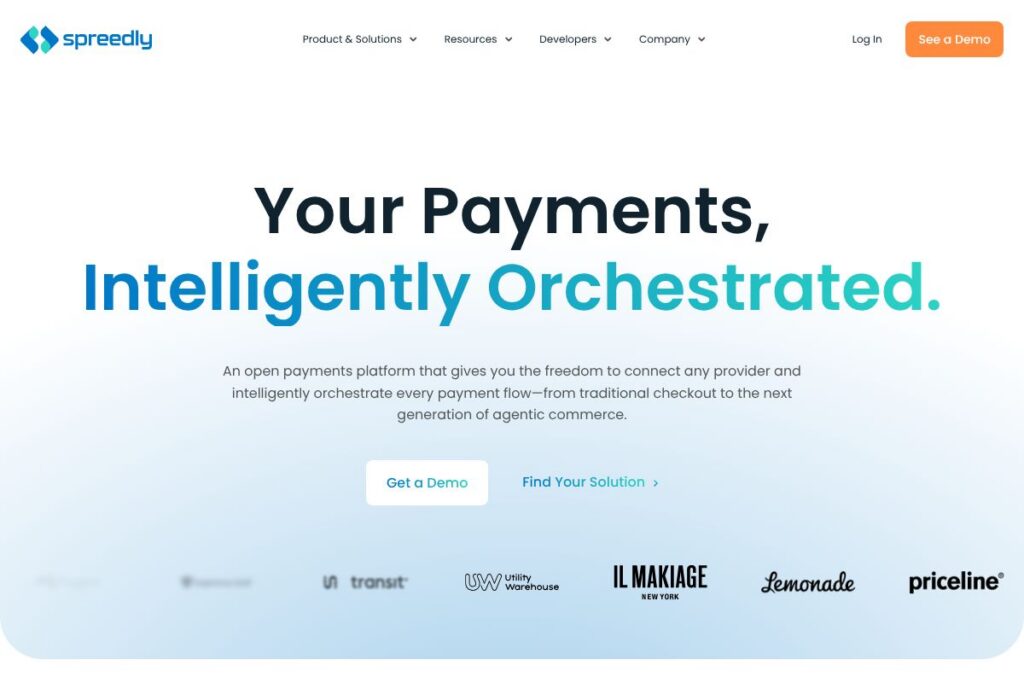

Spreedly: An Overview
Spreedly is a payments orchestration platform that centralizes connectivity to multiple payment gateways, digital wallets, and fraud vendors through a single API. The platform lets payments teams manage payment methods in a vault, apply routing logic and failover, run fraud and authentication workflows, and view unified reporting for authorization performance and reconciliation.
Compared with direct gateway integrations, Spreedly reduces engineering work required to support multiple payment methods and geographic providers. Compared with integrated processors like Stripe and Braintree, Spreedly focuses on neutral orchestration rather than payment processing, enabling you to switch or add gateways without reworking checkout flows. Against full-service global processors such as Adyen, Spreedly is lighter weight for teams that want to build a custom payments stack rather than adopt a single processor platform.
Spreedly does particularly well at multi-provider connectivity and secure tokenization for teams that operate across regions or need a modular payments architecture. Its feature set and API are aimed at payments managers, routing specialists, and payments engineers who need visibility into approval rates, granular routing controls, and a simpler integration surface for many payment partners. For more on capabilities and technical details, see the Spreedly website and the Spreedly API documentation.
How Spreedly Works
Spreedly provides a single API layer that sits between your checkout and the payment providers you choose. You send payment credentials to Spreedly, which securely vaults payment methods and returns a token you use for subsequent transactions, avoiding direct PCI scope for your systems.
Routing and optimization are handled by rules you configure; Spreedly will route authorizations to primary gateways and automatically failover to backups when a provider is down or performing poorly. Fraud checks and 3DS authentication can be orchestrated as part of the transaction flow so that risk and authorization decisions happen before the final capture step.
Operational workflows include unified reporting and reconciliation, transaction search and replay tools, and dashboards for approval-rate monitoring. Engineers use Spreedly’s API to add new gateways, update routing logic, and retrieve transaction analytics without changing payment forms or storage logic across platforms.
Spreedly features
Spreedly’s core feature set centers on connectivity, secure vaulting, intelligent routing, fraud orchestration, and consolidated reporting. The platform also includes tools for reconciliation and dispute resolution, and it offers integrations with a broad ecosystem of gateways, wallets, and risk tools. Recent additions emphasize enhanced analytics and automation to help spot revenue recovery opportunities.
What Makes Spreedly Stand Out
Connect
Connect centralizes payment method and gateway enablement so you can add multiple processors and wallets with a single integration. This reduces duplicate connector work for each payment method and lets teams expand into new regions without changing checkout logic, while preserving the ability to route transactions based on provider performance.
Vault
Vault stores payment credentials as secure tokens and removes sensitive cardholder data from your application environment. The centralized vault supports multiple payment method types including cards and wallets, simplifies PCI compliance scope, and gives one place to manage token lifecycle and migrations across providers.
Protect
Protect is a fraud orchestration and authentication layer that integrates fraud signals and 3DS flows into the authorization path. It lets you evaluate risk, apply different authentication steps per transaction, and prioritize providers that deliver higher approval rates for specific payment methods or regions.
Optimize
Optimize provides routing controls, failover logic, and performance rules so you can maximize authorization rates and recover revenue lost to declines. You can define granular routing by region, card type, or historical success rates, and run A/B routing experiments to quantify gains across providers.
Resolve
Resolve offers transaction search, reconciliation, and dispute support to speed issue resolution and bookkeeping. Combined with unified reporting, Resolve helps operations teams match settlements to authorizations and follow up on exceptions without pulling data from multiple processors.
Reporting & Insights
Reporting delivers unified transaction dashboards, reconciliation exports, and analytics that highlight approval-rate trends and revenue recovery opportunities. The platform exposes metrics for payments managers and routing specialists to quickly identify underperforming providers and to adjust routing rules with measurable impact.
With these capabilities you get a neutral orchestration layer that separates business logic from provider specifics, letting teams iterate faster on routing, fraud rules, and regional expansion.
Spreedly pricing
Spreedly follows an enterprise-focused SaaS model with custom pricing tailored to business needs, rather than a public per-seat plan. Pricing typically scales with transaction volume, the number of connected gateways, and the level of support or SLAs required, which is common for payment orchestration platforms.
For exact rates, volume discounts, and options for managed integrations or pilot programs, contact Spreedly directly via their enterprise contact page or review the product overview for guidance on packaging and commercial arrangements.
What is Spreedly Used For?
Spreedly is used to design a flexible payments stack that separates merchant logic from provider-specific integration work. Typical use cases include routing optimizations to improve authorization rates, PCI-reducing tokenization for stored payment methods, and consolidating reporting across multiple gateways for reconciliation.
Teams that benefit most include payments managers who need visibility into approval performance, routing specialists who want granular control and failover, and payments engineers who prefer a single API to add or switch payment providers. Companies operating in multiple countries or using a mix of domestic and global processors use Spreedly to reduce integration overhead and operational risk.
Pros and Cons of Spreedly
Pros
- Global connectivity: Spreedly connects to a wide set of gateways and wallets across 100+ countries, making it easier to expand payment acceptance without repeated integrations. This reduces time-to-market when adding regional providers.
- Neutral token vault: Centralized tokenization removes sensitive data from merchant systems and simplifies compliance work with consistent token formats across providers. It also enables seamless migration between processors.
- Advanced routing and failover: Granular routing rules, performance-based routing, and automatic failover help increase authorization rates and recover transactions that would otherwise be lost.
Cons
- Enterprise focus and pricing: Spreedly is geared toward mid-market and enterprise customers, which can mean custom pricing and contractual commitments that are less suitable for very small merchants. Smaller teams may find direct processor integrations more cost effective.
- Implementation complexity for custom stacks: While Spreedly reduces repeated work across providers, building an effective orchestration strategy requires careful routing rules and testing; teams may need dedicated engineering and operations resources to realize full benefits.
- Not a payment processor: Spreedly does not act as a processor for settlement; you still need to work with acquiring banks or processors for settlement and certain localized payment features.
Does Spreedly Offer a Free Trial?
Spreedly offers custom enterprise pricing and does not list a public free plan. Organizations can contact Spreedly for pilot programs or trial arrangements that fit their transaction volume and integration needs; reach out via the Spreedly contact page to discuss trial options and scoped proofs of concept.
Spreedly API and Integrations
Spreedly provides a RESTful API for tokenization, gateway routing, vault management, and transaction orchestration; the API documentation details endpoints, authentication, and example flows. Developers use the API to add gateways, store payment methods, run authorizations, and query transaction history without handling raw card data.
Key integrations include gateway and processor partners, digital wallets such as Apple Pay and Google Pay, and third-party risk tools for fraud scoring and 3DS. The platform also integrates with reconciliation and reporting workflows so operations teams can consolidate settlement data across providers.
10 Spreedly alternatives
Paid alternatives to Spreedly
- Stripe – Full-stack payments platform with an extensive API, built-in processing, and published pricing such as 2.9% + $0.30 per card transaction in many markets; good for teams that want processor plus features in one provider. See Stripe’s global payments platform for details.
- Adyen – Global payments processor with end-to-end acquiring and risk tools, aimed at enterprises that prefer a single-vendor solution for acceptance and processing.
- Braintree – A PayPal company offering payment processing, vaulted tokens, and SDKs across web and mobile channels, suitable for merchants wanting an integrated processor with global reach.
- Checkout.com – Merchant acquirer and payments platform focused on cross-border acceptance and API-driven customization for mid-market and enterprise customers.
- Worldpay (FIS) – Large payments processor and gateway with global acquiring coverage and reconciliation services for complex settlement needs.
- PayPal Commerce Platform – Combines PayPal and Braintree capabilities for marketplaces and platforms, with a large consumer footprint and built-in checkout options.
- BlueSnap – Payments orchestration and acquiring features with global routing and marketplace support targeted at merchants needing multiple payment method support.
Open source alternatives to Spreedly
- Kill Bill – Open source billing and payment orchestration engine that supports plugins for gateways, allowing self-hosted routing and extensibility for custom needs. Kill Bill is suitable for teams that want full control over orchestration and billing logic.
- Apache OFBiz – An open source enterprise automation framework that includes payment integration modules, useful for merchants building broader commerce platforms with integrated payments.
- Solidus – Open source e-commerce platform with payment gateway integrations, better suited for merchants who want integrated storefront and payment controls and prefer Ruby-based stacks.
- Spree Commerce – Modular e-commerce framework that supports multiple payment gateways through extensions, helpful for teams that want self-hosted control over checkout and payment flows.
Frequently asked questions about Spreedly
What is Spreedly used for?
Spreedly is used to orchestrate multiple payment providers, tokenize payment methods, and centralize routing and reporting. Merchants use it to reduce integration work, improve approval rates, and consolidate transaction data across gateways.
Does Spreedly have an API for developers?
Yes, Spreedly provides a RESTful API for tokenization, authorizations, routing, and vault management. The Spreedly API documentation includes endpoints, sample requests, and integration guides.
How does Spreedly pricing work?
Spreedly uses custom enterprise pricing rather than published per-transaction rates. Pricing typically depends on transaction volume, number of connected gateways, and the level of support or SLAs required; contact Spreedly via their enterprise contact page for a quote.
Can Spreedly help reduce payment fraud?
Yes, Spreedly supports fraud orchestration and 3DS authentication as part of transaction flows. You can integrate third-party risk tools and enforce authentication steps or vendor selection based on risk scoring to improve approvals and reduce chargebacks.
Is Spreedly PCI compliant?
Spreedly provides tokenization and vaulting that reduce PCI scope for merchants. By storing sensitive payment data in the vault and using tokens in your environment, many merchants can limit the parts of their stack that need full PCI compliance, though final scope depends on your integration design.
Final verdict: Spreedly
Spreedly is a focused payments orchestration solution that excels at connecting many gateways and wallets through a single API, centralizing tokenization, and providing routing and fraud orchestration features. It is best suited to mid-market and enterprise teams that need multi-region acceptance, want to avoid redoing integrations for each provider, and require operational visibility into approval rates.
Compared to Stripe, which offers a unified processor plus published transaction fees like 2.9% + $0.30, Spreedly emphasizes neutral orchestration and custom commercial terms; choosing Spreedly over a single-processor approach makes sense when you need flexibility to route across multiple processors, or when settlements and acquiring must remain with specific banks or local partners. For teams that want a single vendor and published retail pricing, Stripe is often simpler; for teams building a modular payments stack and prioritizing provider choice, Spreedly is the stronger orchestration layer.