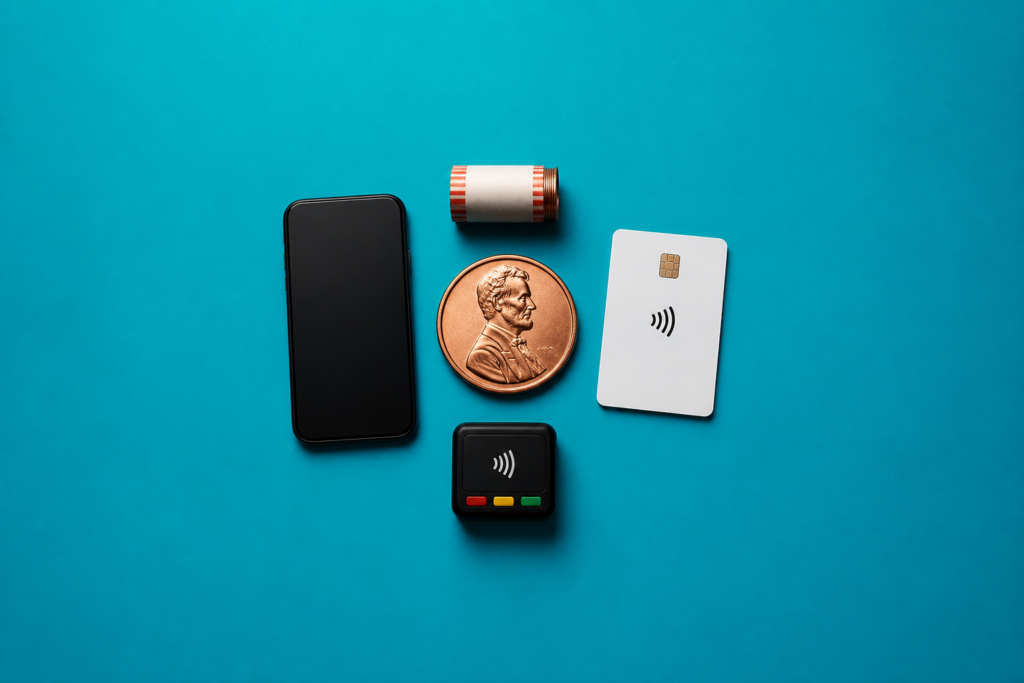

The U.S. Mint stopped producing circulating pennies in November 2025 after 232 years, and each coin had climbed to nearly 4 cents in production cost. Existing pennies stay legal tender, and the stock already in wallets, jars, cash drawers, and bank vaults keeps the coin alive even after the presses went quiet. The result is a split reality: digital payments keep growing, but the smallest coin in the system still has to move through cash transactions, bank channels, and retail tills.
That is the tension behind the penny’s survival. The coin no longer needs new production to exist, but it still needs circulation rules, bank handling, and retailer workarounds to function in everyday commerce.
The End of Penny Production
In November 2025, the U.S. Mint ceased producing circulating pennies after 232 years because the coin cost nearly 4 cents to make. The shift ended a long-running mismatch between face value and manufacturing cost.
Existing pennies remain legal tender. The 300 billion pennies in circulation as of 2026 still move through the economy, so the disappearance is about production, not instant removal from use.
The end of production changes the supply pipeline, not the legal status of the coin. Banks still receive pennies, people still spend them, and businesses still count them when cash changes hands. What has stopped is the Mint’s creation of new circulating pennies to replenish losses from drawers, jars, collections, and wear.
| Year | Cost per Penny (cents) | Total Pennies Produced (millions) | Total Cost (millions) |
|---|---|---|---|
| 2024 | 3.69 | 3,172 | 117.3 |
| 2025 | 3.69 | 0 | 0 |
| 2026 | N/A | N/A | N/A |
Source: When a Penny Costs More Than a Penny: The Economics Behind Ending the Cent
Challenges in Penny Circulation
The supply problem starts the moment cash transactions need exact change and no new pennies enter the stream. Banks and retailers still hold millions of old coins, but local shortages show up quickly when consumers hoard pennies, machines reject them, or branches run low on coin inventories.
- Branches and armored carriers now need tighter sorting and redistribution of existing coin stock, and a Change counter becomes part of that back-office process rather than a convenience item.
- Customers who pay with cash face more situations where exact one-cent change is unavailable, so clerks must round or split payment amounts with other coins.
- Businesses that depended on steady penny replenishment now treat the coin as a limited inventory item instead of a default part of the till.
The Federal Reserve responded by resuming penny deposits from banks and credit unions in January 2026 to keep existing coins moving through the system. The move relieved some of the bottleneck, but it did not restore production, so circulation still depends on how quickly pennies travel from low-use places back into active cash channels.
That change also exposes a mismatch between habits and infrastructure. Consumers still expect exact cents in cash transactions, while the payment network around them has already shifted toward cards, wallets, and account-to-account transfers that never touch physical coinage.
Retailer Rounding Rules and Cash Checkout
Retailers have answered the penny shortage with rounding policies that adjust cash totals to the nearest five cents. That keeps checkout moving when pennies are unavailable and removes the need for clerks to improvise on the spot.
The rule applies only to cash, not to card or tap transactions. A customer paying by card still gets the exact amount, while a cash customer sees the final total rounded in a way that aligns with available coin denominations.
- Some stores round the final total rather than individual items, so the register still shows each product at its listed price.
- Other businesses set posted policies for all cash purchases so clerks do not decide case by case at the counter.
- Financial institutions have matched those practices by adapting their coin handling, cash sorting, and deposit procedures to a world with fewer pennies entering the pipeline.
Retailers and financial institutions have implemented rounding policies for cash transactions because the alternative is friction at the register. That friction is not theoretical. A checkout line slows down when a cashier hunts for one-cent change, and a business with multiple lanes feels that delay across thousands of transactions.
Rounding also changes customer expectations. Once people get used to seeing a total rounded to the nearest nickel, the penny stops functioning as a practical unit of payment even before it stops being legal tender.
Digital Payments, Cash Decline, and the Penny’s Shrinking Job
The penny’s decline tracks a broader shift away from physical cash. Tap-to-pay, mobile wallets, and online checkout remove the need for coins altogether, and every transaction that skips cash reduces the occasions when a penny has a job to do.
That shift is visible in the way value moves now. Digital payments settle exact amounts instantly, eliminate coin handling, and make low-denomination currency less relevant to both consumers and merchants. The penny survives inside the cash economy, but the cash economy is no longer the center of daily payment behavior.
The 2026 Federal Reserve data on 300 billion pennies in circulation as of 2026 shows how much existing stock remains, yet stock size is not the same as utility. A coin can exist in huge numbers and still lose relevance if consumers stop choosing payment methods that use it.
| Year | Pennies in Circulation (billions) | Production Status |
|---|---|---|
| 2024 | 300 | Produced for circulation |
| 2025 | 300 | Produced for circulation; production ceased in November |
| 2026 | 300 | No new production; existing pennies in circulation |
Source: US Mint presses final pennies as production ends after more than 230 years
The larger point is not that cash disappears overnight. Cash remains common enough that low-denomination coins still create operational problems, but digital payment habits keep draining the penny’s everyday usefulness. The coin is now trapped between two systems: one that still accepts it and another that no longer needs it.
What the Penny’s Decline Means for U.S. Currency
The penny’s disappearance from production marks a practical break from the old assumption that every denomination must keep being minted forever. Once a coin costs more to produce than it is worth, the argument for keeping it in the manufacturing line weakens fast.
That leaves the U.S. With a currency system that is more selective about what gets minted and more dependent on whatever coins are already in circulation. The penny’s future now depends on depletion, circulation efficiency, and cash usage patterns, not on new supply.
Low-denomination coins face the same pressure whenever payment habits shift and manufacturing costs rise. The penny is just the first visible example of a system adjusting to a world where tap-to-pay, cards, and wallets handle most transactions while physical change handles less every year.
FAQs
Why did the U.S. Mint stop producing pennies?
The U.S. Mint ceased producing pennies in November 2025 because each coin cost nearly 4 cents to produce. That gap between face value and production cost made circulating penny output economically unsustainable.
Are existing pennies still legal tender?
Yes. Existing pennies remain legal tender and continue to circulate, with an estimated 300 billion pennies in circulation as of 2026.
How has the Federal Reserve addressed the penny shortage?
The Federal Reserve resumed accepting penny deposits from banks and credit unions in January 2026 so existing pennies could move back through the system instead of getting stuck in storage or local shortages.
What rounding policies have retailers implemented due to the penny’s discontinuation?
Retailers and financial institutions have implemented rounding policies for cash transactions, adjusting prices to the nearest five cents so checkout lines keep moving when pennies are unavailable.
The penny is still legal tender, still common in raw circulation, and still awkward in a payment system that has moved on. That combination leaves it alive but diminished: a coin with a large existing stock, no new production, and a shrinking role in a checkout culture built around tap-to-pay.