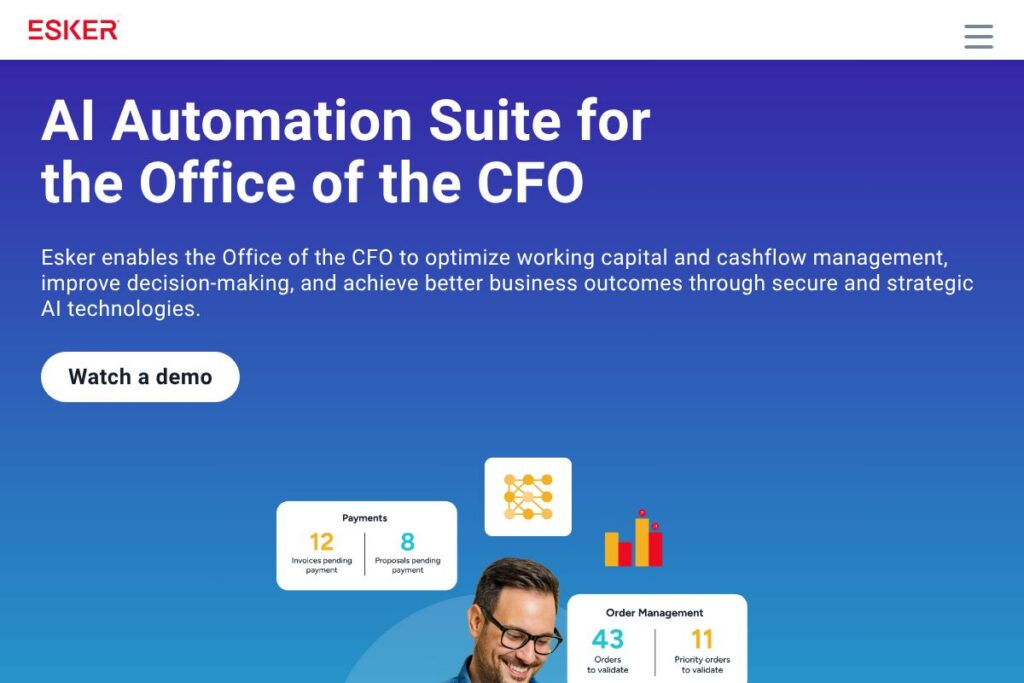

Esker: An Overview
Esker is a cloud software provider focused on automating document-heavy finance processes across Source-to-Pay (S2P) and Order-to-Cash (O2C). Its platform combines document capture, AI-driven data extraction, robotic process automation, and workflow orchestration to accelerate accounts payable, accounts receivable, order management, and related finance tasks.
Compared with competitors, Esker brings a combined S2P and O2C focus that differentiates it from procurement-first platforms like Coupa and from AR specialists such as HighRadius. Compared with broader ERP-native automation such as SAP Ariba, Esker is positioned as an add-on that integrates with existing ERP investments to fill processing gaps rather than replace core systems.
Esker is particularly effective for mid-market to enterprise finance organizations that need to automate both incoming and outgoing document flows, consolidate processing across multiple ERPs, and scale automation globally through a single cloud platform. Its strength lies in connecting procurement, order processing, and cash collection workflows while preserving existing ERP investments.
How Esker Works
Esker captures documents from multiple input channels including email, EDI, fax, and portal uploads, then applies OCR and AI to extract structured data. Extracted data is validated through configurable business rules, routed for approvals, and posted back to the source ERP or accounting system.
Teams typically implement Esker to remove manual touchpoints: suppliers submit invoices or purchase orders, Esker classifies and extracts the information, RPA and workflow handle approvals and exceptions, and finalized documents sync to the ERP. This workflow reduces cycle times for invoice-to-pay and order-to-cash processes and centralizes audit trails for compliance.
What does Esker do?
Esker’s platform is organized around automating end-to-end finance and order processes. Core capabilities include intelligent document capture, AI-based data extraction, configurable workflow and approvals, RPA for repetitive tasks, and analytics for cash and supplier management. The company has expanded its AI capabilities into agentic AI components within its Synergy AI engine to provide more autonomous data orchestration.
Let’s talk Esker’s Features
Intelligent Document Capture and OCR
Esker ingests documents from email, portals, EDI, and scanned images, then applies OCR and classification to turn unstructured files into structured records. This reduces manual data entry and improves first-pass processing rates for invoices and orders, which speeds reconciliation and reduces human error.
AI-powered Data Extraction
The platform uses machine learning models to extract line-level and header-level data from invoices and orders, with confidence scoring and human-in-the-loop validation for exceptions. Over time the models adapt to supplier document formats, which increases automation rates and lowers exception volumes.
Source-to-Pay Automation
Esker automates supplier onboarding, purchase order processing, invoice matching, and accounts payable workflows. Built-in controls and approval routing help enforce procurement policies while improving supplier relationships through faster invoice processing and more predictable payment cycles.
Order-to-Cash Automation
Order intake, credit checks, order validation, invoicing, and cash application are automated to accelerate order processing and improve days sales outstanding. Collections management and deduction handling are integrated to centralize AR workflows and provide better visibility into cash flow.
Agentic AI and Synergy AI Agents
Esker applies agentic AI components to orchestrate data flows and suggest decisions, such as routing exceptions or recommending collection actions. These agents aim to augment finance users by automating routine decisions and surfacing actionable insights rather than replacing human judgment.
ERP Integrations and Connectivity
The solution integrates with a wide range of ERP systems to post transactions and synchronize master data, reducing manual reconciliation work. Esker is designed to work alongside ERPs rather than replace them, which is useful for organizations with multiple or legacy systems.
Robotic Process Automation
RPA components automate repetitive, rules-based tasks such as posting payments, sending reminders, and updating records. This reduces manual workload for finance teams and frees staff to focus on exceptions and value-add activities.
Analytics and Reporting
Esker includes dashboards and reporting for AP and AR performance, cash forecasting, and exception trends, enabling finance leaders to measure automation ROI and monitor operational health. These insights support continuous improvement and help prioritize process changes.
With these features, Esker helps organizations reduce processing time, lower handling costs, and improve payment and order accuracy, making finance operations more predictable and auditable.
Esker pricing
Esker uses a custom enterprise pricing model tailored to deployment scope, process coverage, transaction volumes, and integration complexity, rather than a fixed public price list. Prospective customers receive proposals that reflect required modules, user counts, and service levels.
To understand how Esker would be priced for your organization, contact Esker through their sales and contact pages to request a tailored quote or demonstration. For details on deployment options and licensing models, review Esker’s solutions overview.
What is Esker Used For?
Esker is used to automate invoice processing, purchase order handling, order entry, payment matching, and collections, which makes it a fit for companies looking to reduce manual finance work and improve cash management. Finance, procurement, and order operations teams use Esker to standardize processes across business units and geographies.
It is also appropriate for organizations undergoing ERP consolidation or post-merger integration because Esker can sit on top of multiple ERPs and provide a unified processing layer. Companies that need faster supplier onboarding, better dispute resolution for AR, or improved global compliance often deploy Esker to centralize and automate these workflows.
Pros
- Broad S2P and O2C coverage: Esker automates both procurement-to-pay and order-to-cash processes, allowing finance teams to address upstream and downstream document flows in one platform.
- Strong ERP connectivity: Esker integrates with dozens of ERP systems to post transactions and synchronize master data, which minimizes ERP customizations and preserves existing investments.
- AI and RPA combined: The mix of OCR, machine learning, and RPA increases first-pass automation rates and reduces manual exceptions over time, improving operational efficiency.
- Global deployment and compliance: Esker supports multinational deployments with multiple languages, localized processes, and audit controls that help enterprises manage cross-border operations.
Cons
- Enterprise focus: Esker’s product and pricing model are geared toward mid-market and large enterprises, which may be heavier than what very small businesses need.
- Implementation complexity: Integrating Esker with multiple ERPs and fine-tuning automation rules requires implementation effort and governance, particularly in heterogeneous IT environments.
- Custom pricing and procurement cycle: Tailored pricing means a longer procurement cycle for cost approvals and vendor selection compared with per-seat SaaS offerings.
Does Esker Offer a Free Trial?
Esker offers demos and customer trials for qualified enterprise buyers. Typical engagements begin with a product demonstration and a pilot or proof-of-concept focused on a subset of documents or processes; for access to a trial or pilot, contact Esker through their contact page.
Esker API and Integrations
Esker provides integration capabilities to connect with ERPs, payment platforms, and other enterprise systems, and advertises compatibility with more than 70 ERP solutions to streamline posting and reconciliation. For integration details and supported endpoints, consult Esker’s integration resources.
In addition to direct integrations, Esker supports connector-based integration patterns and APIs for automation orchestration, allowing in-house developers and integration partners to extend workflows and link Esker to complementary systems.
10 Esker alternatives
Paid alternatives to Esker
- Coupa — A procurement-first platform that focuses on sourcing, supplier management, and spend optimization with a strong procurement suite.
- Basware — Offers procure-to-pay and e-invoicing solutions with global network capabilities aimed at large enterprises.
- SAP Ariba — Procurement and supplier network services tightly integrated with SAP ERP ecosystems and global supplier collaboration.
- HighRadius — Specializes in Order-to-Cash automation, credit management, and cash application using AI for receivables teams.
- Taulia — Focuses on supplier financing and payables optimization to accelerate supplier payments and improve working capital.
- Kofax — Provides document capture and intelligent automation tools used for invoice processing and AP automation.
- Medius — Delivers cloud-based accounts payable automation with workflow, analytics, and supplier portal capabilities.
Open source alternatives to Esker
- Odoo — A modular open source ERP with accounting, purchase, and sales modules that can be extended for document automation workflows.
- ERPNext — An open source ERP offering AP and AR modules that can be customized and self-hosted to automate finance workflows.
- Apache OFBiz — A flexible open source business automation framework that can be configured to handle order management and accounting processes.
- Tryton — A general-purpose open source ERP platform with modules for purchasing, sales, and invoicing that can be adapted for automation.
Frequently asked questions about Esker
What is Esker used for?
Esker automates document-centric finance processes across Source-to-Pay and Order-to-Cash. Organizations use it to accelerate invoice processing, order management, cash application, and collections while reducing manual effort and errors.
Does Esker integrate with common ERPs?
Yes, Esker integrates with many ERP systems and lists compatibility with over 70 ERPs. Integration reduces reconciliation work by syncing invoices, orders, and payments back to the source systems; check Esker’s integration resources for common connectors.
How does Esker use AI in its platform?
Esker uses AI for document classification, data extraction, and decision support through its Synergy AI components. Agentic AI layers help orchestrate data flows and recommend actions while RPA handles repetitive tasks to improve automation rates.
Is Esker suitable for global companies?
Yes, Esker supports multinational deployments with multilingual processing and global compliance controls. Its cloud architecture and centralized workflows make it well suited for companies operating across multiple countries and ERPs.
How can I get pricing for Esker?
Esker provides tailored enterprise pricing rather than public list prices. For a quote or to discuss licensing and deployment options, contact Esker via their sales and contact pages.
Final verdict: Esker
Esker is a strong choice for finance teams that need end-to-end automation across both S2P and O2C processes, especially in organizations with multiple ERPs or global operations. Its combination of document capture, AI extraction, RPA, and workflow orchestration creates a single automation layer that reduces manual touchpoints and improves cash and supplier management.
Compared with a procurement-first vendor like Coupa, which focuses heavily on sourcing and spend optimization, Esker is broader in covering order management and receivables as well as payables; compared with AR specialists such as HighRadius, Esker offers a more integrated document automation approach across the finance cycle. Pricing is enterprise-tailored, so organizations should engage Esker for a demo and pilot to evaluate automation outcomes and total cost of ownership via their contact page.