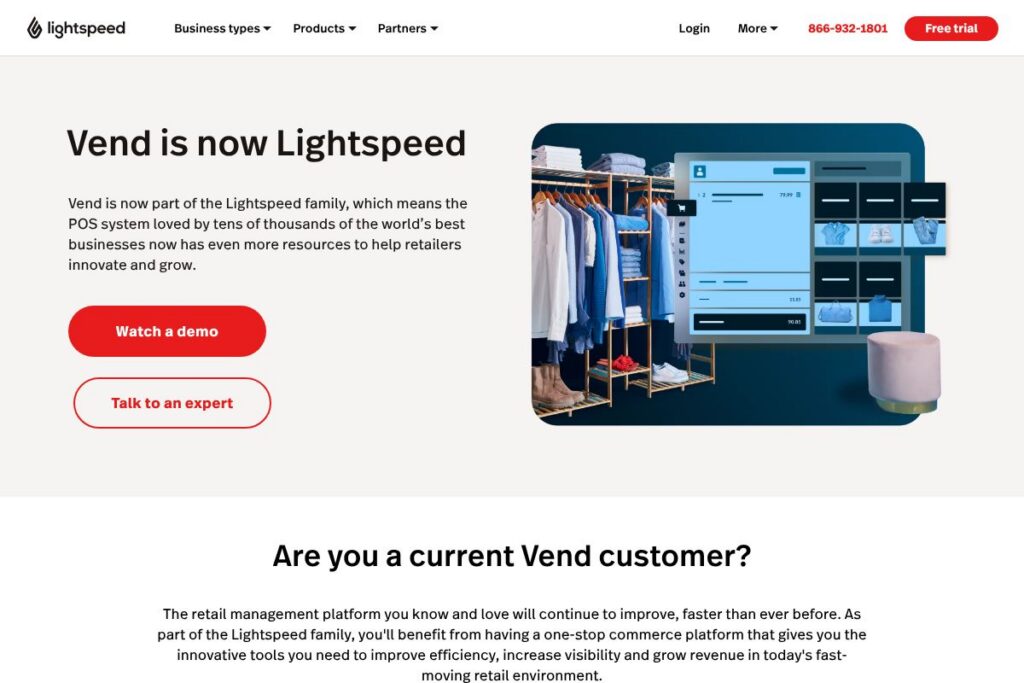

Lightspeed: An Overview
Lightspeed is a cloud-native point-of-sale and retail management platform built for merchants who manage inventory across multiple channels. The product previously known as Vend is now integrated into Lightspeed Retail (X-Series), which combines POS, payments, inventory, reporting, and eCommerce tooling in a single platform. This consolidation lets retailers manage in-store and online sales from a unified back office while keeping product and customer data synchronized.
Compared with Shopify, which pairs a commerce-first online store with optional POS hardware, Lightspeed places more emphasis on advanced inventory control, multi-location operations, and in-store workflows that larger inventory-driven retailers require. Compared with Square, which is simple to set up and optimized for low-touch retail and service businesses with fee-based processing, Lightspeed targets merchants who need deeper inventory features and richer reporting across outlets. Compared with Clover, which bundles hardware and payments tightly, Lightspeed aims to offer broader integrations and a more extensible developer API for custom workflows.
All of this makes Lightspeed particularly well suited to specialty retail, multi-location chains, and merchants who need granular inventory control and omnichannel order management. The platform scales from single shops to larger retailers who want a single system of record for sales, stock, customers, and suppliers.
How Lightspeed Works
Lightspeed runs as a cloud-hosted POS with native apps for in-store terminals and a web-based back office for business management. Staff use the POS to ring sales, accept embedded payments, and manage customer interactions while the back office handles inventory, purchase orders, pricing rules, and reporting.
Inventory, sales, and customer records synchronize in real time across devices and channels so that online orders, in-store purchases, and stock movements update the same product catalog. Practical workflows include scanning or selecting products at checkout, creating purchase orders from low-stock alerts, and using customer profiles for targeted loyalty and marketing campaigns.
Lightspeed also integrates payments directly into the POS so settlements, batch reporting, and refunds are managed within the same interface. For multi-location retailers, the platform supports consolidated reporting with the ability to drill into specific outlets, employees, or product lines for operational insights.
Lightspeed features
Lightspeed is organized around unified POS, inventory management, omnichannel eCommerce, customer marketing and loyalty, and developer extensibility. Key capabilities include real-time inventory across channels, built-in payments, marketing and loyalty tools (via Marsello), eCommerce integration, an open API for custom workflows, and merchant financing through Lightspeed Capital. Recent focus has been on tighter integration between retail POS and payments along with expanded marketing and loyalty features.
Let’s talk Lightspeed’s Features
Unified POS and Payments
The POS combines sales, customer lookup, and payment acceptance in one interface with Payments embedded into checkout. Embedded payments reduce manual entry errors, speed up checkouts, and provide batch settlement reports directly from the POS, while the platform maintains PCI compliance and end-to-end encryption for transactions.
Inventory Management
Inventory tools track SKUs, variants, unique serial numbers, and stock levels across multiple locations and channels. Built-in purchase orders enable reordering from the POS, while pricing controls, bundled items, and seasonal promotions let retailers optimize floor sales and manage markdowns.
Omnichannel eCommerce
Lightspeed eCom connects the POS catalog to online storefronts and marketplaces so merchants can sell in-store, online, and via social channels. The eCommerce features include multi-currency and multi-language storefront options, shipping integration for order tracking, and SEO tools to increase discoverability.
Marketing & Loyalty (Marsello)
Integrated marketing and loyalty features via Marsello let merchants create loyalty programs, automate email and SMS campaigns, and build customer segments from behavioral data. These tools help convert one-time shoppers into repeat customers and allow messaging across in-store and online touchpoints.
Open API and Integrations
A developer-facing API and a rich integrations marketplace allow custom reports, ERP and accounting connections, and checkout workflow extensions. The API documentation and developer resources make it possible to integrate Lightspeed with external systems like accounting, CRM, or specialized inventory tools; see the Lightspeed API documentation for endpoints and examples.
Lightspeed Capital
Lightspeed Capital is a merchant cash advance program for accessing working capital without personal credit checks and with a flat-fee repayment structure. Advances can be deposited quickly to help with inventory purchases, renovations, or short-term cash needs; learn more on the Lightspeed Capital page.
The biggest benefit across these features is that Lightspeed packages POS, payments, inventory, eCommerce, and marketing into a single platform designed for retailers. That reduces data fragmentation and gives owners consolidated reporting and control over both physical and online operations.
Lightspeed pricing
Lightspeed uses a subscription pricing model tailored to different business sizes and feature needs, with additional fees for payment processing and optional add-ons. Pricing details and plan comparisons vary by region, hardware choices, and whether you choose bundled payments or a third-party processor.
For the most accurate information about plan tiers, regional availability, and merchant processing fees, see Lightspeed’s pricing and plans. The product pages and sales team can provide current monthly and annual options as well as enterprise quotes for multi-location deployments.
What is Lightspeed Used For?
Lightspeed is used to run point-of-sale operations, manage inventory across multiple outlets, and consolidate sales reporting for retailers that sell both in-store and online. Typical users include specialty retailers, apparel shops, sporting goods stores, electronics resellers, and any business that needs SKU-level stock control and omnichannel order management.
Retail teams use Lightspeed for daily checkout, returns and exchanges, purchase order creation, stock transfers between locations, customer loyalty programs, and data-driven promotions. Operations and finance teams rely on its reporting to reconcile sales, analyze product performance, and plan inventory purchases.
Pros and Cons of Lightspeed
Pros
- Unified retail platform: Combining POS, payments, inventory, marketing, and eCommerce eliminates data silos and gives a single source of truth for sales and stock management.
- Strong inventory controls: Supports SKUs, variants, unique serial numbers, and multi-location stock visibility which helps reduce stockouts and overstock situations.
- Extensible integrations and API: The developer API and app marketplace make it possible to connect accounting systems, ERPs, and custom workflows for larger or specialized retailers.
- Retail-focused support and services: Around-the-clock support, onboarding assistance, and dedicated migration help reduce friction when moving from another POS.
Cons
- Subscription and processing complexity: The combined platform approach means pricing can vary with plan choices, add-ons, and payment options, which can be harder to estimate for very small merchants.
- Learning curve for advanced features: Merchants moving from simple, consumer-focused POS systems may need time to adopt advanced inventory and multi-location workflows.
Does Lightspeed Offer a Free Trial?
Lightspeed offers a free trial and the ability to create a free account so merchants can explore the platform before committing to a subscription. The trial gives access to core POS and retail management features, and Lightspeed sales or support can provide guided onboarding and one-on-one assistance during evaluation.
Lightspeed API and Integrations
Lightspeed provides a public developer API for extending the POS platform, building custom reports, and integrating with ERPs and accounting systems. The Lightspeed API documentation lists endpoints for orders, products, customers, inventory, and more.
Key native and marketplace integrations include marketing and loyalty via Marsello, accounting integrations like Xero and QuickBooks, marketplace connectors for Amazon and eBay, and shipping integrations for carrier tracking. These integrations help keep channels and data in sync without manual exports.
10 Lightspeed alternatives
Paid alternatives to Lightspeed
- Shopify — A commerce-first platform with integrated online stores and an optional POS; strong for merchants prioritizing eCommerce and simple omnichannel sync.
- Square — An easy-to-deploy POS and payments platform with per-transaction pricing, suited to small shops and mobile sellers that need minimal setup.
- Clover — POS hardware and software bundles with configurable apps for payments, appointments, and basic inventory management.
- Revel Systems — A POS platform focused on enterprise and multi-location operations with strong back-office controls and reporting.
- NCR Silver — A legacy retail and hospitality POS with hardware options and services aimed at established merchants and franchises.
- Toast — While restaurant-oriented, Toast offers robust POS and payments workflows for food and beverage retailers with integrated online ordering.
Open source alternatives to Lightspeed
- Odoo — An open source ERP with a POS module, inventory, and eCommerce that can be self-hosted and extended with community modules.
- ERPNext — A full open source ERP with retail, POS, inventory, and accounting modules suited to teams that can self-host and customize.
- uniCenta — A Java-based open source POS that supports multi-terminal deployments and basic inventory tracking.
- Chromis POS — A free POS forked from uniCenta offering touchscreen-friendly interfaces and printer integration.
Frequently asked questions about Lightspeed
What is Lightspeed used for?
Lightspeed is used to run retail point-of-sale operations and centralize inventory, sales, and customer data across channels. Merchants use it to manage in-store checkouts, online orders, purchase orders, and loyalty programs.
Does Lightspeed (ex Vend) integrate with accounting software?
Yes, Lightspeed integrates with common accounting platforms like Xero and QuickBooks. These integrations help automate sales reconciliation and simplify bookkeeping across multiple outlets.
Can Lightspeed handle multiple store locations?
Yes, Lightspeed supports multi-location management with consolidated reporting and per-location visibility. You can track stock transfers, view outlet-specific sales, and analyze performance across stores from a single back office.
Is Lightspeed suitable for online and in-person sales?
Yes, Lightspeed supports omnichannel retail with integrated eCommerce and in-store POS. The platform synchronizes product catalogs, inventory levels, and customer data between online storefronts and physical registers.
Does Lightspeed provide developer APIs?
Yes, Lightspeed offers a developer API for custom integrations and workflow automation. The Lightspeed API documentation provides endpoints for orders, inventory, customers, and other core objects.
Final Verdict: Lightspeed
Lightspeed is a comprehensive retail platform that excels at inventory accuracy, multi-location operations, and unified omnichannel workflows. Its strengths are advanced stock controls, integrated payments within the POS, and extensibility through an API and partner ecosystem, which together make it a strong choice for specialty and multi-store retailers.
Compared to Square, which is simpler to launch and relies more on per-transaction processing fees, Lightspeed aims at merchants willing to adopt a subscription-based platform for deeper inventory and reporting capabilities. For retailers whose core challenge is managing SKUs, variants, and stores across channels, Lightspeed provides a more feature-rich foundation, while Square remains attractive for low-volume merchants who prioritize minimal setup and predictable per-sale fees.
Overall, Lightspeed (including the former Vend product now in the X-Series) is a solid option for retailers who need a single platform for POS, payments, inventory, eCommerce, and marketing, especially when multi-location visibility and inventory accuracy are priorities. For a hands-on look at plans and to evaluate fit for your shop, review Lightspeed’s pricing and plans and consider a trial or guided onboarding session from their retail specialists.