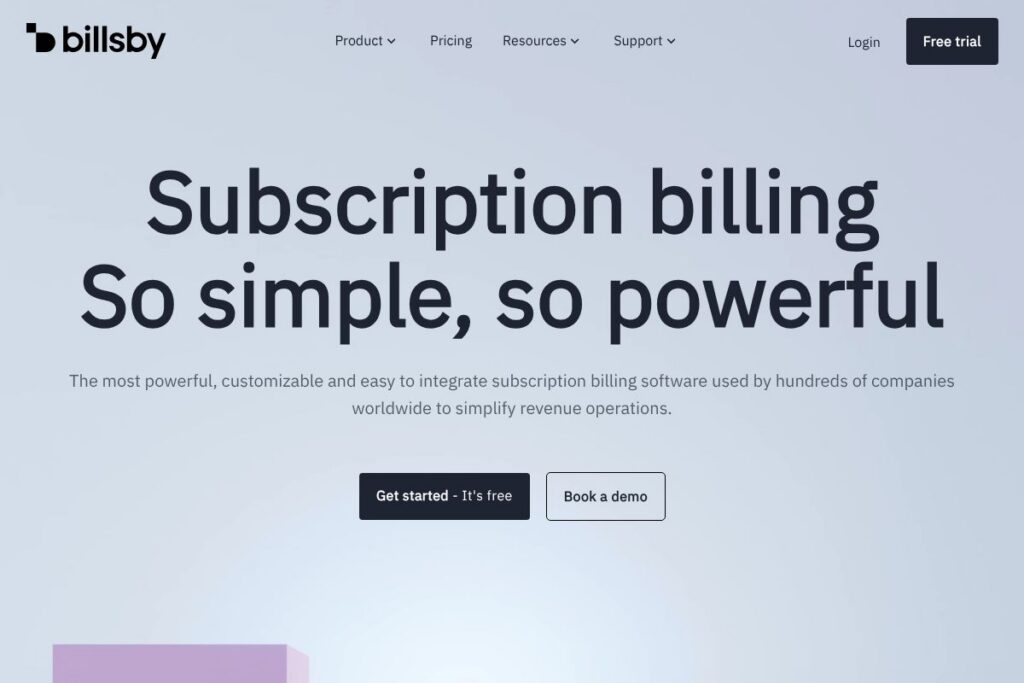

Billsby: An Overview
Billsby is a subscription billing platform designed to handle recurring payments, flexible pricing models, and customer self-service portals. The platform focuses on modular product and plan configuration, multi-gateway support, and developer-friendly APIs so engineering teams can embed billing into existing applications with minimal friction.
Compared with Chargebee, Recurly, and Stripe Billing, Billsby emphasizes gateway portability and straightforward developer tooling. Chargebee has extensive billing automation and marketplace integrations, Recurly targets high-scale subscription companies with enterprise features, and Stripe Billing ties tightly into Stripe’s payments ecosystem. Billsby differentiates by offering customizable billing cycles, integrated checkout snippets, and a focus on switching gateways without migrations.
Billsby works well for small to mid-market SaaS vendors, digital publishers, and product teams that need programmable billing but want control over gateways and tax handling. Its configuration and customer portals make it possible to go from setup to live billing quickly, which is useful for teams that want control without lengthy vendor onboarding.
How Billsby Works
The platform models your business around products, plans, and billing cycles, allowing teams to define metered usage, trial periods, and tiered pricing. You can attach plans to customers, manage upgrades and downgrades, and the system handles invoice generation and recurring charge attempts automatically.
Billsby connects to one or more payment gateways so transactions are processed by the gateway you choose; as your needs change you can move between gateways with minimal data migration. Developers integrate via REST APIs and client SDKs, and Billsby Checkout can be embedded on a website with a short snippet, enabling hosted or embedded checkouts without rebuilding your frontend.
Operational workflows include webhooks for subscription lifecycle events, automated dunning for failed payments, and reporting APIs for revenue recognition and analytics. Typical implementations pair Billsby with a CRM or accounting stack to sync customer and invoice state into accounting ledgers and support systems.
Billsby features
Billsby groups billing around subscriptions and revenue operations with features that cover plan management, payments, compliance, reporting, and developer tooling. Recent improvements emphasize tax compliance and expanded reporting to support multi-jurisdiction sales.
Products, plans and cycles
Define products, multiple plans per product, trial windows, billing cycles, and add-ons. This lets teams represent common subscription models such as tiered pricing, usage-based billing, and bundled plans, while managing upgrades and proration automatically.
Multiple payment gateways
Support for multiple gateways means you can route payments through different processors by region or card type and switch gateways as requirements change. This reduces vendor lock-in and can help lower processing costs as your volume grows.
Integrated checkout
Billsby Checkout can be added to a website or app with a small code snippet, delivering hosted checkout pages and embedded payment forms. This reduces PCI scope and speeds implementation while allowing brand customization and secure card capture.
Tax compliance
Tools for handling VAT, GST, and sales tax help businesses collect, record, and report tax correctly across jurisdictions. Tax features include configurable tax rules and metadata to support compliance during invoice generation and transactions.
Advanced reporting
Built-in reporting surfaces revenue metrics, churn, MRR/ARR, and invoice histories in one place, and APIs let you pull raw data into BI tools. These reports support financial close processes and provide the data needed for revenue recognition workflows.
Developer friendly
Comprehensive REST APIs, client SDKs, and webhook support make automation and custom integrations straightforward. Documentation and examples reduce time to production and allow engineering teams to control lifecycle events programmatically; view the Billsby developer documentation for endpoint details and examples.
Dunning and recovery
Automated dunning retries and configurable communication templates reduce involuntary churn and keep subscription revenue more predictable. Teams can define retry schedules and escalation rules to align with their customer experience.
With these capabilities, the largest benefit is a flexible billing engine that balances end-user checkout simplicity and deep developer control, making it practical for businesses that need both operational control and fast implementation.
Billsby pricing
Billsby uses a SaaS subscription model with flexible plans and enterprise options tailored to business needs. Pricing details are managed per customer and may vary by volume, gateway usage, and required features, with enterprise contracts available for high-volume or custom integrations.
For up-to-date pricing, plan descriptions, and enterprise options see the Billsby homepage or reach out via the Billsby contact page to request a custom quote and implementation timeline.
What is Billsby Used For?
Billsby is commonly used to manage recurring billing for SaaS products, membership sites, and subscription-based digital services. It handles plan configuration, trials, upgrades, and the recurring invoicing cycle so teams can focus on product and growth rather than billing mechanics.
Teams also use Billsby for gateway consolidation and migration projects, where switching payment processors without a costly migration is crucial. The developer API and webhook support make it suitable for embedding billing into existing customer platforms and automating revenue operations.
Pros and Cons of Billsby
Pros
- Developer-friendly API: Easy to automate billing workflows and integrate with existing systems using REST endpoints and webhooks. This reduces manual work and allows engineering teams to control lifecycle events.
- Gateway portability: Switch or support multiple payment gateways without major migrations, helping to optimize processing fees and regional payment coverage. This reduces vendor lock-in and operational risk.
- Flexible product and plan modeling: Support for trials, tiers, metered billing, and proration covers most subscription pricing strategies. Teams can represent complex offerings without custom billing code.
- Integrated checkout options: Hosted or embedded checkout reduces PCI scope and speeds implementation, making it easier to launch subscription flows quickly.
- Built-in reporting and dunning: Revenue metrics and automated recovery tools help maintain predictable recurring revenue and support finance workflows.
Cons
- Limited public pricing transparency: Pricing is typically provided via custom quotes, which can make initial vendor comparisons slower. Prospective customers need to contact sales for precise cost estimates.
- Smaller ecosystem than some competitors: Compared with larger vendors, there may be fewer pre-built marketplace integrations and third-party plugins available. Some teams may need to build custom connectors.
- Enterprise feature parity: Very large enterprises with extreme scale or specialized billing rules may find some gaps compared with long-established enterprise billing platforms and may require professional services.
Does Billsby Offer a Free Trial?
Billsby offers a free trial and demo options for prospective customers. New users can request a trial or product walkthrough to validate integration approaches and confirm that plan and gateway configurations meet business needs before committing to a paid contract.
Billsby API and Integrations
Billsby provides a developer-focused REST API and webhook-based event notifications to automate subscription lifecycle tasks and integrate with CRMs, accounting systems, and analytics platforms. See the Billsby developer documentation for API endpoints, authentication, and webhook examples.
Key integrations commonly used with Billsby include major payment gateways such as Stripe, PayPal, Braintree, and Adyen, along with connectors to accounting and CRM tools to synchronize invoices and customer records. The platform’s multi-gateway approach supports routing payments by region or card type.
10 Billsby alternatives
Paid alternatives to Billsby
- Chargebee — Subscription billing with advanced revenue operations, tax and compliance support, and a marketplace of integrations.
- Recurly — High-scale subscription billing platform with robust dunning, analytics, and enterprise features for complex billing needs.
- Stripe Billing — Tight integration with Stripe payments and a developer-first billing API that is popular among startups and product teams.
- Zuora — Enterprise-grade subscription management and revenue recognition designed for very large subscription businesses.
- Paddle — Unified checkout and merchant of record services tailored to software and SaaS businesses selling internationally.
- Chargify — Billing platform focused on recurring revenue with a strong set of lifecycle management and analytics tools.
- FastSpring — Commerce platform that supports global payments, tax, and compliance with merchant-of-record options.
Open source alternatives to Billsby
- Kill Bill — Open source subscription billing and payments orchestration engine with a plugin architecture for gateways and plugins for taxes and metrics.
- Solidus — Open source e-commerce platform that can be extended with subscription and billing extensions for customizable storefront and billing logic.
- Apache OFBiz — A suite of business applications including billing and e-commerce modules that can be adapted for recurring revenue use cases.
- Spree Commerce — Open source e-commerce platform with extension points to build subscription flows and integrate with payment gateways.
Frequently asked questions about Billsby
What is Billsby used for?
Billsby is used for subscription billing and managing recurring payments. Businesses use it to run subscription plans, handle invoicing, and automate lifecycle events like upgrades and retries.
Does Billsby support multiple payment gateways?
Yes, Billsby supports multiple payment gateways. You can configure and switch gateways, route payments by region or type, and reduce the risk of vendor lock-in.
Can Billsby handle tax compliance across countries?
Billsby includes tax handling tools to help with VAT, GST, and sales tax. The platform allows configuration of tax rules and works with reporting and invoice metadata to support compliance.
Does Billsby provide developer APIs and webhooks?
Yes, Billsby provides a REST API and webhook support. Developers can automate subscription workflows, listen for lifecycle events, and integrate billing state with CRMs and accounting systems.
Is there a free tier for Billsby?
Billsby offers trial and demo options to evaluate the platform. For production use, pricing is tailored to volume and feature needs and is available by contacting their sales team.
Final Verdict: Billsby
Billsby is a pragmatic choice for companies that need a flexible, developer-friendly subscription billing engine with the ability to support multiple payment gateways. It combines product and plan configuration, embedded checkout options, tax handling, and reporting in a package that is oriented toward teams that want control over billing logic and gateway routing.
Compared with Chargebee, which publishes tiered plans and a broad integrations marketplace, Billsby focuses more on gateway portability and straight developer integration; for organizations prioritizing gateway flexibility and embedded control, Billsby is a strong fit. For details on commercial terms and to compare feature coverage for your specific use case, review the Billsby homepage or the Billsby contact page to request a tailored quote and demo.