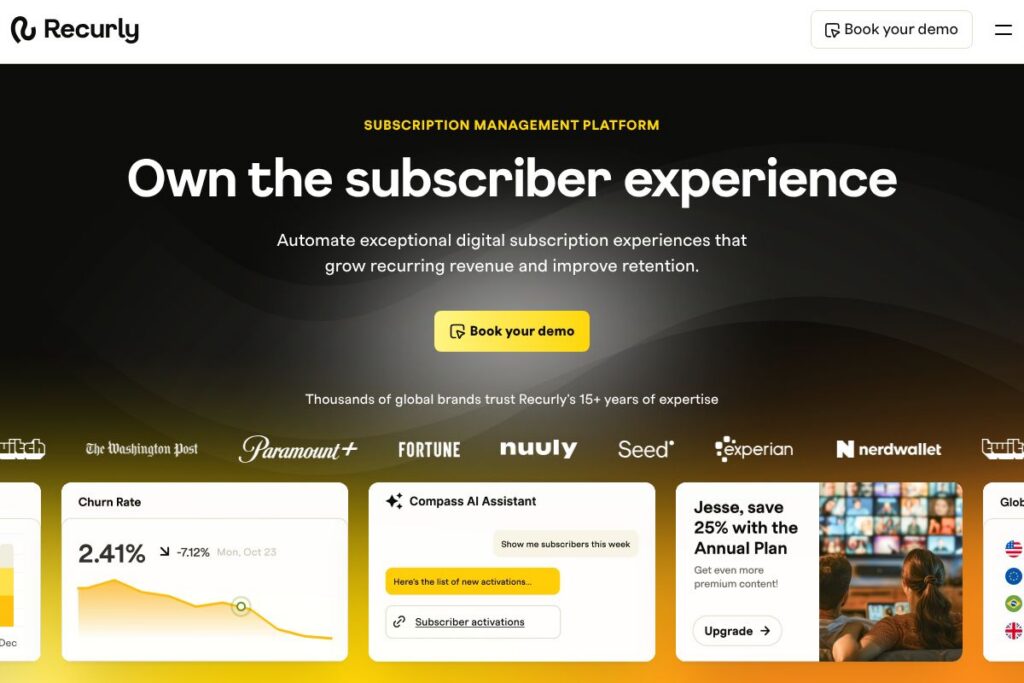

Recurly: An Overview
Recurly provides a subscription billing and lifecycle platform that covers plan configuration, checkout, billing, collections, revenue recognition, and analytics. It is positioned for businesses that operate recurring revenue models at scale, including digital publishers, SaaS companies, commerce merchants, and membership services. The product emphasizes a modular architecture with APIs, webhooks, and prebuilt integrations to plug into existing stacks.
Compared with Stripe Billing, Recurly focuses more on enterprise subscription lifecycle features such as advanced dunning, revenue recognition workflows, and prebuilt ERP connectors. Compared with Chargebee, Recurly routes more of its value toward large-scale revenue recovery and global payment orchestration. Compared with Zuora, Recurly provides a simpler onramp for fast plan launches while retaining features needed for compliance and complex billing rules.
All of this makes Recurly well suited for teams that need a production-ready billing engine plus operational tools to reduce churn and automate revenue compliance. It is most useful for product, finance, and engineering teams that require PCI-compliant payments, automated dunning, and integrations to tax and ERP systems.
How Recurly Works
Recurly runs as a SaaS billing platform that connects to your checkout, payment gateways, and customer data sources. Merchants define plans, add-ons, and coupons in the platform or via API, then use hosted or embedded checkout flows to create subscriptions and collect payments.
The platform automates routine lifecycle tasks such as retrying failed payments, sending dunning emails, applying cancel-save flows, and processing refunds. Transactions and events stream to Recurly for reporting, and the platform can emit webhooks or call your services so product and CRM systems remain synchronized.
For implementation, teams typically deploy a sandbox to test plan configurations and gateway behavior, then integrate using Recurly’s API for subscription lifecycle events, or install the native Shopify app for commerce sites. The platform also offers configurable reconciliation and RevRec features to reduce manual accounting work.
What does Recurly do?
Recurly’s feature set is organized around subscription lifecycle management and the operational tasks that scale recurring revenue. Core capabilities include plan configuration, payment orchestration, automated revenue recovery, revenue recognition for ASC-606 and IFRS-15, customer self-service portals, and analytics. Recent additions emphasize AI-assisted insights through Recurly Compass and deeper commerce integrations for platforms like Shopify.
Here are some key features worth highlighting:
Subscription management
Recurly lets teams create flexible plans, add-ons, trials, and prepaid models, then deploy those configurations through hosted or API-driven checkouts. This supports experiments with pricing and packaging without heavy engineering changes, and it centralizes subscriber state for reporting and lifecycle automation.
Billing and payments
The platform supports multiple payment methods and gateways, tokenization for PCI scope reduction, and centralized payment methods per account. Built-in intelligent retry logic and payment routing help improve authorization rates and reduce churn from card declines.
Dunning and revenue recovery
Recurly provides configurable dunning strategies, cancel-save flows, and targeted win-back offers to recover at-risk revenue. Teams can tailor retry schedules and messaging by plan type or customer segment to maximize recovery while minimizing customer friction.
Recurly Compass (AI insights)
Compass uses historical subscriber data plus your event stream to surface anomalies, suggest dunning changes, and generate configuration snippets from natural language prompts. It is designed to accelerate operations and reduce time spent digging for root causes in large subscription datasets.
Automated revenue recognition (RevRec)
Recurly automates revenue recognition processes that align with ASC-606 and IFRS-15, producing prepackaged reports and entries that reduce manual intervention at close. This helps finance teams shorten close cycles and reduce audit risk.
Commerce and platform integrations
Recurly offers a native Shopify subscription app and connectors for other commerce platforms, enabling membership, bundles, and prepaid plans to be managed alongside the checkout experience. The platform also supports self-service subscriber portals for plan changes, skips, and cancellations.
Reporting and analytics
Real-time reporting includes renewal events, payment metrics, churn analysis, and cohort-based revenue views. These reports help teams measure the impact of retention strategies and track subscription health across regions and product lines.
With these capabilities, Recurly centralizes the operational pieces of subscription commerce so product, finance, and growth teams can iterate on offers, reduce failed transactions, and automate compliance work.
Recurly pricing
Recurly uses a custom enterprise pricing model that is tailored to transaction volume, required features, and integrations. Pricing typically varies by the scale of payment volume, the degree of managed services, and which add-ons such as automated revenue recognition or premium support are required.
Because Recurly negotiates plans based on business needs, the recommended way to get precise pricing is to contact sales or request a demo through Recurly’s site. For sandbox access and technical documentation useful during evaluation, see Recurly’s documentation hub and the contact options on the Recurly site.
What is Recurly Used For?
Recurly is used to run subscription commerce across consumer and B2B scenarios, including SaaS, streaming and digital content, membership services, subscription box commerce, and any business with recurring payments. It handles plan lifecycle, billing, collections, and customer self-service in one platform so teams can focus on product and retention.
Typical users include billing and payments teams looking to reduce failed transactions, finance teams that need automated recognition and audit-ready reporting, and product/growth teams that want to run pricing experiments and in-product subscription prompts. Recurly also suits merchants who must scale internationally with many currencies and payment methods.
Pros and Cons of Recurly
Pros
- Enterprise-grade compliance and RevRec: Reduces manual work for ASC-606 and IFRS-15 compliance, providing prebuilt reports and journal entries that help finance teams close faster.
- Strong revenue recovery tools: Configurable dunning, intelligent retries, and cancel-save flows lead to measurable reductions in involuntary churn and recovered revenue.
- Wide integration ecosystem: Prebuilt connectors and APIs make it straightforward to integrate with payment gateways, tax providers, ERPs, and CRM systems for end-to-end workflows.
- Sandbox and developer tooling: A developer-friendly sandbox and API documentation speed up testing and iteration for new billing models.
Cons
- Custom pricing model: Because pricing is negotiated per customer, it can be harder for small teams to estimate total cost without engagement with sales. This requires planning for a sales conversation during evaluation.
- Enterprise focus can be complex: The platform’s breadth and enterprise orientation can introduce configuration complexity for very small merchants seeking a minimal setup.
- Feature overlap with platform tools: Teams that use platform-native billing (for example, app store billing or simple gateway subscriptions) may find some Recurly capabilities overlap with existing systems and require consolidation work.
Does Recurly Offer a Free Trial?
Recurly offers a free sandbox environment and the option to request a demo for evaluation; production pricing is custom and requires engagement with sales. Use the sandbox to simulate subscriptions and payment flows, and request a demo or sales consult via Recurly’s documentation hub and contact pages to understand how a tailored plan would be priced.
Recurly API and Integrations
Recurly provides a RESTful API and comprehensive developer documentation for subscription, invoice, and transaction management. The Recurly API documentation describes endpoints for accounts, subscriptions, invoices, adjustments, and webhooks for event-driven integrations.
The platform also publishes a full integrations list with connectors for payment gateways, tax engines, CRM systems such as Salesforce, ERP systems, and commerce platforms like Shopify. Integration options include APIs, webhooks, a hosted checkout, and a native Shopify subscription app for commerce use cases.
10 Recurly alternatives
Paid alternatives to Recurly
- Stripe Billing – Developer-centric billing with usage-based metering and a large payments ecosystem that is easy to integrate for teams already on Stripe.
- Chargebee – Subscription management with published tiers and built-in revenue operations tools that appeal to mid-market SaaS companies and scale-ups.
- Zuora – Enterprise-grade subscription finance and billing platform focused on complex monetization models and deep ERP integrations.
- Chargify – Billing and subscription management focused on recurring billing logic and flexible product catalog capabilities for SaaS and commerce.
- Paddle – Combined payments and merchant of record services that simplify global tax and compliance for digital goods sellers.
- SaaSOptics – Finance and revenue recognition tooling tailored to SaaS companies that need detailed ARR and financial reporting.
Open source alternatives to Recurly
- Kill Bill – Open source subscription billing and payments orchestration platform designed for customization and self-hosting, with a plugin architecture for gateways and tax systems.
- Solidus – An open source ecommerce platform that can be extended with subscription logic for merchants comfortable building custom billing workflows.
- Broadleaf Commerce – Java-based commerce framework with extensible billing and customer management modules useful for teams that want full control over subscription behaviors.
Frequently asked questions about Recurly
What is Recurly used for?
Recurly is used for subscription billing, revenue recovery, and revenue recognition for recurring revenue businesses. It centralizes plan management, payment orchestration, and analytics for teams running subscription commerce.
Does Recurly have an API?
Yes, Recurly offers a RESTful API and developer documentation. The API supports subscriptions, invoices, transactions, and webhooks for event-driven integrations, and you can review the endpoints in the Recurly API documentation.
Can Recurly handle global payments and multiple currencies?
Yes, Recurly supports multiple payment methods and over 140 currencies. The platform includes payment routing and integrations with many global gateways to help increase authorization rates internationally.
Is Recurly suitable for enterprise finance teams?
Yes, Recurly includes automated revenue recognition and prepackaged reports for ASC-606 and IFRS-15. These features help finance teams reduce manual reconciliation and speed up the close process.
How do I get pricing for Recurly?
Recurly uses custom pricing based on transaction volume and required features. To get a tailored quote and learn about available add-ons, request a demo or contact sales through Recurly’s contact pages and documentation hub.
Final Verdict: Recurly
Recurly is a robust choice for organizations that need more than basic recurring billing, particularly finance-led teams that require automated revenue recognition and lifecycle tools to reduce churn. Its strengths are enterprise-grade compliance, configurable dunning and recovery strategies, and a broad set of integrations that ease connection to ERPs, tax engines, and CRMs.
Compared with Chargebee, which publishes tiered plans and is often chosen by mid-market teams for predictable pricing, Recurly leans toward a negotiated pricing model that scales with payment volume and managed services. Feature-wise, Recurly places heavier emphasis on revenue recovery and enterprise accounting features, while Chargebee emphasizes quicker self-service onboarding with visible pricing tiers.
For businesses with high transaction volumes, complex billing rules, or strict compliance needs, Recurly offers the tooling and operational support to manage growth and reduce manual accounting overhead. For smaller teams seeking a straight-priced starter plan, exploring published-tier competitors may be a faster path to evaluation.