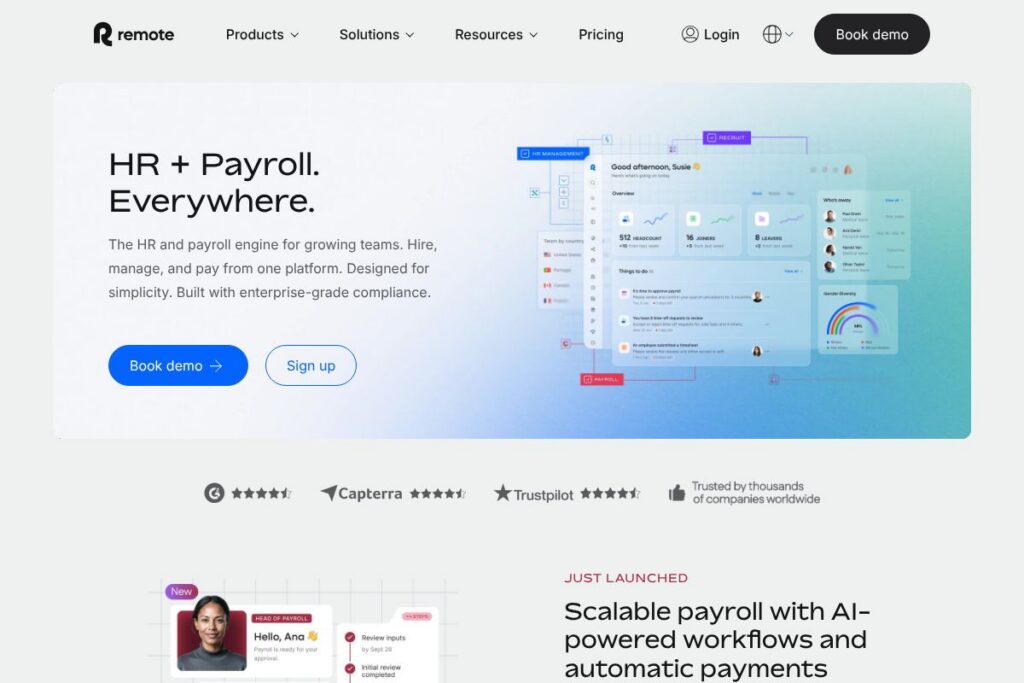

Remote: An Overview
Remote provides a single platform to hire, onboard, pay, and manage international employees and contractors while handling local payroll, taxes, benefits, and compliance requirements. The core proposition is to let companies employ people in other countries quickly, using employer of record services or contractor management when a local legal entity is not available.
Compared with competitors like Deel and Papaya Global, Remote focuses on a tightly integrated workflow that covers both employees and contractors, with strong reporting and benefits administration. Deel emphasizes flexible contract types and integrations, while Papaya Global has a heavy focus on payroll automation across many countries; Remote competes by packaging EOR, payroll, and contractor management into a single experience.
Remote does well at simplifying legal and tax obligations for international hires and at centralizing payroll and payments into one dashboard. This makes it suitable for companies that need to scale distributed teams quickly while reducing the need to set up local entities.
How Remote Works
Remote connects your company to local employment frameworks through either an employer of record model or contractor management and payroll services. When you use Remote’s EOR service, Remote becomes the local employer for an employee, handling onboarding, mandatory benefits, payroll taxes, and statutory filings while you retain day-to-day management of the hire.
For contractors, Remote manages contracts, invoicing, and payments to ensure local regulatory compliance and correct tax handling, reducing manual administration. Payroll runs are consolidated in Remote’s platform so you can see salary, taxes, and benefits across countries in one place, and payments can be routed in local currency or via global payment rails.
Remote features
Let’s talk Remote’s Features. The platform groups core capabilities around hiring, payroll, compliance, benefits, and contractor management, and it aims to reduce the operational complexity of running a global workforce. Recent improvements emphasize payroll accuracy, country coverage, and streamlined onboarding.
Global payroll
Remote centralizes salary calculation, tax withholding, and statutory payroll filings for many countries so your finance team can run cross-border payroll from one dashboard. The system shows gross-to-net calculations, tax contributions, and generates payroll reports useful for accounting and audits.
Employer of Record (EOR)
Remote’s EOR service lets companies employ staff in jurisdictions where they do not have a legal entity, by taking on local employer responsibilities for payroll, taxes, and statutory benefits. This reduces legal risk and accelerates hiring timelines when expanding internationally.
Contractor of Record (COR)
The Contractor of Record capability is designed to engage contractors with compliant contracts and managed payments, including VAT handling where required. It helps reduce misclassification risk and centralizes contractor documentation and payments.
Contractor management
Remote provides tools to onboard, manage contracts, and pay contractors globally while storing compliance documentation centrally. These features streamline contractor scaling and reduce the administrative burden of managing many independent contractors across jurisdictions.
Professional Employer Organization (PEO) for the US
Remote’s PEO offering covers payroll, benefits administration, and HR support for US-based hires without the need to build an internal HR admin team. It is intended to simplify US employment onboarding and benefits enrollment while ensuring federal and state payroll compliance.
Benefits administration
The platform supports local statutory benefits and employer-provided benefits, enabling companies to offer country-appropriate benefit packages and to manage benefit contributions and enrollment through the same system. This helps maintain competitive compensation packages across regions.
Compliance and local tax filing
Remote handles local statutory filings and tax reporting obligations on behalf of employers in supported countries, reducing compliance risk and the need to coordinate multiple local vendors. The platform maintains documentation for audits and supports reporting for HR and finance teams.
Cross-border payments and FX
Remote consolidates payments to employees and contractors across currencies, offering options to pay in local currency or through global payment rails to minimize conversion friction. This capability reduces manual payment reconciliation and helps control FX exposure.
With these features, Remote concentrates the most operational tasks of international employment into a single service, making it easier for HR and finance teams to scale global hiring without creating or managing local legal entities.
Remote pricing
Remote uses a custom, enterprise-style pricing model rather than a fixed public price list; plan structure is tailored to the customer based on countries, headcount, and selected services. For specific rates and plan details, organizations should consult Remote’s sales team and review the options provided on their public site.
Enterprise and custom plans
Enterprise – Custom pricing (includes EOR, payroll across multiple countries, compliance management, and premium support). View current pricing options for how Remote structures enterprise engagements.
SMB / Growth – Custom pricing (smaller international teams, contractor management, payroll services). Check Remote’s service overview pages for guidance on which solution fits your scale.
For a tailored quote and to compare service components, contact Remote via the Remote homepage or request a demo to see contract, payroll, and EOR options mapped to your requirements.
What is Remote Used For?
Remote is commonly used to hire and pay employees and contractors in countries where companies do not have legal entities, and to centralize global payroll and compliance operations. HR and finance teams use it to reduce the operational complexity of cross-border employment and to ensure local legal requirements are met.
Typical use cases include expanding into new markets quickly with EOR support, managing a mixed workforce of employees and contractors, consolidating payroll runs across countries for easier accounting, and offering locally compliant benefits. It is particularly useful for startups and mid-size companies that need global reach without building an international legal presence.
Pros and Cons of Remote
Pros
- Comprehensive global coverage: The platform supports a broad set of employment types, allowing companies to manage employees and contractors across many jurisdictions in one place, which simplifies global expansion.
- Reduced legal and tax risk: Remote takes on payroll tax filing, statutory benefits, and local employment compliance when acting as employer of record, lowering the chance of missteps in unfamiliar jurisdictions.
- Centralized payroll and reporting: Finance teams can run consolidated payroll and access standardized reports across countries, which improves visibility and simplifies reconciliations.
Cons
- Custom pricing model: Because pricing is negotiated per customer, it can be harder to compare costs directly without engaging sales, which lengthens procurement cycles for some buyers.
- Dependency on provider for legal functions: Using EOR or COR means relying on a third party for critical legal and payroll tasks, which requires trust in the provider’s local compliance capabilities and responsiveness.
Does Remote Offer a Free Trial?
Remote is paid-only with custom enterprise and business plans. Organizations can request a demo or a tailored quote via the Remote homepage, and Remote typically provides onboarding assistance rather than a free trial; reach out to sales through the Remote homepage to discuss trial or pilot arrangements.
Remote API and Integrations
Remote provides an API to automate payroll, user provisioning, and data exports; developers can consult the Remote developer resources for endpoints and authentication details. See the Remote API documentation for developer guides and example workflows.
The platform also integrates with common HR and finance systems to import employees, push payroll journals, or sync payroll data to accounting systems. Typical integrations include payroll accounting exports and single sign-on connections to identity providers for simplified employee access.
10 Remote alternatives
Paid alternatives to Remote
- Deel — Global hiring platform with EOR, contractor management, and payroll, known for flexible contract tooling and multiple integration options.
- Papaya Global — Payroll-focused solution that automates payroll across many countries, with emphasis on payroll processing and tax compliance.
- ADP — Large incumbent payroll and HR provider with global capabilities and deep payroll tax services for enterprise clients.
- Rippling — HR and payroll software that combines HRIS, benefits, and payroll with automation and many app integrations, mostly focused on US and growing international support.
- Gusto — Payroll and HR platform for small and medium businesses, strong in the US market for payroll, benefits, and compliance.
- Safeguard Global — Workforce management and global payroll provider offering EOR and payroll services for multinational teams.
- Workday — Enterprise HR and financial management suite with global HR capabilities, best suited for large organizations needing broad ERP features.
Open source alternatives to Remote
- Odoo — Open source ERP with HR and payroll modules that can be self-hosted; requires configuration for country-specific payroll rules.
- ERPNext — Open source ERP that includes HR and payroll functionality and is extendable for multi-country workflows with custom development.
- OrangeHRM — Open source HR management system focused on HR processes, with community editions that can be extended for payroll needs.
Frequently asked questions about Remote
What is Remote used for?
Remote is used to hire, pay, and manage international employees and contractors while handling local payroll, taxes, and compliance. Companies use Remote when they need to expand hiring into new countries without setting up legal entities.
Does Remote act as an Employer of Record?
Yes, Remote provides Employer of Record services. When Remote acts as EOR, it assumes local employer obligations like payroll taxation, statutory benefits, and local filings while you manage the employee’s daily work.
How does Remote handle payroll taxes?
Remote calculates and files payroll taxes through its local payroll processes in supported countries. The platform consolidates tax withholdings, employer contributions, and statutory filings to reduce the administrative burden on your finance team.
Does Remote offer an API for automation?
Yes, Remote offers an API for payroll and HR automation. Developers can use the API to provision users, export payroll data, and integrate payroll workflows with accounting systems; see the Remote API documentation for details.
How much does Remote cost?
Remote uses custom pricing tailored to company size, countries, and services required. For specific pricing and to request a quote, consult the Remote homepage and contact their sales team.
Final Verdict: Remote
Remote packages EOR, payroll, contractor management, benefits administration, and compliance into a single platform that reduces the operational work of employing people across borders. It performs strongly where companies need a single vendor to handle the legal and payroll side of international hires, and it centralizes reporting and payments for finance teams.
Compared with Deel, which markets flexible contract options and publicized plan tiers, Remote positions itself with a bundled enterprise approach and negotiates pricing per customer; this can mean broader white-glove services for complex global setups, while Deel may be easier to evaluate quickly thanks to clearer public pricing and modular features. Choose Remote if you prioritize consolidated compliance and payroll handling across many countries and prefer a single vendor relationship for global employment.