What is Vero
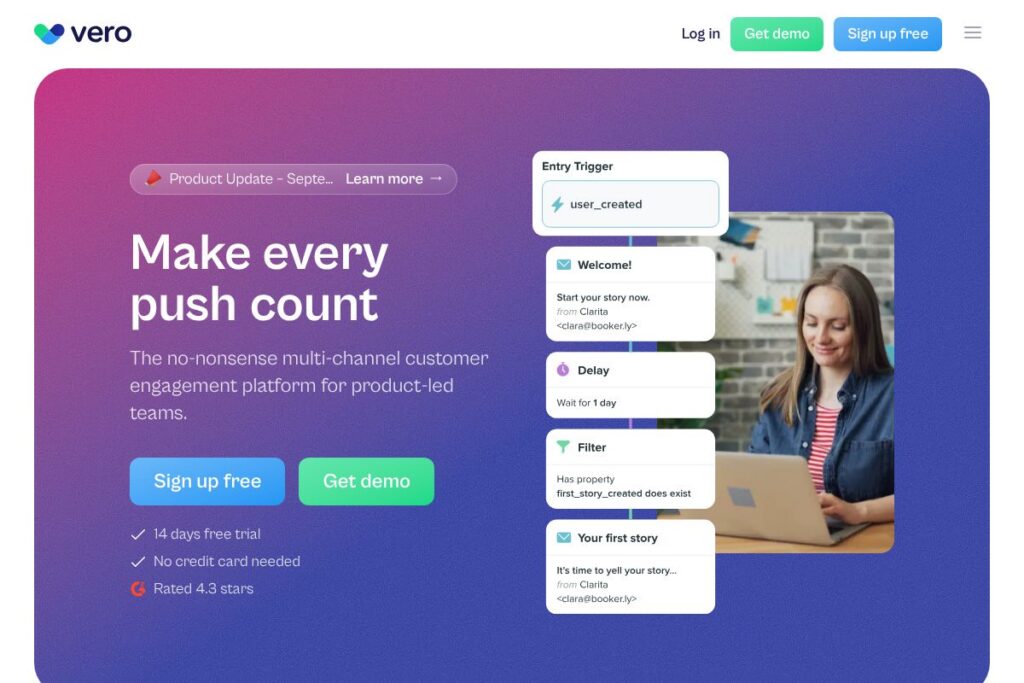
Vero is a customer engagement platform focused on sending personalized messages across email, iOS/Android push, and SMS based on how users behave inside a product. It combines event-based targeting, a visual journey builder, message editors, and an API to let product and growth teams design onboarding flows, re-engagement campaigns, and lifecycle messaging that respond to real user actions.
Compared with Braze, Vero aims for simpler setup and a product-led user experience, while Braze targets larger enterprises with a broader enterprise feature set and higher pricing. Against Customer.io, Vero offers comparable event-driven segmentation and journey building but positions itself with an emphasis on ease of use and straightforward support for teams without large data engineering investment. Compared with Iterable, Vero is more narrowly focused on product-triggered workflows and multi-channel messaging for startups and mid-market teams.
All of this makes Vero particularly well suited for product teams that need reliable, event-driven messaging to move users through onboarding and feature adoption. It excels at connecting product events to targeted messages and at supporting multi-channel journeys that help users reach key product moments faster.
How Vero Works
Vero captures product events and user attributes either via its SDKs and API or by connecting to your SQL data warehouse. Those events feed segmentation rules and the visual journey builder so you can map triggers, delays, and channel decisions for each user path.
Messages are created with dedicated editors for email, push, and SMS, and can be personalized using user properties and event data. Campaigns and journeys can include A/B tests, conditional splits, and retries to improve delivery and conversion.
For operational workflows, Vero provides webhooks and API endpoints to trigger messages from backend systems, and it surfaces delivery analytics so teams can iterate on timing and content. Typical implementations follow a cycle of instrumenting events, building segments, creating journeys, and refining with A/B testing and analytics.
Vero features
Vero’s core feature set centers on event-driven segmentation, a visual journey builder, multi-channel message editors, and developer-friendly integration options. Recent emphasis in product messaging includes reliability and straightforward APIs to reduce time-to-launch for experiments and lifecycle campaigns.
Visual journey builder
Design multi-step flows with triggers, conditional splits, waits, and channel choices using a drag-and-drop interface. The visual builder helps non-engineering team members map onboarding and re-engagement paths without code, while still allowing developers to add custom event checks via the API.
Email editor
Create responsive, personalized email templates with variable substitution, templates, and AMP-like interactive options when supported by clients. The editor integrates with segmentation so emails are sent only to users who match the event and property criteria you define.
Push notifications (iOS/Android)
Send targeted mobile push messages that reference specific product events and user properties, with options for deep links and action buttons. Push campaigns can be sequenced inside journeys to complement emails and SMS for higher engagement.
SMS messaging
Compose and send transactional or campaign SMS messages with personalization and delivery controls. SMS can be used as a primary channel or a fallback within multi-channel journeys to reach users who do not open email or push.
Event-driven segmentation
Build highly specific segments using event history, user attributes, and behavioral windows to target users who completed or did not complete certain actions. The segmentation engine can query recent events and historical activity to support time-sensitive campaigns.
SQL warehouse and data integrations
Connect Vero to your product data via direct SQL warehouse integration or push events through SDKs and the API. This lets teams use canonical product data for segmentation and ensures messaging reflects the most up-to-date user state; see Vero’s API documentation for integration patterns.
A/B testing and optimization
Run A/B tests on subject lines, message content, and send timing to measure lift and iterate quickly. Built-in reporting surfaces open, click, conversion, and attribution metrics to inform follow-up experiments.
Deliverability and reliability
Vero emphasizes message deliverability and operational reliability with transparent system status and delivery analytics. Teams can monitor sends, failures, and retries, and rely on Vero’s uptime and delivery processes for critical lifecycle communications.
Support and account services
Vero provides email support with product specialists and technical assistance to help with implementation and campaign best practices. Dedicated help resources and status updates help teams keep campaigns running during critical moments.
With these capabilities, Vero’s biggest benefit is enabling product and growth teams to move from idea to live campaign quickly while keeping messages tightly coupled to real user behavior.
Vero pricing
Vero uses a SaaS pricing model that is tailored to different business sizes and usage patterns; specific plan prices are not listed here. For the most up-to-date details about plan tiers, seat counts, and message volume, consult Vero’s homepage for current pricing options and contact their sales team for enterprise quotes.
What is Vero Used For?
Vero is commonly used to accelerate user onboarding by sending targeted messages when users reach specific product milestones or fail to complete key actions. That makes it valuable for product-led businesses that want to reduce time-to-value and improve activation rates.
Teams also use Vero for lifecycle messaging such as feature announcements, win-back campaigns, trial-to-paid nudges, and transactional notifications across email, push, and SMS channels. Marketing, product, and customer success teams can collaborate on journeys while engineers provide event data and integrations.
Pros and Cons of Vero
Pros
- Event-driven segmentation: Vero lets teams target users based on precise product events and properties, enabling behaviorally relevant messaging that improves conversion and engagement.
- Multi-channel orchestration: The ability to sequence email, push, and SMS in the same journey reduces channel fragmentation and simplifies coordinated campaigns across platforms.
- Developer-friendly API: The API and warehouse connections make it straightforward to send canonical product data into Vero and trigger messages programmatically.
- Focused support and reliability: Transparent system status and a dedicated support team help teams troubleshoot sends and maintain uptime for critical messages.
Cons
- Enterprise feature parity: Large enterprise platforms like Braze may offer broader enterprise-scale controls and built-in CDP capabilities that some large teams require for complex use cases. Vero focuses on core messaging and product-led workflows which may not cover every enterprise need.
- Pricing transparency: Public pricing is not listed here, so teams will need to contact Vero for custom quotes and to understand how message volume and channels affect costs.
Does Vero Offer a Free Trial?
Vero offers free trial and demo options for new users. You can request a trial account or schedule a demo to evaluate multi-channel messaging, the journey builder, and integrations; check Vero’s homepage to start a trial or contact their sales team.
Vero API and Integrations
Vero provides an API for sending events, managing users, and triggering messages; the Vero API documentation outlines endpoints, SDK usage, and webhook patterns. The API supports programmatic control of campaigns and integrates with back-end systems to fire messages based on real-time events.
In addition to the API, Vero connects to SQL data warehouses and supports webhooks and common analytics partners to bring product data into segmentation and journeys. See Vero’s integrations guide in their documentation for recommended patterns and partner connections.
10 Vero alternatives
Paid alternatives to Vero
- Braze — Enterprise-focused customer engagement platform with extensive personalization, segmentation, and analytics for high-volume, multi-channel campaigns. Best suited for large companies with complex needs.
- Iterable — Growth marketing platform that combines cross-channel orchestration with customer data features and a focus on lifecycle campaigns for mid-market and enterprise teams.
- Customer.io — Event-driven messaging platform that emphasizes workflow flexibility and programmable automation for product and marketing teams.
- Sendinblue — Email and SMS marketing platform that offers affordable plans and CRM features for small and mid-sized businesses.
- Twilio (Messaging + SendGrid) — Low-level messaging infrastructure for teams that want granular control over email and SMS delivery, with a strong developer focus.
Open source alternatives to Vero
- Mautic — Open source marketing automation that supports email campaigns, segmentation, and basic workflows; requires self-hosting and maintenance. Good for teams wanting full control of data and infrastructure.
- Mailtrain — Self-hosted newsletter app built on Node.js with segmentation and automation features; suitable for teams managing lists and campaign sends on their own infrastructure.
- Postal — Open source mail delivery platform that helps teams run their own SMTP infrastructure; used mainly for transactional and bulk sending when full control over delivery is required.
Frequently asked questions about Vero
What is Vero used for?
Vero is used for behavior-driven customer messaging across email, push, and SMS. Product and growth teams use it to onboard users, run lifecycle campaigns, and send transactional notifications based on product events.
Does Vero have an API for sending events?
Yes, Vero provides a developer-facing API and SDKs. The API supports event ingestion, user updates, and programmatic campaign triggers; see the Vero API documentation for details.
Can Vero send push notifications and SMS in the same campaign?
Yes, Vero supports multi-channel campaigns including email, iOS/Android push, and SMS. Messages can be sequenced and combined inside the visual journey builder to create coordinated user experiences.
How does Vero handle segmentation for product events?
Vero builds segments from event history and user attributes. You can target users who performed or did not perform specific actions within time windows, and combine those conditions to create precise cohorts.
Is Vero suitable for startups and enterprise teams?
Vero is suitable for both startups and larger teams, with features that scale from simple onboarding flows to complex journeys. For enterprise requirements such as custom SLAs and dedicated account services, contact Vero’s sales team to discuss tailored plans.
Final Verdict: Vero
Vero stands out for making event-driven, multi-channel messaging accessible to product-led teams. Its visual journey builder, behavior-based segmentation, and combined support for email, push, and SMS let teams iterate on onboarding and lifecycle campaigns without heavy engineering lift.
Compared with Braze, Vero is positioned for teams that want a simpler, more product-focused experience and a lower operational overhead; Braze offers a wider enterprise feature set but typically at a higher cost and greater implementation complexity. For teams prioritizing quick time-to-launch and reliable event-driven messaging, Vero is a solid option.